Sovereign AI for housing associations
Housing associations run CRM, documents, finance and compliance on one sovereign OS, tenant data in the building, every record backed by an audit trail.
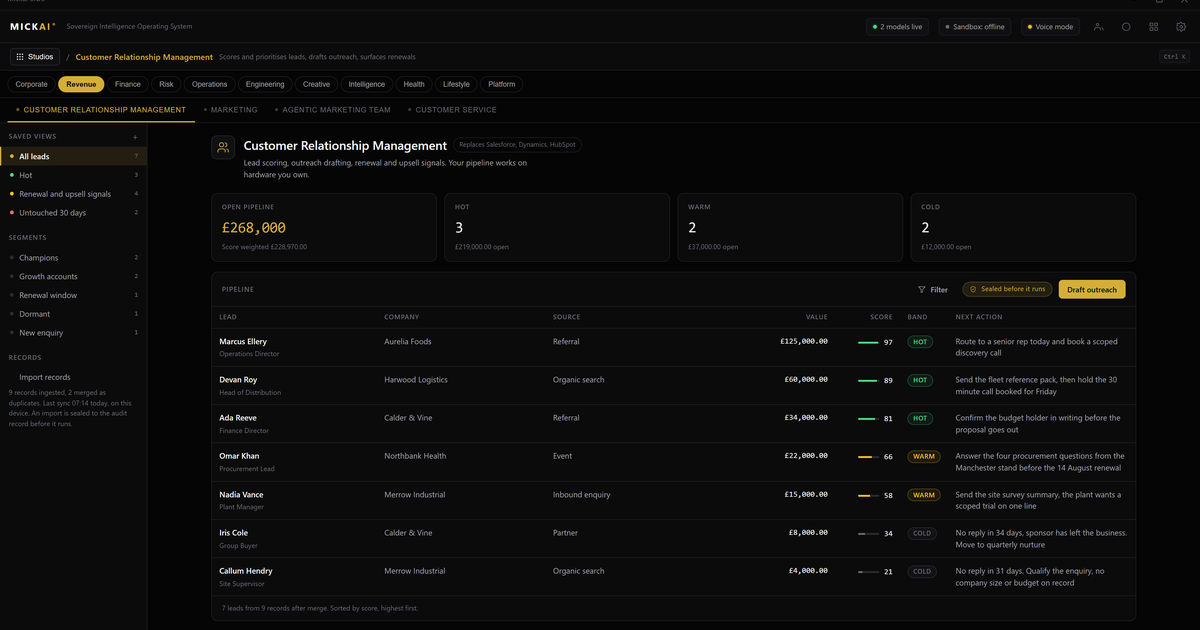
Housing associations can run their core software on their own hardware, with tenant data that never leaves the building. The CRM, the documents system, the finance system and the compliance system are studios on one sovereign operating system, sharing the association's own data. Every record is backed by an audit trail that shows who did what, to which tenant, and when.
That is the whole proposition. Not a model to plug into your existing sprawl of subscriptions, but the software stack itself, owned rather than rented, with one assistant across all of it.
What an association actually runs
A housing association is a data business wearing a property coat. Tenancies, arrears, repairs, complaints, gas safety, electrical certificates, damp and mould cases, board papers. Most of it sits today across a rented CRM, a rented office suite, a rented finance package and a rented support desk, each holding its own copy of the tenant.
We give you those functions as studios on one operating system:
- Our CRM holds tenants, tenancies and cases. Arrears, complaints, repairs and safeguarding all hang off the same tenant record, not four different ones.
- Our documents system holds tenancy agreements, correspondence, notices and board papers. It is the file store and the word processor, working on the association's own data.
- Our finance system runs rent, service charges, arrears and supplier payments against the same tenant and property records the CRM uses.
- Our compliance system tracks gas, electrical, fire, asbestos and damp and mould obligations, with the certificate and the case sitting next to the tenant they belong to.
Because these are studios on one operating system and not four separate products, a repair raised in the CRM, the invoice for it in finance, and the gas certificate in compliance all point at the same property and the same tenant. Nobody reconciles four copies at month end.
The assistant works across all of it
There is one assistant, and it reaches every studio. Ask it to pull every open damp and mould case over a rent account in arrears, and it reads the compliance studio and the finance studio together, because they run on the same data. Ask it to draft the response to an ombudsman enquiry, and it assembles the tenancy file, the repair history and the correspondence into one place.
It does this locally. The reasoning layer runs on the association's own hardware, on the association's own records. We do not send a tenant's history to a public model to have it summarised. The assistant is the same intelligence across CRM, documents, finance and compliance, so staff learn one way of working rather than four.
Tenant data stays in the building
This is the part that matters most for social housing. The people on your patch did not choose to have their arrears, their safeguarding notes and their disrepair claims processed in someone else's cloud. Under this model, they are not.
The hardware is yours. The data sits on it, in your office or your data room. The system is air gapped by default, so it works with no internet line at all and, more to the point, nothing about a tenant has to leave the premises to be useful. Private deployment is the baseline anyone should now expect. Our value is beyond it: the whole software stack runs where the data lives, so there is no copy step, no export, no third party holding a shadow of your tenant list.
For an association answering to the Regulator of Social Housing and the Housing Ombudsman, "we know exactly where every tenant record is, and it never left the building" is a stronger sentence than any data processing agreement.
The audit trail is the point
Regulation in social housing is moving toward proof. Awaab's Law and the consumer standards ask associations to show what they did about a hazard and when, not just to assert that they have a policy.
Every studio and the assistant write to an action level Open Audit Record. That means the log is not a list of logins. It records each action taken on a record: the damp case opened, the surveyor assigned, the works ordered, the certificate filed, the letter sent, and which person or which studio did each one. When the Ombudsman asks for the history of a case, you produce the record instead of reconstructing it from email.
Because the trail is at the level of the action and not the sign in, it answers the questions an investigation actually asks. Who decided this. When. On what information. What happened next.
The money you stop renting
Software you rent is a cost that returns every year and rises. The way to size it is plain. Take your seat count. Multiply by the published per user per month list price of each tool you rent. Multiply by twelve. That is one year, and next year it is larger.
Work an example. A 200 seat association typically pays, per user per month, for a business tier of an office and email suite, again for a CRM licence, and again for a customer support platform. Published list prices for those tiers commonly sit in the tens of pounds per user per month each. Put a business office suite at a mid business tier, a CRM at a professional tier and a support desk at a standard tier, and 200 seats across the three lands in six figures a year on list price alone, before storage, add ons and the finance package.
We are not going to quote you a MICKAI price here. The point is the shape of the decision. Renting means that six figure line repeats every year and you own nothing at the end. Owning the stack turns that recurring rent into hardware and software you keep, running on your own premises. Use your own real seat count and your own current invoices for the comparison. The method holds whatever the exact figures are.
Why sovereign fits social housing specifically
Housing associations are exactly the regulated, mid sized organisations this is built for. Large enough to hold serious volumes of sensitive personal data. Not so large that they run their own hyperscale platform teams. Accountable to a regulator that increasingly wants evidence, not assurances. Under real pressure on cost.
The offer answers each of those. Data stays in the building, so the data protection story is simple. The audit trail is at the action level, so the regulatory story is evidence. The whole stack is owned, so the cost story stops being an annual increase. And it is one operating system with one assistant, so a stretched IT team runs it without stitching four vendors together.
MICKAI holds 104 filed UK patent applications covering 2,340 claims, and runs 63 studios on the one sovereign operating system. For an association, the relevant claims are the ordinary ones: fewer subscriptions, tenant data that stays put, and a record you can hand to an inspector.
Getting there
You do not rebuild everything on day one. Start with the studio that carries the most regulatory weight, usually compliance, and put its data and its audit trail in the building. Bring the CRM alongside it so cases and certificates share a tenant. Move finance and documents as the association is ready. Each studio you bring on is one more subscription you stop renting and one more set of records that comes home.
The end state is a housing association whose software it owns, whose tenant data never leaves its buildings, and whose every action on a tenant is on the record. That is what sovereign AI means here. Not a smarter chatbot bolted to the old sprawl, but the CRM, the documents, the finance and the compliance running as studios on one operating system you own, with one assistant across all of it.
Frequently asked questions
Where does tenant data live?
On hardware the association owns, inside its own buildings. Nothing about a tenant leaves the estate to reach a public model or a vendor's cloud. The studios read and write the same data in place, so records are not copied out to be processed.
Which studios does a housing association actually run?
A CRM for tenants and cases, a documents system for tenancy files and correspondence, a finance system for rent and service charges, and a compliance system for gas, electrical, fire and damp records. One assistant works across all of them.
How does this compare on cost to renting the usual tools?
Take your seat count times the published per user per month price of each incumbent, times twelve. For a 200 seat association across an office suite, CRM and a support platform, list prices commonly land in six figures a year, every year. Owning the stack moves that spend from rent to an asset you keep.
What does the audit trail record?
Every action a studio or the assistant takes: who or what did it, to which record, when, and why. It is an action level Open Audit Record, not a login log. That is what an inspector or an ombudsman investigation asks for.
Do you hold SOC 2, ISO 27001 or Cyber Essentials?
No. We do not claim certifications we do not hold. What we give you is architecture you can put in front of an auditor: data that stays in the building, air gapped by default, and a full record of every action taken on a tenant.
Can it run without an internet connection?
Yes. The system is air gapped by default. The studios and the assistant run on your own hardware, so an association with a patchy line or a strict security posture keeps working when the connection does not.