Sovereign AI for Hedge Funds
Alpha models you own, zero leakage, and decisive timing on hardware you control.
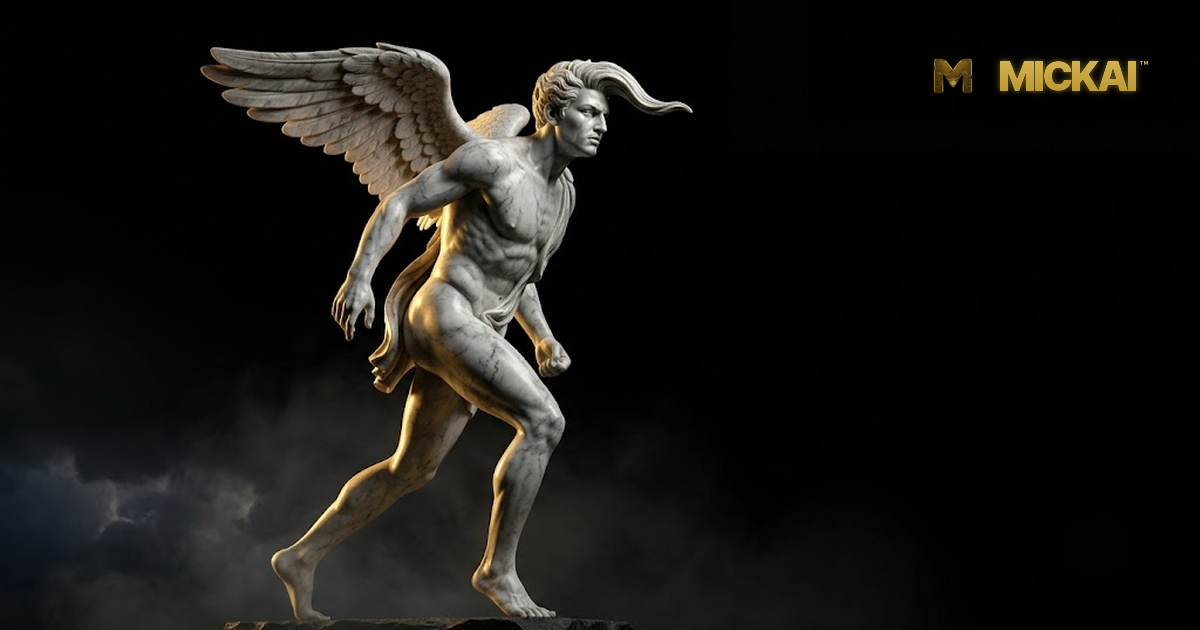
A hedge fund is, at its core, a machine for turning proprietary insight into return. The signals, the factor weights, the execution logic: these are the firm. So it is a strange arrangement that so much of the modern quantitative stack now runs on infrastructure the fund does not own, cannot inspect at the byte level, and cannot fully wall off from the vendor who built it.
We think that arrangement is ending. Sovereign AI for hedge funds means alpha models you own outright, running on hardware you control, with zero leakage of your edge to anyone. At Mickai we have built exactly that boundary. This is how it works, and why timing, ownership, and containment are the three things a serious desk can no longer outsource.
Your alpha is your edge, so it cannot leave the building
Every prompt a trader types, every backtest a researcher runs, and every feature a model consumes is a fragment of the firm's thesis. Sent to a public inference endpoint, those fragments become telemetry on someone else's machine. Even with the strongest contractual assurances, the physics are unforgiving: data that leaves your perimeter has left your control.
Mickai is a Sovereign Intelligence Operating System, a SIOS, and it inverts that flow entirely. It runs on hardware the customer owns, air-gapped or on-premise, with zero data egress. The brains that generate signals, the studios that run research, and the voice interface a portfolio manager speaks to all live inside your rack. Nothing about your strategy is ever the price of admission to the compute.
Models you own, not models you rent
Renting intelligence is a comfortable habit until you notice what you are renting. A rented model can be deprecated, re-weighted, rate-limited, or retired on a schedule you do not set. For a discretionary or a systematic desk, that is model risk disguised as convenience. When the engine behind your signal changes silently, your track record is quietly being rewritten by a third party.
Our subsystems are sovereign brains: revocable, versioned, and yours. You can freeze a brain for the life of a strategy, audit exactly what it does, and retire it on your own terms rather than on a vendor's roadmap. Because the weights sit on your hardware, reproducibility stops being a promise and becomes a property of the system. A backtest run today can be re-run identically in three years, because the model that produced it has not moved.
Kairos: decisive timing as a first-class primitive
The Greeks had two words for time. Chronos was sequence, the ticking clock. Kairos was the opportune moment, the narrow window where an action lands or is lost. Trading lives in Kairos. The same signal acted on a beat too late is not a smaller edge; it is often no edge at all, or a loss.
Sovereign infrastructure is what makes Kairos yours. When inference runs across a public network, latency and availability are hostages to a queue you do not manage and a region you do not choose. On hardware you control, the path from signal to decision to attested action is measured against your own budget, not someone else's rate limit. Decisive timing stops being something you hope a vendor preserves and becomes something you engineer.
Every action signed before it fires
Speed without control is how desks come undone. Our answer is the Operation Attestation Record, the OAR, which signs every action before it executes. A model wanting to size a position, rebalance a book, or route an order produces an attestation first: what it intends, on what inputs, under whose authority. Only then does the action fire.
Those records are written to a tamper-evident, cryptographically-signed audit ledger, hash-linked with SHA-3-512 and sealed with post-quantum signatures under FIPS 204 ML-DSA-65, the Federal Information Processing Standard for digital signatures. The chain verifies offline, so a compliance officer or an auditor can prove what the system did without trusting the system that did it. High-stakes actions require multi-brain plus voice-biometric approval, so no single model and no single person can move size alone.
The regulator is already in the room
A hedge fund does not get to treat AI governance as a future problem. Under MiFID II, the Markets in Financial Instruments Directive, and DORA, the Digital Operational Resilience Act, operational and algorithmic accountability are supervisory expectations now. The EU AI Act adds obligations on high-risk automated decisioning, and the GDPR, the General Data Protection Regulation, still governs any personal data in your research corpus. ISO 42001 and the NIST AI Risk Management Framework increasingly define what good looks like.
A sovereign, attested substrate answers these frameworks by construction rather than by paperwork. When every action carries a signed record and the ledger verifies offline, the question shifts from can you demonstrate control to here is the cryptographic proof. That is a far calmer conversation to have with a prime broker, with an allocator's operational due-diligence team, or with a supervisor.
The public cloud is an ally, not the venue for your edge
None of this is a war on the hyperscalers. OpenAI, Microsoft, AWS, Google, and Oracle are extraordinary at what they do, and they remain allies at a different layer of the stack. There is a great deal a fund can and should run on public cloud. The strategy itself is simply not one of those things.
Mickai serves the regulated boundary the public cloud cannot cross, on the customer's own terms. Our capability set is protected by 104 filed UK patent applications, 2,340 claims, owned by Mickai LTD, covering the attestation, containment, and sovereign-brain machinery described here. The point of that portfolio is durability: the boundary you build your firm on should still be standing, and still yours, a decade from now.
The bottom line
A hedge fund that rents its intelligence rents its edge back to the market one prompt at a time. Sovereign AI closes that leak. You own the alpha models, you run them on hardware you control, and every decision they make is signed before it fires and provable long after. Kairos, the decisive moment, belongs to the desk that controls its own clock. We built Mickai so that desk can be yours.