Sovereign AI for financial advisers and wealth managers
Run your CRM, documents, compliance and email on a sovereign OS you own. Client data stays in the building, with one assistant across all of it.
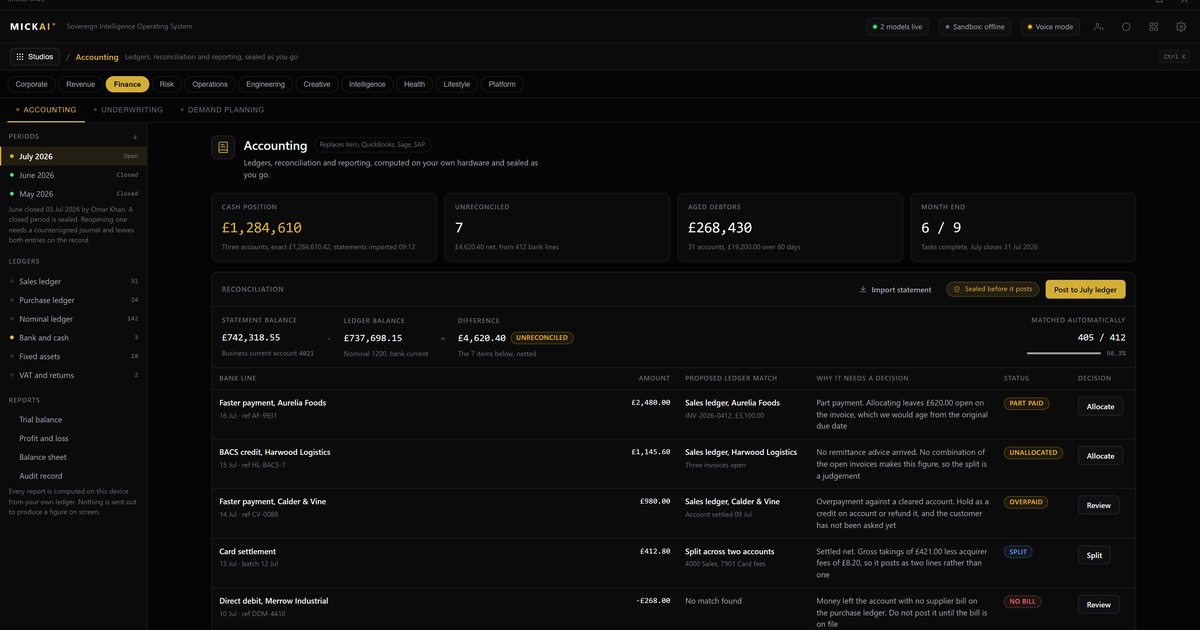
Financial advice firms run on other people's software. The client book sits in a rented CRM, the advice files in a rented document suite, the correspondence in a rented mailbox, and the whole record of who advised whom, and why, is spread across accounts you do not own and cannot fully see. MICKAI puts that stack back in your building: the CRM, the documents, the compliance trail, the email and the meetings become studios on one sovereign operating system, running on hardware you own, with your client data staying put and one assistant across all of it.
The studios an advice firm runs
An advice firm does not need a hundred disconnected apps. It needs a handful of things that work together and share the same records. On MICKAI those are studios on one operating system, not separate subscriptions.
Our CRM holds the client book: the people, the households, the mandates, the fact-finds and the review cycles. Our document system holds the advice files, suitability reports, letters and the templates behind them. Our email and calendar handle client correspondence and the diary of reviews and deadlines. Our meetings platform runs the annual review and the paraplanning call. Our messaging keeps the adviser, the paraplanner and the compliance officer in one thread instead of a chain of forwarded mail. And the assistant sits over all of it, reading the same records every studio writes to.
The point is not that each of these exists. It is that they are one system on your data. When an adviser updates a client's circumstances in the CRM, the document studio drafting the suitability report is working from the same fact, not a stale copy pasted from a screen an hour ago. Nothing has to be exported, re-keyed or reconciled between vendors, because there is only one store and you own it.
Client data stays in the building
The reason firms tolerate the rented stack is that the alternative used to mean running your own IT department. It no longer does. MICKAI runs on hardware the firm owns, in your own office or your own rack, and the studios read and write to a single store that never leaves your control.
Air-gapped is the default. The system does not phone home, and it does not send client records to an outside model or cloud to get its work done. For a firm holding suitability data, health and vulnerability information, and the full financial position of every client, that is the difference between a data map you can draw on one page and one that runs through terms of service you did not write. When a client asks where their information is, the honest answer is a room you can point to.
Private deployment on its own is the baseline that serious institutions have always expected. Our value sits beyond it. The whole stack runs on your hardware, the audit record is written at the level of individual actions, and the default posture is closed rather than open. You are not integrating a model into someone else's platform. You are running the platform.
The reasoning layer, working across the studios
There is one assistant, and it works everywhere. Ask it to prepare for a client review and it pulls the household from the CRM, the last suitability report from the documents studio, the correspondence from email and the notes from the last meeting, and drafts the agenda and the review pack from those records. Ask it to draft a suitability letter and it works from the fact-find and the recommendation already on file, not from a blank page.
What matters here is what the reasoning layer does for the studios, not what sits underneath it. It reads the firm's own data, drafts against the firm's own templates, and leaves everything it touched on the record. It does not need the client book shipped to an outside service to be useful, because it runs where the data already is.
Suitability and record-keeping, backed by the audit trail
Advice is a regulated act, and the evidence that advice was suitable is only as good as the record behind it. Every action the assistant and the studios take is written to an Open Audit Record at the action level. That is not a login log. It is a time-stamped account of what was read, what was drafted, what was changed and by whom, tied to the underlying client data.
For a compliance officer, that turns the advice file from a folder of documents into a trail. When a suitability assessment is questioned, months or years later, the record shows the circumstances that were known at the time, the recommendation made against them, and the communications that followed. The firm can reconstruct the decision rather than reassemble it from memory and scattered emails. Record-keeping stops being a chore performed after the fact and becomes a by-product of doing the work in the system.
We hold no certifications and we do not claim any. What we provide is the software and the audit record; the accreditation of your environment is yours to evidence, and the architecture is built so that your data and your controls stay in your hands to do it.
What you own instead of rent
The everyday advice stack is bought per user, per month, and the bill grows with headcount and with every product tier a vendor introduces. The honest way to see the number is to price the incumbents you would otherwise pay, on published list prices, and total them across your seats.
Take a firm of 25 people. A mainstream business productivity suite for email, documents and meetings is commonly listed at 22 pounds per user per month on its mid business tier. That alone is 25 times 22 times 12, which is 6,600 pounds a year, before the CRM. A widely used advice-and-sales CRM lists popular professional tiers in the region of 80 pounds per user per month, which at 25 seats is 25 times 80 times 12, or 24,000 pounds a year. Add a separate team-messaging product at a listed business rate near 12 pounds per user per month and that is another 25 times 12 times 12, or 3,600 pounds a year. On those published rates the three together come to more than 34,000 pounds a year for 25 people, and none of it is yours at the end of it.
These are illustrative list prices, quoted per user per month and totalled as users times price times twelve, and your real invoices will differ with tier, discount and add-on. The method is the point. The rented stack is a recurring cost that scales with your headcount and rises with the vendor's roadmap, and it buys you access, not ownership. MICKAI is a stack you own and run on your own hardware, so the client data, the advice files and the audit trail belong to the firm rather than to a landlord.
We do not publish a MICKAI price here. What we can say plainly is that the comparison is between renting the pieces forever and owning the whole.
Why sovereignty suits the regulated smaller firm
The firms that gain most from this are not the largest. A national institution can already fund a private cloud and a security team. The regulated small and mid-sized advice firm has the same duties, the same regulator and the same client-data risk, but not the same infrastructure budget. MICKAI is built for that firm: one operating system, on hardware you own, that gives a practice of a few advisers the data-control posture that used to require a large IT function.
Our patent position sits behind the platform rather than in front of it. For context, MICKAI has 104 filed UK patent applications carrying 2,340 claims, filed and not granted, and there are 63 studios on the one sovereign operating system. The headline is not the paperwork. It is that an advice firm can run its whole working day on software it owns, keep its clients' data in the building, and have a durable record of every action behind the advice it gives.
FAQ
Where does client data live when we run MICKAI? On hardware you own, inside your own building or your own rack. The studios read and write to one store that never leaves your control. Air-gapped is the default, so nothing is sent to an outside model or cloud unless you deliberately open a door.
Which tools does an advice firm actually replace? The everyday stack: email and calendar, documents and spreadsheets, meetings and messaging, the CRM, and the file store. Each becomes a studio on one operating system, sharing the same client records rather than sitting in separate accounts you rent.
How does this help with suitability and record-keeping? Every action the assistant and the studios take is written to an Open Audit Record at the action level. That gives you a durable, time-stamped trail behind suitability assessments, advice files and client communications, tied to the underlying data.
Do you hold SOC 2, ISO 27001 or Cyber Essentials? We hold no certifications and claim none. The architecture is built so your data stays on your hardware and your controls are yours to evidence. What we provide is the software stack and the audit trail; the accreditation of your environment is yours.
Is this a single model we have to integrate? No. It is the whole software stack, not a model to wire into your existing tools. The reasoning layer sits under every studio and drives them from one assistant, so you are adopting an operating system, not stitching an API into someone else's cloud.
Does it fit a small or mid-sized firm, or only large institutions? It is built for the regulated small and mid-sized firm. You own the platform outright and run it on your own hardware, which is why a firm of a few advisers can hold the same data-control posture that used to require a large IT function.
Frequently asked questions
Where does client data live when we run MICKAI?
On hardware you own, inside your own building or your own rack. The studios read and write to one store that never leaves your control. Air-gapped is the default, so nothing is sent to an outside model or cloud unless you deliberately open a door.
Which tools does an advice firm actually replace?
The everyday stack: email and calendar, documents and spreadsheets, meetings and messaging, the CRM, and the file store. Each becomes a studio on one operating system, sharing the same client records rather than sitting in separate accounts you rent.
How does this help with suitability and record-keeping?
Every action the assistant and the studios take is written to an Open Audit Record at the action level. That gives you a durable, time-stamped trail behind suitability assessments, advice files and client communications, tied to the underlying data.
Do you hold SOC 2, ISO 27001 or Cyber Essentials?
We hold no certifications and claim none. The architecture is built so your data stays on your hardware and your controls are yours to evidence. What we provide is the software stack and the audit trail; the accreditation of your environment is yours.
Is this a single model we have to integrate?
No. It is the whole software stack, not a model to wire into your existing tools. The reasoning layer sits under every studio and drives them from one assistant, so you are adopting an operating system, not stitching an API into someone else's cloud.
Does it fit a small or mid-sized firm, or only large institutions?
It is built for the regulated small and mid-sized firm. You own the platform outright and run it on your own hardware, which is why a firm of a few advisers can hold the same data-control posture that used to require a large IT function.