Can care providers use AI on safeguarding and resident data?
Yes, when the AI runs inside the provider's own boundary, professionals keep every decision, and each action is sealed to a verifiable record.
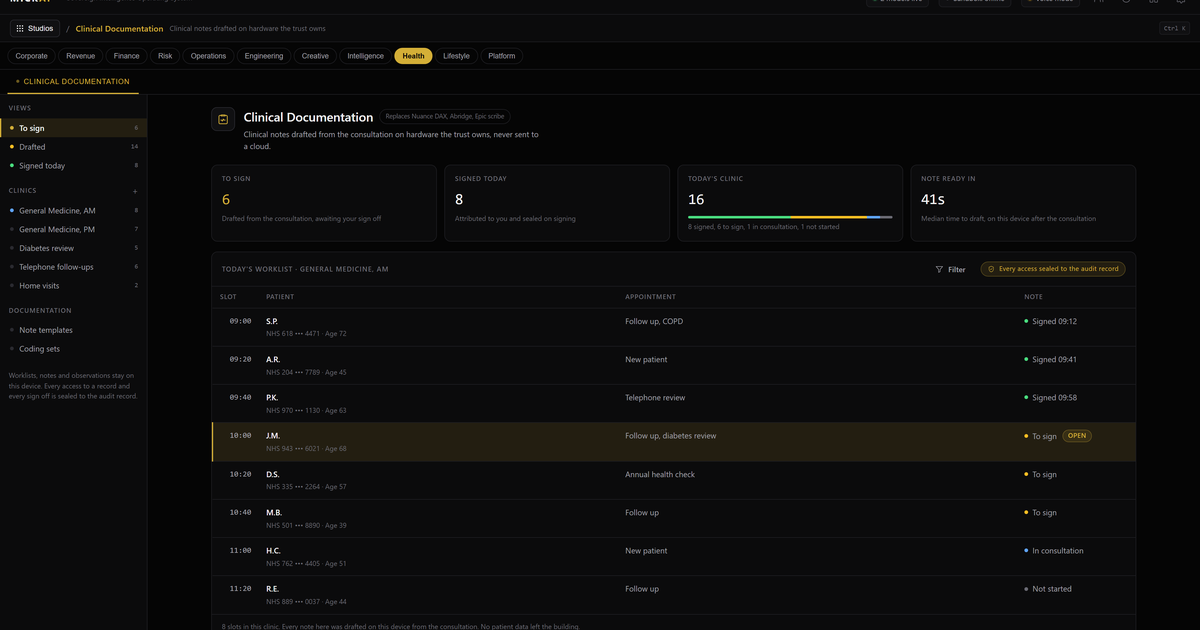
Yes, care providers can use AI on safeguarding and resident data, under two conditions that decide whether the deployment is defensible. The processing should run inside the provider's own boundary, on infrastructure the provider controls, and the AI must draft while registered professionals decide. Care records sit among the most sensitive data held anywhere, so the real question is not whether AI can help with the documentation burden but where it runs and who can prove what it did.
The question matters in 2026 because, in practice, it is already being answered badly. Care staff are drowning in documentation, AI drafting of notes and reports is a genuine productivity gain, and consumer AI services are leaking into the sector unofficially. A provider that does not decide this deliberately will find its staff have decided it on their own phones.
What makes resident data different from ordinary personal data?
Concentration. A care provider, whether a care home, a domiciliary care service or supported living, holds records that gather a person's whole life in one place: safeguarding concerns, mental capacity and deprivation of liberty records, health and medication data, life histories, family disputes and financial vulnerability. Nearly all of it is special category data under UK GDPR or safeguarding-critical, and the common law duty of confidentiality applies alongside the statute. A resident file is not a customer record; its misuse can harm someone who may not be able to protect themselves.
Why is AI already inside the sector, approved or not?
Because the documentation burden is real and the relief is immediate. Care notes, incident reports, handovers and care plan reviews consume hours staff would rather give to residents, and records quality is exactly what inspection increasingly examines. A consumer AI service can draft a shift note in seconds, so unofficial use is spreading, which means resident data may already be leaving through personal devices with no controls, no record and no contract behind it. Banning AI does not stop this. Providing a controlled route does.
What can AI legitimately do with care records?
The drafting and synthesis work around professional judgement:
- Drafting care notes and incident reports from a carer's brief account.
- Summarising a resident's recent record for a handover or a new shift.
- Turning daily logs into review-ready summaries for care plan reviews.
- Flagging records with gaps or overdue entries for senior attention.
The boundary is bright: AI drafts, registered professionals decide. Medication decisions stay human. Safeguarding judgements stay human. An AI-produced draft is material for a professional to confirm, amend or reject, never a decision in itself.
What does the law require before resident data touches AI?
UK GDPR carries the main weight. Special category data needs an Article 9 condition, with health and social care processing the usual route, and the processing must be necessary and proportionate to the care purpose. The common law duty of confidentiality applies independently: information shared for a person's care is not available for other purposes. Sending resident records to a consumer AI service raises questions the provider must answer before the event, including where prompts go, who can see them and what the vendor retains. When processing never leaves the provider's own infrastructure, those questions have short, checkable and stable answers.
What will a CQC inspector, a safeguarding board or a coroner ask?
Who recorded this, what did they know, and when. Records quality is already a live inspection theme, and AI-assisted records add a further question: which parts did the AI draft, which did the professional confirm, and can the provider show the difference. A sealed record of every AI action answers that directly. On Mickai, a Sovereign Intelligence Operating System, every draft, summary and access is sealed to a post-quantum signed audit ledger bound to hardware-attested identity, with per-resident access controls, so a CQC inspection, a safeguarding board or a coroner's inquest can verify exactly what the AI did and what the human decided, and the record verifies offline.
What does a sovereign deployment look like in a care setting?
Smaller than the phrase suggests. The models run on hardware the provider owns, and inference is selectable between CPU and GPU, so drafting and summarisation for a typical service does not demand specialist accelerators. Per-resident access controls mean staff see only the residents in their care, and a zero-egress perimeter means there is no outbound route for records to leave. Staff get the drafting help they are already reaching for, and the provider gets something consumer services cannot offer: a complete, verifiable account of every interaction between the AI and the residents' records.
“In care, the record is part of the safeguard, so a system that helps write the record must be able to prove exactly what it did.”
The architecture that makes this possible is set out in full at /sovereign-ai, and the film at /film shows the interface in operation.
Frequently asked questions
Can our care home use ChatGPT to write care notes?
Putting resident data into external AI services such as ChatGPT, Claude, Gemini or Microsoft 365 Copilot means special category data leaving the provider's control, which is very hard to justify against UK GDPR conditions and the duty of confidentiality. The capability is legitimate; the venue is the problem. The same drafting help inside the provider's own boundary changes the answer.
Who is accountable for a care record the AI helped to draft?
The professional who confirms it, exactly as before. AI drafting does not move accountability, which is why the record needs to show what the AI drafted and what the human reviewed and confirmed. A sealed audit trail preserves that distinction instead of leaving it to memory.
Can AI make medication or safeguarding decisions in a care setting?
No. AI can summarise the record around a medication round or assemble the chronology behind a safeguarding concern, but the decision belongs to a registered professional. The honest deployment treats every AI output as a draft for human judgement, and the sealed record shows that this is how the system actually ran.
What happens to AI-drafted records at an inspection or an inquest?
They are examined like any other record, with one additional question: what did the AI contribute. A provider with a sealed, verifiable log of every AI action can answer precisely, resident by resident and entry by entry. A provider whose staff used consumer services on personal phones cannot answer at all.
Is a small care provider really able to run its own AI?
Yes. An operating system approach packages the models, retrieval and audit as one installable substrate on a single capable machine, and CPU-selectable inference keeps the hardware ordinary. The skills required are the ones a provider already applies to its care planning and rostering systems, plus governance judgement the sector already exercises daily.