Sovereign AI for Aerospace
Design and safety-case intelligence that runs on hardware you own, explains its reasoning, and binds cryptographic provenance to every artifact before it exists.
Aerospace is the discipline where a single miscalculated tolerance can end lives, and where the evidence trail behind every design decision must survive decades of audit, litigation and regulatory scrutiny. The intelligence that helps engineers reason about lift, load, fatigue and failure modes is now indispensable. Yet the moment that intelligence reaches into cloud infrastructure owned by another company, a defence prime or a civil airframer inherits a problem it cannot govern: sensitive design data crossing a boundary it does not control, and safety-case reasoning it cannot fully reconstruct.
We built Mickai, a Sovereign Intelligence Operating System, for exactly this boundary. It runs on hardware the customer owns, air-gapped or on-premise, with zero data egress, and it treats every artifact it touches as evidence. For aerospace, that combination changes what artificial intelligence is allowed to do near a certifiable design. The intelligence comes to the data, and the data never has to travel to reach it.
The boundary the public cloud cannot cross
An airframe design contains export-controlled geometry, propulsion data governed by the International Traffic in Arms Regulations (ITAR), and structural models that a competitor or a hostile state would pay handsomely to see. Sending any of it to a general-purpose cloud endpoint is, for many programmes, simply forbidden. The cloud giants, OpenAI, Microsoft, Amazon Web Services (AWS), Google and Oracle, are formidable allies at a different layer of the stack, and we serve the regulated boundary their public services are not designed to reach, on the customer's own terms.
Mickai sits inside the perimeter, on the engineering network, behind the air gap where the most sensitive programmes already live. The design brains, the safety reasoning, the provenance ledger and the approval logic all execute locally. Nothing leaves. This is not a hosted service reaching in through a permitted gap. It is a sovereign environment that keeps the intelligence and the evidence in the same trusted place.
Design intelligence that shows its working
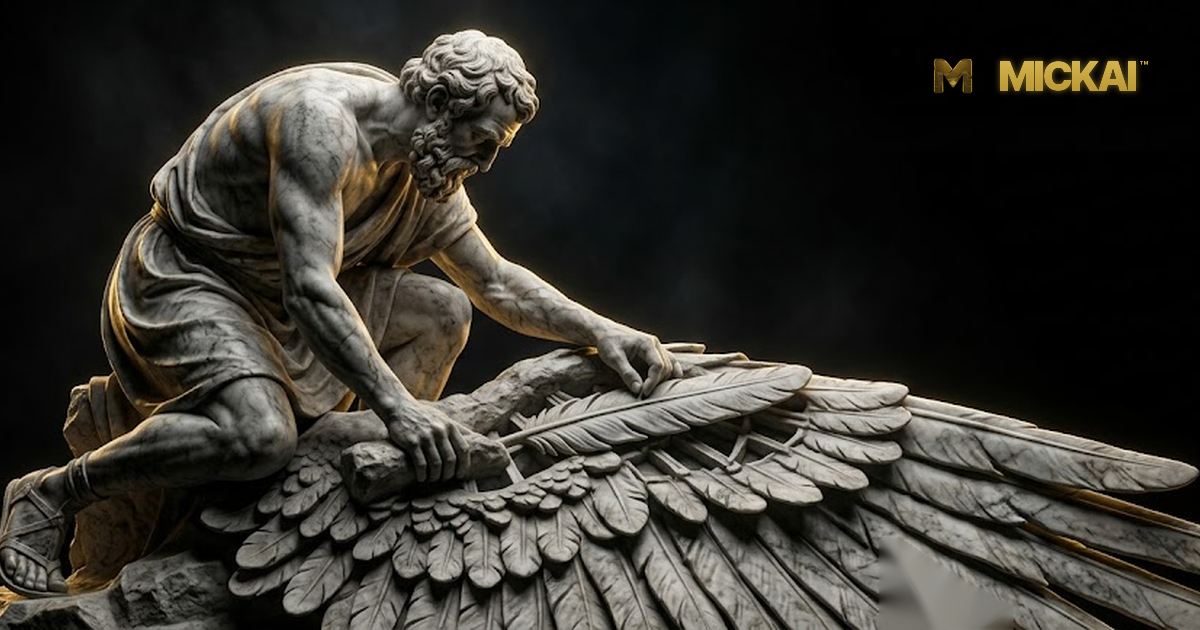
Daedalus, the mythic engineer who built wings that flew, is our figure for design intelligence, and the myth carries its own warning: a design is only as trustworthy as the discipline behind it. Our design brains help engineers explore geometry, interrogate load paths, run trade studies across weight, cost and margin, and surface the second-order consequences of a change before it propagates through a bill of materials. These are subsystems that reason over the customer's own data, not a hosted model peering at borrowed corners of a document.
Crucially, the intelligence never hands back a bare answer. Every suggestion carries its assumptions, its source artifacts and its chain of reasoning, so a stress engineer can see why the system proposed a thicker spar or flagged a fastener pattern. In a domain where an unexplained recommendation is a liability, reasoning that shows its working is the only kind that belongs near a wing.
The safety case as a living, signed object
A safety case is the argument that a system is acceptably safe, built from claims, evidence and the reasoning that binds them. Traditionally it is assembled by hand across thousands of documents, and its weakest point is traceability: when a requirement changes, which analyses, tests and assumptions downstream are now stale? Mickai treats the safety case as a living object. Every claim links to the evidence that supports it, every piece of evidence links to the artifact it came from, and the whole structure is hash-linked so that tampering or drift is immediately visible.
When an input changes, the system can trace precisely which conclusions depend on it and mark them for review, rather than leaving an engineer to hope nothing important was missed. The safety case stops being a snapshot and becomes a continuously verifiable argument, which is exactly what certification authorities increasingly expect.
Cryptographic provenance on every artifact
This is the heart of the matter. In Mickai, every artifact, a mesh, a report, a load case, a revised drawing, is bound to a cryptographic record of where it came from, who or what produced it, and on the basis of which inputs. We use post-quantum digital signatures, the Federal Information Processing Standard 204 (FIPS 204) Module-Lattice Digital Signature Algorithm, ML-DSA-65, so that the signatures remain trustworthy against future quantum attack, and we chain the records with SHA-3-512 into a tamper-evident, cryptographically-signed audit ledger.
Before any action executes, the system writes an Operation Attestation Record (OAR) that signs the intended operation in advance. Nothing the intelligence does is retrofitted into the log after the fact. The record is created first, the action follows, and the two are bound together. Years later, an auditor, an accident investigator or a regulator can verify the entire lineage offline, on hardware they trust, without asking us or anyone else to vouch for it.
Authority that no single brain holds alone
High-consequence actions must not rest on one automated judgement. In Mickai, promoting a design to a certifiable baseline, or releasing an analysis into the safety case, can require multi-brain agreement combined with human approval, and where the stakes warrant it, voice-biometric confirmation from a named, authorised engineer. Brains are revocable: if a subsystem is found wanting, its authority can be withdrawn without unpicking the whole environment, and every prior action it signed remains independently verifiable.
The result is a system where automation accelerates the work but never quietly seizes authority it was not granted. The signature on a released artifact tells you not just that it was approved, but by which combination of brains and people, under which policy, at which moment.
Compliance that is evidenced, not asserted
Aerospace programmes answer to a dense weave of obligations, from export regimes such as ITAR to emerging duties under the European Union Artificial Intelligence Act (EU AI Act) and management standards such as the International Organization for Standardization 42001 (ISO 42001) and the National Institute of Standards and Technology AI Risk Management Framework (NIST AI RMF). Most tooling lets an organisation assert compliance. Mickai lets it evidence compliance, because the audit ledger is the compliance artifact. Data residency is provable because nothing egressed. Model governance is provable because every brain and every decision is recorded and signed.
That distinction matters when a regulator or a customer asks not whether you have a policy, but whether you can demonstrate, cryptographically and offline, that the policy held on the day the artifact was produced. Our 104 filed United Kingdom patent applications, comprising 2,340 claims and owned by Mickai LTD, describe the capabilities that make this attestation possible, from advance operation signing to hash-linked provenance.
The bottom line
Aerospace cannot trade safety, secrecy or auditability for the convenience of borrowed intelligence. Mickai gives design and safety-case teams powerful reasoning that stays on hardware they own, never egresses their data, and binds cryptographic provenance to every artifact it produces. The intelligence explains itself, the safety case verifies itself, and the evidence outlives the programme. That is what sovereign artificial intelligence for aerospace has to mean, and it is what we built.