Scheduling and calendars you own
Our calendar and scheduling studio runs on the sovereign OS you own, sharing availability with email, meetings and team management on your hardware.
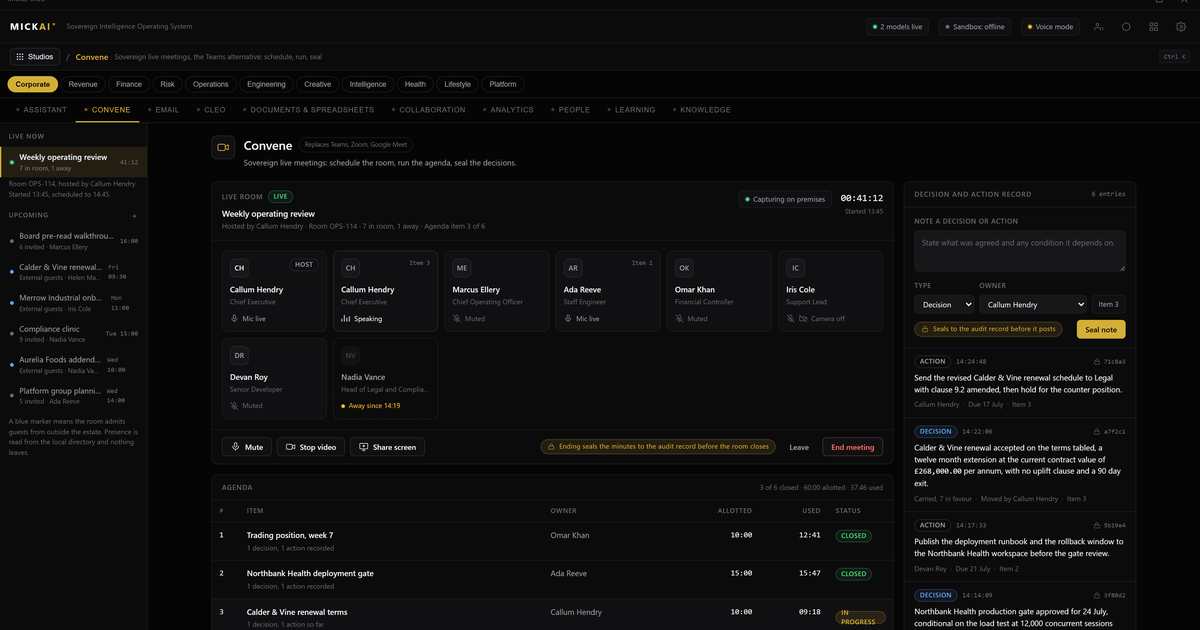
Our calendar and scheduling studio runs on the MICKAI sovereign operating system, on hardware you own. It manages availability, bookings, invitations and reminders, and shares that data directly with your email, your meetings platform and your team management, without sending a single free/busy record to an outside vendor. You get the connectedness of a full suite and the control of owning every part of it.
That is the whole point. A calendar is not a small thing. It is a live map of who your people meet, when, and about what. Most firms hand that map to a vendor and pay per seat, every month, forever. We think you should own it.
What the studio does
The scheduling studio does the work you expect from a calendar, and it does it as part of one operating system rather than as a separate app you bolt on.
- Shared team calendars with the access rules you set.
- Free/busy lookups across the whole company without exposing meeting contents.
- Booking pages and links you can publish outward, so clients and candidates pick a slot from your real availability.
- Invitations, acceptances and reminders that flow straight into email.
- Room and resource booking, so a meeting request checks the space as well as the people.
- Recurring events, working hours, time zones and holiday handling.
None of this is unusual on its own. What is unusual is where it runs and what it connects to.
The control case
When your calendar lives in someone else's cloud, your availability data lives there too. Every invite, every attendee list, every recurring pattern is a record held by a company you do not control, under terms you did not write.
Our studio runs on your hardware. It is air-gapped by default. Your diaries, your invitee lists and your free/busy signals stay inside your own walls. There is no external tenant holding a copy, no vendor with a standing view into who your leadership meets and when.
Two things sit underneath that.
First, the Open Audit Record. Every action the system takes is recorded at the action level, so you can see what happened, when, and on whose instruction. That is a stronger position than "the vendor cannot read your data". It means you can prove, to a regulator or to yourself, exactly what the software did.
Second, this is software you run, not a model you integrate. The scheduling studio is not an API you call into a distant service. It is part of the operating system installed on your own machines. If the line to the outside world is cut, your calendars still work.
Private deployment where the vendor cannot see your data is where we start, not where we stop. Plenty of serious vendors offer on-premise or isolated tenancy. Our value is beyond that baseline: action-level audit, air-gapped operation, the whole stack rather than one piece, and a focus on the regulated small and mid-sized firm that the largest vendors tend to leave behind.
The connectedness case
Control is worth little if it costs you the joined-up experience that made the big suites attractive in the first place. So we did not build a calendar in isolation. We built it as one studio on an operating system where every studio shares the same data.
A meeting request in the scheduling studio checks people, rooms and resources in one pass, then writes the invitation into your email studio. When an attendee accepts, that acceptance updates the event without a second system needing to sync. When the meeting happens on your meetings and collaboration platform, the calendar already knows. Team management sees the same availability the scheduler sees, because there is only one record, not three copies kept in step by syncing.
One assistant works across all of it. Ask it to find a ninety minute window next week for six people across two departments, book a room and send the invites, and it acts across scheduling, team management and email at once, because they are studios on one operating system reading the company's own data. There is no integration layer to break, because there is nothing to integrate. It is already one system.
This is the trade the incumbents ask you to make and we do not: they give you connectedness at the price of ownership. We give you both.
What it costs to rent the alternative
We do not publish MICKAI pricing. But it is fair to look at what firms currently pay to rent the same functions from the large vendors, using their own published list prices as public facts.
Microsoft 365 Business Standard is published at 12.50 US dollars per user per month on an annual commitment. Google Workspace Business Standard is published at 14 US dollars per user per month annually. Both bundle calendar, email and meetings.
Take a conservative worked example. A firm of 200 people on Microsoft 365 Business Standard at the published 12.50 dollars per user per month pays 200 times 12.50 times 12, which is 30,000 US dollars a year, every year, for as long as it rents. On Google Workspace Business Standard at the published 14 dollars, the same 200 people cost 200 times 14 times 12, which is 33,600 US dollars a year.
The assumption here is explicit: this is the list price for the standard business tier, per user, on an annual plan, before any add-ons, and it recurs annually with no end. Real bills often run higher once premium tiers, extra storage, telephony and security add-ons are counted. The point is not the exact number. The point is the shape of it: rented seats are a cost that never stops and never becomes an asset.
Owning the software changes that shape. You run it on hardware you already need, and the calendar, the email and the meetings sit inside a platform you hold rather than a subscription you service.
One studio among many
Scheduling is one of 63 studios on the sovereign operating system. Clients do not switch on all of them at once. You onboard onto a focused initial set that matches how you work, and the calendar naturally sits alongside email, meetings and collaboration, and team management, because those are the studios a diary talks to every day.
Because they are studios on one operating system and not separate products, adding the next one does not mean another vendor, another contract, another data silo or another integration project. It means turning on more of a platform you already own.
Our patent position stands behind the platform: 104 filed UK patent applications across 13 families, with 2,340 claims. Those are filed applications, not granted patents. They describe how the operating system, its audit record and its studios fit together. They are the moat under the product, not the headline. The headline is simpler. You own your calendar, and everything it touches.
FAQ
What is the MICKAI scheduling and calendar studio? It is a calendar and scheduling studio that runs on the MICKAI sovereign operating system, on hardware you own. It handles availability, bookings, invites and reminders, and shares data directly with your email, meetings and team management studios.
Does my availability data leave my building? No. The studio runs on your own hardware and is air-gapped by default. Your calendars, invitees and free/busy data stay on the machines you control. No external vendor holds a copy.
How is this different from a private cloud tenant? Private deployment where the vendor cannot see your data is our baseline, not our ceiling. We add action-level audit through the Open Audit Record, air-gapped operation, and one operating system across every studio rather than separate apps to integrate.
Can external people still book time with us? Yes. You can publish booking links and share free/busy windows outward when you choose to. Sharing is a decision you make per link and per person, not a default that exposes your whole diary.
Does it work with the rest of the platform? Yes. Scheduling is one of 63 studios on the same operating system. It shares data with email, meetings and collaboration, and team management, and one assistant works across all of them.
Do you publish a price? No. We do not publish MICKAI pricing. We reference incumbent published list prices as public commentary so you can compare the cost of renting seats against owning the software outright.
Frequently asked questions
What is the MICKAI scheduling and calendar studio?
It is a calendar and scheduling studio that runs on the MICKAI sovereign operating system, on hardware you own. It handles availability, bookings, invites and reminders, and shares data directly with your email, meetings and team management studios.
Does my availability data leave my building?
No. The studio runs on your own hardware and is air-gapped by default. Your calendars, invitees and free/busy data stay on the machines you control. No external vendor holds a copy.
How is this different from a private cloud tenant?
Private deployment where the vendor cannot see your data is our baseline, not our ceiling. We add action-level audit through the Open Audit Record, air-gapped operation, and one operating system across every studio rather than separate apps to integrate.
Can external people still book time with us?
Yes. You can publish booking links and share free/busy windows outward when you choose to. Sharing is a decision you make per link and per person, not a default that exposes your whole diary.
Does it work with the rest of the platform?
Yes. Scheduling is one of 63 studios on the same operating system. It shares data with email, meetings and collaboration, and team management, and one assistant works across all of them.
Do you publish a price?
No. We do not publish MICKAI pricing. We reference incumbent published list prices as public commentary so you can compare the cost of renting seats against owning the software outright.