Revocable and Auditable AI Brains
Why a system you can take apart is safer than a black box you cannot
Every artificial intelligence system makes a promise about what it will and will not do. The trouble with the monolithic model, the single vast black box trained behind a vendor's walls, is that the promise cannot be inspected, cannot be pared back, and cannot be withdrawn. You take the whole thing or nothing. When one capability inside it turns out to be wrong, biased, or simply no longer permitted, you have no scalpel. You have only the blunt choice to keep trusting it or to tear the whole edifice down and begin again.
Mickai is built on the opposite conviction. Our Sovereign Intelligence Operating System, a SIOS, is not one mind but fifty. Each brain is a named specialist with a defined remit, and every one of them can be audited on its own and revoked on its own without disturbing the rest. This is the quiet architectural claim beneath everything we do: that modular sovereign intelligence, running on hardware the customer owns, is safer than any monolithic black box precisely because you can take it apart.
The black box is a governance problem, not just a technical one
When a regulator, a board, or a chief risk officer asks a simple question of a large model, namely what did you use to reach that decision and can you remove the part that got it wrong, the honest answer from a monolith is that you cannot. The capability that produced the output is entangled with every other capability in the same set of weights. You cannot excise the credit-scoring behaviour without touching the medical triage behaviour, because there is no seam between them.
That entanglement is a governance failure long before it is a technical one. Under the European Union AI Act (EU AI Act), high-risk systems must be documented, testable, and subject to human oversight. Under the General Data Protection Regulation (GDPR), a subject can demand to know the logic of an automated decision. Under the Digital Operational Resilience Act (DORA), a financial firm must be able to isolate and contain a failing component. A single opaque model answers none of these cleanly. A system built from separable, individually accountable parts answers all of them by design.
Fifty brains, fifty seams you can cut
Inside the SIOS the intelligence is divided into fifty brains: twenty-five domain experts covering fields from health to engineering to governance, and twenty-five operational brains that orchestrate, govern, and maintain the whole. Each brain is a discrete, revocable subsystem with its own identity, its own permitted scope, and its own signed record of everything it has done.
Because the seams are real and not rhetorical, a customer can suspend a single brain the moment it misbehaves and the other forty-nine carry on untouched. A hospital that no longer trusts a particular diagnostic specialist can revoke it at nine in the morning and keep its scheduling, records, and logistics brains running without interruption. There is no rebuild, no retraining of the whole, no downtime imposed on unrelated work. The blast radius of a single failure is contained to a single brain, which is exactly what containment is supposed to mean.
Argus never blinks: what independent audit really means
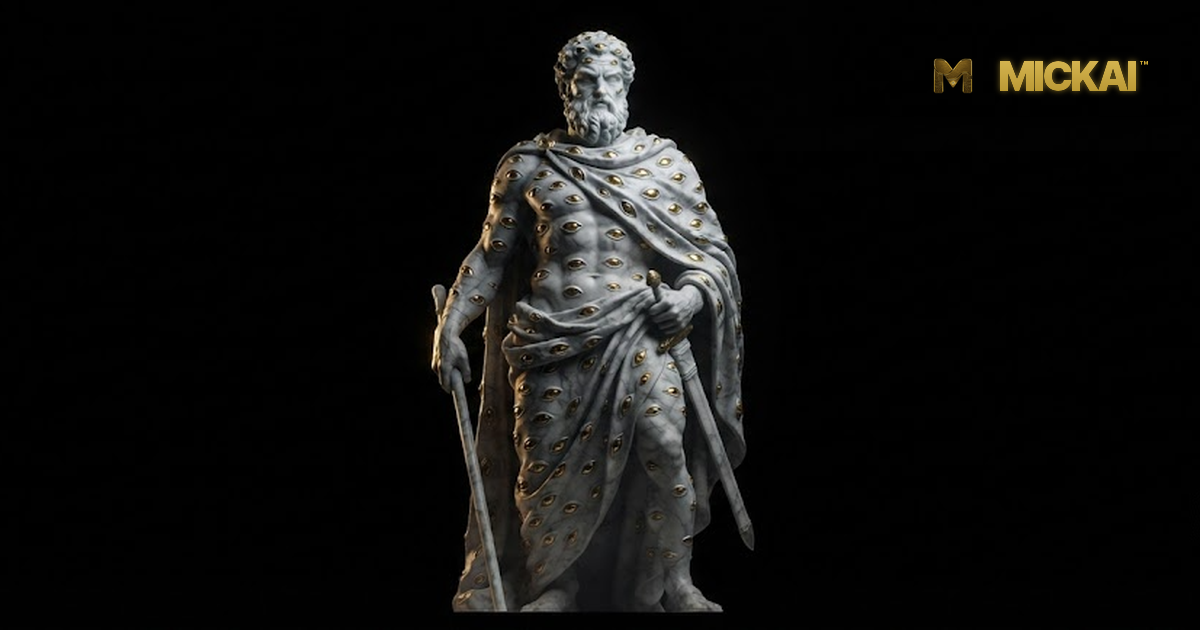
In the myth, Argus Panoptes was the giant with a hundred eyes, some always open while the others slept, set to watch and never to be wholly deceived. We named one of our specialist brains after him because auditability in the SIOS is not a log file written after the fact. Every action a brain proposes is wrapped in an Operation Attestation Record (OAR), which is signed before the action is allowed to execute, not after.
That signature is a post-quantum one, using the FIPS 204 standard ML-DSA-65 scheme, so the attestation remains verifiable long into the future and cannot be forged by tomorrow's cryptography. Every OAR is chained into a tamper-evident, cryptographically signed audit ledger, a causal record in which each entry commits to the ones before it. Alter a single past decision and the whole chain breaks visibly. The result is that each brain can be audited entirely on its own terms. You can pull the complete signed history of what one specialist did, verify it offline against its own keys, and never have to trust the vendor, the network, or any third party to confirm it.
Policy that binds before the act, not after
Revocation and audit are only as strong as the policy layer that decides what a brain may attempt in the first place. In the SIOS, permission is not a setting buried in a dashboard. It is a cryptographic policy enforced by dedicated governance brains that sit between intent and execution. A request is decomposed, checked against the operator's rules, and either attested and permitted or refused, all before anything happens in the world.
High-stakes actions raise the bar further. A payment above a threshold, a change to a patient record, an export that might touch material controlled under the International Traffic in Arms Regulations (ITAR): these can be gated behind multi-brain agreement and voice-biometric approval from a named human, so that no single subsystem and no single person can push them through alone. Because the policy is expressed cryptographically and every decision it makes is itself recorded in the ledger, an auditor can later prove not only what was done but that it was permitted under the rules in force at that moment.
Why modular beats monolithic on the regulated boundary
The public cloud giants, OpenAI, Microsoft, Amazon Web Services, Google, and Oracle, build extraordinary general-purpose models, and they remain allies for the vast majority of work. But they operate a different layer. On the regulated boundary, where health records, defence data, financial strategy, and personal data cannot leave the building, a customer needs answers the shared-cloud monolith cannot give on their own terms: which subsystem acted, prove it independently, remove it without collateral damage, and confirm all of this with no data leaving the premises.
Mickai runs entirely on hardware the customer owns, air-gapped or on-premise, with zero data egress. Nothing is sent to us to be checked, because the customer holds the keys and the ledger is theirs to verify offline. Modularity is what makes this possible. You cannot independently revoke a slice of a monolith, because the slice does not exist as a separable thing. You can revoke a Mickai brain because it was engineered from the outset to stand, and to fall, alone.
Filed capability, not a legal trophy
This architecture is the subject of concrete engineering claims. Across 104 filed United Kingdom patent applications, comprising 2,340 claims and owned by Mickai LTD, we describe the mechanisms that make independent revocation and audit real: the attestation record signed before execution, the post-quantum signed causal ledger, the hardware-attested binding of a brain to an identity, and the multi-party approval of high-stakes actions. We frame these as filed capabilities rather than as trophies, because what matters to a regulator is not the certificate on the wall but the function it protects.
The bottom line
A monolithic model asks you to trust the whole or none of it, and gives you no way to inspect or amputate the part that fails. A sovereign system built from fifty individually auditable, individually revocable brains gives you the scalpel instead of the sledgehammer. You can watch each brain like Argus, prove its history offline, bind it under cryptographic policy, and cut it loose the instant it forfeits your trust, all without touching the rest and without a single byte leaving your walls. That is not a smaller promise than the black box makes. It is a promise you can actually check, and that is the only kind worth making on the regulated boundary.