Rented AI can change its terms overnight. Owned AI cannot.
Anthropic's June 2026 Claude usage restructure shows how rented AI economics shift under you. Owned AI cannot be re-priced overnight.
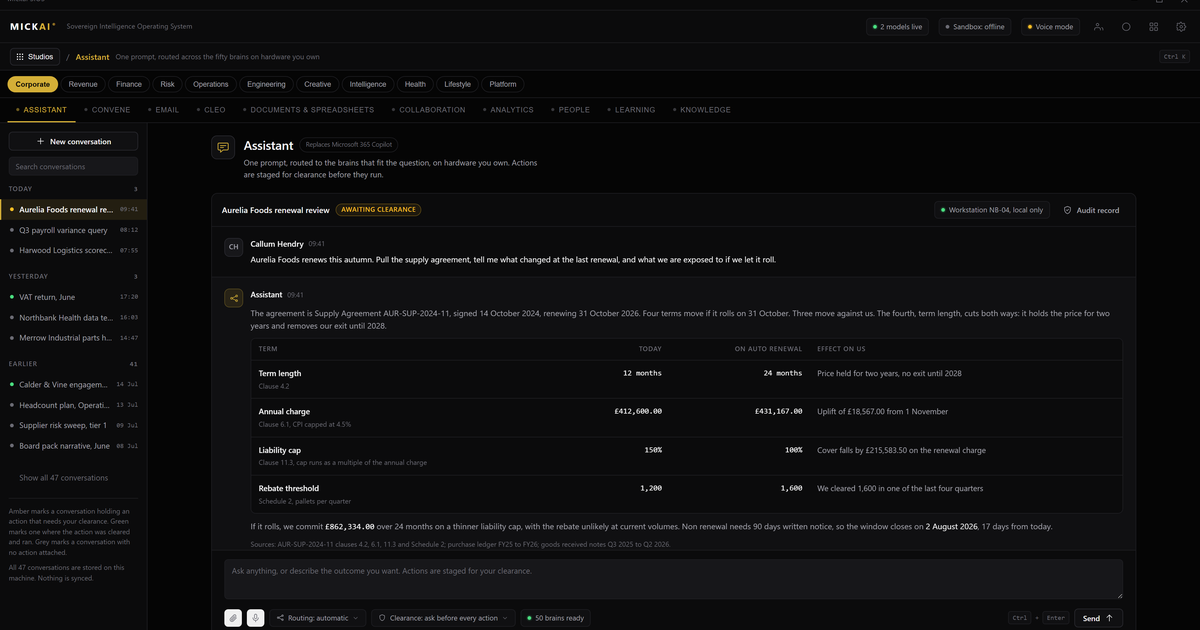
Yes, the economics of rented artificial intelligence can change under a customer with little notice and no say, because the terms belong to the vendor and not to the buyer. Anthropic's restructuring of paid Claude usage on 15 June 2026 is the clearest recent example. The sticker price did not move, and yet the effective monthly cost of running automated workloads on a subscription rose. A business that builds on a rented model carries a line in its budget that another company controls, and that is the case for owning the thing outright.
What actually changed with Claude in June 2026?
On 15 June 2026, Anthropic restructured how paid Claude usage is charged. This was not a headline subscription price increase. Claude Pro stayed at 20 US dollars a month. Claude Max stayed at 100 US dollars a month for the Max 5x plan and 200 US dollars a month for the Max 20x plan. Those numbers were unchanged through 2026.
What changed was the structure underneath them. Interactive use, meaning the Claude.ai chat interface and Claude Code used interactively by a person at a keyboard, kept its existing flat-rate limits at no extra cost. Programmatic and agentic use, meaning the Agent SDK and automated or unattended workflows authenticated through a subscription, moved to a separate metered credit pool. Each plan now includes a monthly credit allowance for that programmatic use. Once the allowance is spent, further programmatic usage draws full API rates on top of the subscription.
The effect was uneven, and that is the important part. For an ordinary interactive user, little changed. For a developer or a business running automated or agentic workloads on a consumer subscription, the effective monthly cost rose, and in some narrow cases it rose sharply, even though the headline price on the plan did not move. The published pricing at claude.com/pricing and the independent write-ups that followed tell the same story: the plan names and their prices held, while the meaning of what those plans include for automated work was redrawn.
Why the sticker price is the wrong thing to watch
Most buyers watch the sticker price, because it is the number on the contract and the number in the board pack. The Claude restructure is a clean lesson in why the sticker price is the wrong thing to watch. Nothing on the price list changed for the headline plans, and yet a real cost moved for a real class of customer.
This is not a trick, and it was not hidden. It is simply how rented software works. A vendor sells access, and the vendor defines what access means. It can hold the price and change the allowance. It can hold the allowance and change what counts as included. It can move a capability from one tier to another. Each of those is a legitimate commercial adjustment, and each of them can land on the customer's bill without the customer signing anything new. The number you budgeted can move without the number you agreed to changing.
There is a second reason the sticker price misleads. A subscription is sold as a fixed monthly cost, which makes it feel like a settled line in the budget, the same shape as rent or payroll. It is not. It is an option the vendor renews on its own terms, and the fixed feeling lasts exactly until the vendor decides otherwise. The restructure broke no promise, because the promise was never that the terms would hold. That is the part worth internalising before you build something important on top of a rented model.
Is this a criticism of Anthropic?
No, and it is worth stating plainly. Anthropic is a serious and capable company, and the June change reads as a fair commercial actor bringing the price of a resource into line with the cost of providing it. Automated and agentic workloads consume far more than a person typing in a chat window, and metering them separately is a reasonable thing to do. We are not making a case against Anthropic or against any vendor.
The point is structural, and it would be exactly the same point whichever vendor made whichever change. When you rent intelligence, the party that sets the terms is not you. That is true when the terms are generous and it is true when they change. A good vendor changing its model fairly and a poor vendor changing its model unfairly both leave the customer in the same position: exposed to a decision made on the other side of the table.
What renting exposes a business to
A company that builds on a rented model takes on a dependency it does not govern. The dependency is not only the price. It is the whole set of terms: the rate, the allowance, the definition of what is included, the availability of the plan, the roadmap of the model, and the continued existence of the tier you designed around. Any of those can move. When a workflow is automated and unattended, it also consumes on its own, which means a change to metering can raise a bill that no person was watching in the moment.
For an individual using a chat window, this is a minor consideration. For a business that has wired a rented model into the way it runs, it is a line in the budget owned by someone else, and a plan that can be redrawn between one month and the next. You can forecast it, but you cannot fix it, because the lever is not in your building.
Does this mean never rent a model?
No. Renting has real advantages. It is fast to start, it needs no hardware, and it lets a team try an idea before committing to it. For experiments, for spikes of work, and for cases where the data is not sensitive, renting is often the right call. The argument is not that renting is wrong. It is that renting should be a decision made with open eyes as to who holds the terms. The moment a rented model moves from an experiment to the thing a business depends on, the question of who controls the cost stops being academic. The June restructure is the reminder. A capability that is central to how you operate is one you should be able to govern, and you cannot govern a line another company can redraw.
What owning the system changes
Owning the system changes the character of the cost. When a company owns the hardware and runs the software itself, the money it spends is capital it controls, not a subscription another company can re-price or restructure. The machine sits in the building. The software runs on it. There is no monthly allowance to spend down, no separate meter for automated work, and no renewal at which a vendor can move the terms. The terms cannot be changed under you, because there is no counterparty holding them.
This is the shape MICKAI is built in. It is a sovereign intelligence operating system that runs on hardware the customer owns, air-gapped by default, so the workloads run on machines the business controls rather than on a vendor's servers. Because it runs in your building, an agentic workflow that runs a thousand times overnight costs what the electricity and the hardware cost, not what a meter decides it costs this month. Every action the system takes is written to the Open Audit Record, so the business can show what ran and when. The platform spans 63 studios on one operating system, and a firm onboards onto the set that matches how it works. We do not publish pricing here, because the argument does not need a number. It needs only the distinction of shape: capital you own against a subscription someone else can re-price.
The decision in one line
Rented intelligence is a capability you can switch on quickly and a cost you do not control. Owned intelligence is a commitment you make once and a cost that stays yours. The Claude restructure of June 2026 did not raise a headline price, and it still moved the real cost for a class of customer, which is exactly why the distinction matters. For a business deciding how to build on artificial intelligence for the long run, the question is not which vendor is cheapest this quarter. It is whether the terms of the thing you depend on sit inside your building or outside it. It is worth noting, without leading on it, that the system is backed by 104 filed UK patent applications, 2,340 claims in total, filed rather than granted. The reason to own it, though, is simpler than any of that: the terms cannot change overnight when they are yours.
Frequently asked questions
Did Anthropic raise Claude's prices in June 2026?
Not as a headline subscription increase. On 15 June 2026 Anthropic restructured paid usage. Claude Pro stayed at 20 US dollars a month and Claude Max at 100 and 200 US dollars a month. Interactive use kept its flat-rate limits, while programmatic and agentic use moved to a separate metered credit pool, so for businesses running automated workloads on a subscription the effective cost rose even though the sticker price held.
Why does a usage restructure matter if the sticker price stays the same?
Because the cost you budget can move without the price you agreed to changing. A vendor can hold the plan price and change the allowance, or change what counts as included. The Claude restructure held every headline price and still raised the real monthly cost for automated workloads. Watching only the sticker price misses the thing that actually moved.
Is this a criticism of Anthropic?
No. Anthropic is a serious and capable company, and metering automated workloads separately from a person typing in a chat window is a reasonable commercial decision. The point is structural, not a swipe at any vendor. When you rent intelligence, the party that sets the terms is not you, and that holds whether the terms are generous or whether they change.
How does owning the system change the cost?
It changes the character of the cost from a subscription to capital. When a company owns the hardware and runs the software itself, the spend is controlled by the company, not by a vendor who can re-price or restructure it. There is no monthly allowance to spend down and no renewal at which the terms can move. An agentic workflow that runs overnight costs what the hardware and electricity cost, not what a meter decides.
Can a sovereign system's terms be changed under us the way a subscription's can?
No. When you own the hardware and run the software in your own building, there is no counterparty holding the terms, so there is nothing for a third party to re-price or redraw. The cost becomes a commitment you make once and control from then on, rather than a plan someone else renews on their own terms.
What is MICKAI?
MICKAI is a sovereign intelligence operating system that runs on hardware the customer owns, air-gapped by default, with every action written to the Open Audit Record. It spans 63 studios on one operating system, and a firm onboards onto the set that matches how it works. It is backed by 104 filed UK patent applications, 2,340 claims in total, filed rather than granted.