Recruitment and applicant tracking you own
Our recruitment studio holds candidates and pipelines on your own hardware, wired to HR, with the assistant screening. Compared to Greenhouse and Workday.
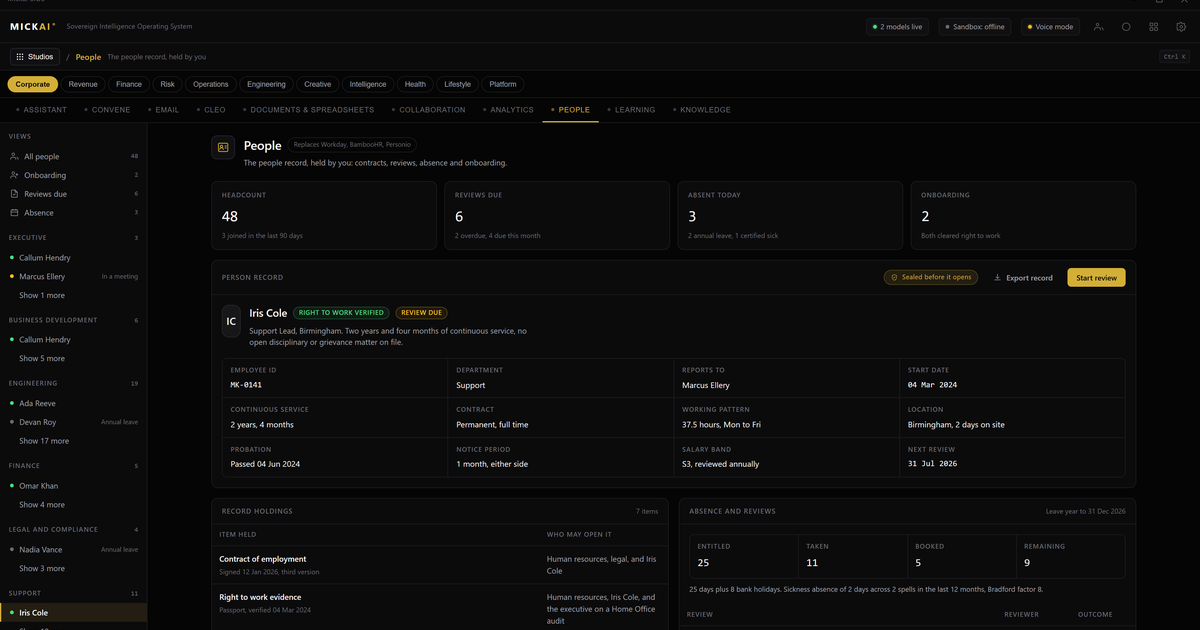
Recruitment and applicant tracking you own is a hiring system where every CV, application, interview note and offer lives on hardware your company controls, not in a vendor's cloud. Our recruitment studio is one part of the MICKAI sovereign operating system: candidates and pipelines sit in your building or your private rack, the studio is wired straight into HR, and the same assistant that runs your email and meetings screens applicants and organises the funnel with you. You rent nothing, and the most sensitive data your firm handles never leaves the premises.
What the recruitment studio actually does
It does the work you expect an applicant tracking system to do. It posts vacancies, collects applications, parses CVs, moves candidates through named pipeline stages, schedules interviews, captures scorecards and interview notes, manages offers, and reports on time to hire, source of hire and where candidates drop out. Hiring managers, recruiters and interviewers all work from the same pipeline, so nobody is chasing the current state of a role across inboxes and spreadsheets.
The difference is where all of it lives. In a typical cloud recruiting product your candidate database, your interview feedback, your rejection reasons and your salary offers sit on a vendor's servers under their control. With our studio the entire store is on your own machine. When a recruiter opens a role, the applicants are read from local hardware. When an interviewer files a scorecard, it is written to local hardware. Nothing crosses your boundary to make the product work.
That is the baseline we start from: a deployment where the vendor cannot see your hiring data. Private cloud arrangements get you part of the way. We go further. The studio is air-gapped by default, so it functions with no connection to the outside, and every action is written to an audit record you hold. Applicant data is a legal duty as much as a business asset. Keeping it on hardware you control is the plain, correct default.
One operating system, wired straight into HR
Most companies do not buy applicant tracking in isolation. They buy an ATS, then an HR system, then a set of connectors to move a new hire from one to the other. Each connector is another vendor, another subscription and another copy of personal data crossing a boundary.
Our recruitment studio is not a separate app. It is a studio on one operating system, sharing one data store with our HR system, our email, our meetings and collaboration platform, and the assistant. Because they sit on the same foundation, a candidate who accepts an offer becomes an employee record without an export, an import or a sync job. The interview history, the offer terms and the start date are already in one place. There is no window where recruiting and HR disagree about who was hired and on what terms.
This is what we mean by taking the whole software stack rather than a model to integrate. You are not wiring an ATS into a landscape of other clouds. Recruiting, HR, the mailbox and the meeting room are studios on the same system, running on your hardware, reading and writing the same records.
How the assistant screens and organises
Here is the practical picture. A role opens and applications arrive. Because our email system is a studio on the same operating system, an application that comes in by email is already attached to the right vacancy. The assistant reads each CV against the criteria you set for the role, shortlists candidates who meet them, and flags the ones that are close so a human decides. It spots duplicates where someone has applied twice, and it surfaces gaps, a missing right to work date, an unanswered screening question, so nothing stalls unnoticed.
You book interviews using our meetings and collaboration platform, and the invitations, notes and scorecards land against the same candidate record. After an interview the assistant can draft the next message, move the candidate to the correct stage and set the follow up task, because it can read across the pipeline, the mailbox and the interview notes at once. It is one assistant across every studio, working from your data on your hardware, not a screening tool bolted onto a single app.
Ask the assistant "who is our strongest shortlist for this role" and it answers from the applications and the scorecards together. Ask "which candidates have gone quiet" and it reads the pipeline and the last contact date and tells you. The value is a capable assistant that sees the whole hiring picture because the whole picture is in one place you own. On the screening decisions that matter, it organises and recommends and a person signs off.
What it costs to rent the alternative
We do not publish MICKAI pricing. What we can do is show you how the incumbents charge, so you can model your own number honestly.
Cloud recruiting is sold on a recurring subscription, billed every year, forever. Greenhouse and Workday do not both post a simple public per user per month figure the way some tools do; recruiting suites are commonly quoted by company headcount or employee count, on annual contracts, with the exact figure depending on the modules you take. So the method matters more than any single number, and here is the method.
Take the basis the vendor quotes you. If it is a per user per month seat price, multiply by your recruiter and hiring manager seat count, then by twelve for one year. If it is a headcount based annual fee, take the quoted annual figure directly. A worked example on a stated assumption: a seat price of 150 pounds per user per month for 20 recruiting seats is 20 times 150 times 12, which is 36,000 pounds a year. On a headcount based contract a mid sized employer might instead be quoted a five figure annual platform fee that recurs every year and rises as you grow. Those are illustrative figures on a stated assumption, not a quote; put in the real basis the vendor gives you and you have your own number.
Now hold that recurring number against the shape of what we offer: the software running on hardware your company owns, as one of many studios on a single operating system rather than a standalone subscription you rent in perpetuity. Add the connectors and the separate HR licence you would otherwise buy to link a standalone ATS to the rest of your stack, and the rented bill grows again. Measure the subscription you would pay year after year against owning the tools instead.
Built for the regulated small and mid-sized firm
The heavyweight suites are built for very large employers. The regulated small and mid-sized firm, the practice, the broker, the clinic, the manufacturer with a compliance duty, often gets the same multi-tenant cloud with none of the leverage and all of the exposure. Recruiting data is unusually sensitive. It holds personal details, references and, if you are not careful, protected characteristics. If a regulator, an auditor or a rejected candidate asks where that data sits and who can see it, "a vendor cloud in a region we do not control" is an awkward answer.
Our recruitment studio gives that firm a straight answer. The data is here, on our hardware, in our building. Access is logged at the action level in the Open Audit Record, so we can show who viewed, edited or exported an application, which is exactly what a data subject access request or a fairness challenge needs. It runs air-gapped, so an outside connection is not a condition of getting to your own pipeline. To be clear about what we do not claim: we hold no SOC 2, ISO or Cyber Essentials certification. What we give you is architectural control and a full action level audit trail on kit you own, which is what most of these questions are really about.
The wider platform
The recruitment studio is one part of the system. The operating system spans 63 studios on the same foundation, and clients onboard onto a focused initial set rather than switching everything at once. The point is not the count. The point is that recruiting, HR, email, meetings and the assistant are the same system, sharing your data, running on your hardware. You own the candidate relationships, you own the record that follows a hire into employment, and you own the software that manages both.
Frequently asked questions
Where does our recruitment studio store candidate data? On hardware your company owns. CVs, applications, interview notes and offer records sit inside your building or your private rack, not in a vendor's multi-tenant cloud. No third party holds a copy of your applicant pipeline.
How does it compare on price to Greenhouse and Workday? Those vendors sell recruiting on a recurring subscription, typically scaled by headcount or employee count and billed every year. We do not publish MICKAI pricing. The honest comparison is a rental bill that recurs forever against owning the software on your own kit, so use the vendor's own quoted price to model your annual spend.
Does the recruitment studio connect to HR? Yes. Recruitment and HR are studios on one operating system sharing one data store, so a hire flows from candidate to employee record without a connector or a data export between systems.
What does the assistant do in hiring? It reads applications against the role, shortlists to your stated criteria, organises the pipeline, drafts replies and flags gaps or duplicates. It works from your data on your hardware and writes every action to an audit record.
Does it keep working when the internet is down? Yes. The studio is air-gapped by default and runs on local hardware, so live vacancies and candidate pipelines stay available with no outside connection.
How do we answer a candidate who asks to see or delete their data? Everything is on hardware you hold, and every view, edit and export is logged at the action level in the Open Audit Record, so you can locate a candidate's data and act on a request directly.
Frequently asked questions
Where does our recruitment studio store candidate data?
On hardware your company owns. CVs, applications, interview notes and offer records sit inside your building or your private rack, not in a vendor's multi-tenant cloud. No third party holds a copy of your applicant pipeline.
How does it compare on price to Greenhouse and Workday?
Those vendors sell recruiting on a recurring subscription, typically scaled by headcount or employee count and billed every year. We do not publish MICKAI pricing. The honest comparison is a rental bill that recurs forever against owning the software on your own kit, so use the vendor's own quoted price to model your annual spend.
Does the recruitment studio connect to HR?
Yes. Recruitment and HR are studios on one operating system sharing one data store, so a hire flows from candidate to employee record without a connector or a data export between systems.
What does the assistant do in hiring?
It reads applications against the role, shortlists to your stated criteria, organises the pipeline, drafts replies and flags gaps or duplicates. It works from your data on your hardware and writes every action to an audit record.
Does it keep working when the internet is down?
Yes. The studio is air-gapped by default and runs on local hardware, so live vacancies and candidate pipelines stay available with no outside connection.
How do we answer a candidate who asks to see or delete their data?
Everything is on hardware you hold, and every view, edit and export is logged at the action level in the Open Audit Record, so you can locate a candidate's data and act on a request directly.