Quotes and proposals as a studio
Our proposals studio draws quotes from your CRM and product data, signs them in the OS and tracks them to the deal. Compare with PandaDoc pricing.
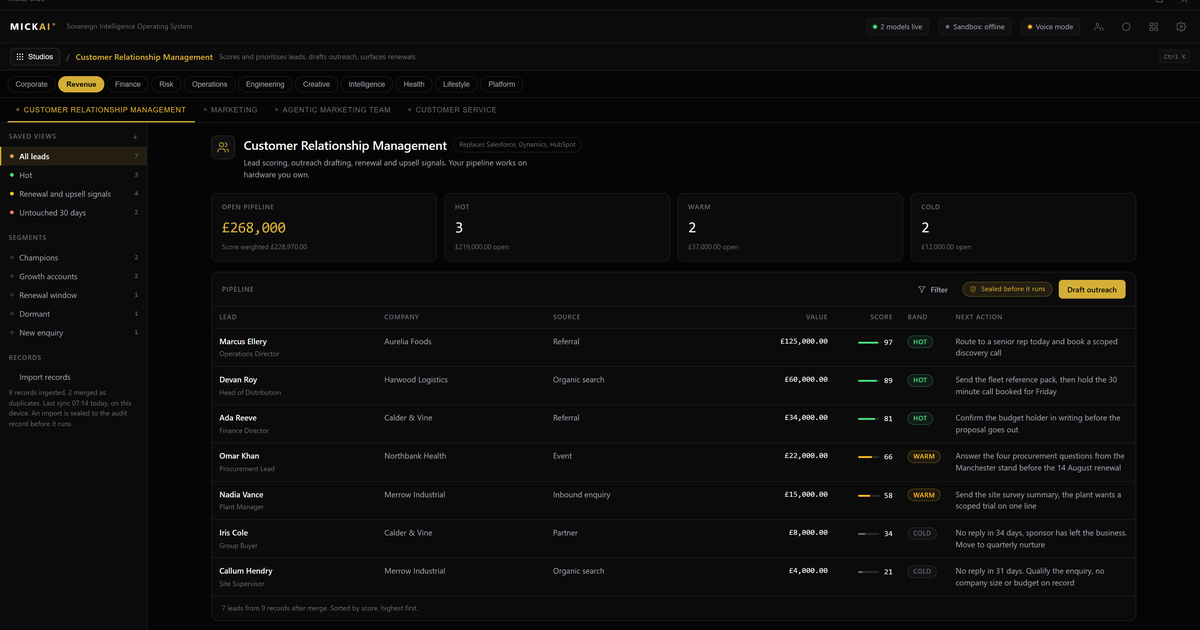
Quotes and proposals as a studio means the document your customer signs is built from your own live data, signed inside the operating system, and tracked against the deal, all on hardware you own. Our proposals studio pulls the account, the line items and the prices from your CRM and product data, lets the customer sign in place, and writes the signed version back to the deal record. There is no separate document cloud holding your pricing, and no retyping figures from a spreadsheet into a tool that keeps its own copy.
What the proposals studio actually does
It does the work you expect from a quoting and proposal tool. You build a quote from a template, add line items and quantities, apply discounts, show terms, and produce a clean branded document. The customer opens it, reads it, and signs it. You see when it was opened, what was agreed, and when it was signed. The deal moves forward.
The difference is where the numbers come from and where the signed document ends up. In a typical setup the proposal tool is a separate cloud. Your salesperson copies the account name, the contact and the prices out of the CRM and into the document builder, or wires up a connector to sync them across. The finished document, with your pricing and your terms, then lives on that vendor's servers. Our proposals studio is not a separate cloud. It reads the account straight from our CRM and the prices straight from your product data, because they are studios on the same operating system sharing one store. The quote is assembled from current figures, not a stale copy pasted in by hand.
That is the baseline we start from: your pricing and your executed contracts on hardware you control. The proposals studio is air-gapped by default, so building and signing happen on local kit with no dependency on an outside service. Your price book and your signed agreements are among the most sensitive things your firm holds. Keeping them on hardware you own is the plain, correct default.
Quotes drawn from the CRM and your product data
A quote is only as good as the data behind it. The account details, the contact, the deal history and the right pricing all have to be correct, or the document you send is wrong before it leaves the building.
Because our proposals studio sits on the same operating system as the CRM, the account and the deal are already there. You start a quote from the deal, and the customer, the contacts and the history are filled in from the record. You are not searching for the account again in a second tool.
The line items come from your product data on the same system. Your catalogue, your list prices, your discount rules and your terms are held once and read by the proposals studio directly. When a price changes in your product data, the next quote uses the new price. There is no separate price list inside the document tool to keep in step, and no window where the CRM says one thing and the proposal says another. The numbers on the page trace back to a single source you own.
Signed in the OS, tracked to the deal
When the quote is ready, the customer signs it inside the operating system. The signature, the exact version of the document that was signed, and the timestamp are recorded on your hardware. There is no separate e-signature vendor holding the executed copy and charging for the privilege.
The signed proposal is then attached to the deal in the CRM. The record shows the quote that went out, the version the customer agreed, and the date it was signed, in one place. Sales, account management and finance all read the same signed document against the same deal, so nobody is chasing a PDF in an inbox or asking which version was final.
Every step is written to the Open Audit Record. Who built the quote, which prices it used, when it was sent, when it was opened, and who signed it are logged at the action level on hardware you hold. If you need to show how a number was reached or prove what was agreed, the trail is yours and it is complete.
One operating system, not a stack of separate apps
Most firms do not buy a proposal tool on its own. They buy a CRM, then a document and e-signature tool, then a connector to pass data between them, then perhaps a separate billing tool the signed quote has to reach next. Each one is another vendor, another subscription, and another place your pricing and your contracts are copied to.
Our proposals studio is a studio on one operating system, sharing one data store with our CRM, our email system, our meetings platform and the assistant. Because they sit on the same foundation, the quote already knows the account, the prices already come from your catalogue, and the signed document already lands on the deal. There is no sync job, no e-signature subscription, and no gap where two systems disagree.
This is what we mean by taking the whole software stack rather than a model to integrate. You are not wiring a document tool into a landscape of other clouds. The quote builder, the price book, the signature and the deal record are studios on the same system, running on your hardware, reading and writing the same data.
How it works with email, meetings and the assistant
Here is the practical picture. A prospect asks for a quote in a meeting. Because our meetings platform is a studio on the same operating system, the notes and the action point sit against the deal. You build the quote from that deal, the assistant drafts the covering note in our email system, and the whole thread stays attached to the record.
Ask the assistant to draft a proposal for an account and it works from the deal, the catalogue and the recent emails at once. It can pull the right line items, apply the discount your rules allow, and produce the document ready for your review. After the customer signs, ask it what has been agreed and it answers from the signed version on the record, not from memory. It is one assistant across every studio, working from your data on your hardware, not a chatbot bolted onto a single app. We do not name the model behind it. What matters is what it does for the studios: it reads across the deal, the price book and the signed document because all of it is in one place you own.
What it costs to rent the alternative
We do not publish MICKAI pricing. What we can do is show you the recurring bill the incumbents publish, so you can model your own number honestly.
Document and proposal software is sold per user per month, billed every year, forever. PandaDoc publishes tiered per seat pricing on its website; the exact figure depends on the plan you pick and moves over time, so read the current list price for the tier you would actually buy straight from the vendor. The method matters more than any single number, so here is the method.
Take your seat count. Multiply by the vendor's published price per user per month. Multiply by twelve. That is one year. A worked example with a stated assumption, and the price here is an assumed rate for the illustration, not a quoted PandaDoc figure: at an assumed 35 pounds per user per month, a 20 person sales team is 20 times 35 times 12, which is 8,400 pounds a year. A 50 person team at the same assumed 35 pounds per user per month is 50 times 35 times 12, which is 21,000 pounds a year. Those figures rest on that assumption; put in your real seat count and the real published price for the plan you want, read from the vendor's own site, and you have your own figure. If you also pay for a separate e-signature product, add its per seat price on the same basis, because the proposals studio does the signing too.
Now hold that recurring number against the shape of what we offer: the software running on hardware your company owns, as one of many studios on a single operating system rather than a standalone subscription you rent in perpetuity. Add the connector to your CRM and the separate signature tool you would otherwise buy, and the rented stack grows again. We are not going to print our price here. We are saying: measure the subscriptions you would pay year after year, and measure them against owning the tools instead.
Built for the regulated small and mid-sized firm
Smaller regulated firms feel this most. They send quotes and contracts that must be right, they must be able to show how a price was reached, and they carry the same duty of care over customer data as a large enterprise, without the same budget for a wall of separate clouds.
Owning the proposals studio on the operating system answers all three. The numbers trace to your own product data. The signed document and its full history sit on your hardware, air-gapped by default and written to an audit record you hold. And you carry one system, not a CRM plus a document cloud plus a signature vendor plus the connectors between them. When you need to prove what was quoted and what was agreed, the evidence is yours, at the action level, in your building.
That is the case for quotes and proposals as a studio. Not a document tool bolted onto your CRM from another vendor's cloud, but a studio on the operating system you own, drawing on your own data, signing in place, and tracking every deal on hardware you control.
Frequently asked questions
Where does the proposals studio get its numbers?
From your own systems. Line items, prices and discounts are drawn from your CRM and your product data, which live on hardware you own. You are not retyping figures from a spreadsheet into a separate document tool that holds its own copy.
How does it compare on price to PandaDoc?
PandaDoc publishes a per user per month subscription that recurs every year. We do not publish MICKAI pricing, but the honest comparison is a recurring rental bill against owning the software on your own kit. Use the vendor's own list price to model your annual spend.
Can a customer sign the proposal?
Yes. The quote is signed inside the operating system. The signature, the version signed and the timestamp are recorded on your hardware and attached to the deal, with no separate e-signature vendor holding the executed document.
Does it work when the internet is down?
Building and signing a proposal runs on local hardware and is air-gapped by default. You send the finished document however you send documents today; the record of it stays with you.
Is this a finished product or an early build?
It is a working studio, one of 63 studios on the operating system. Clients onboard onto a focused initial set of studios rather than all of them at once.
What stops an old price or an unapproved discount going out?
Because prices come from your product data and every action is written to the Open Audit Record, the source of each number is traceable and edits, sends and signatures are logged at the action level on your own hardware.