


Proof, Not Payload: Why Artificial Intelligence Belongs On-Chain as a Fingerprint
Pantheon anchors the cryptographic seal of every action, never the data behind it, because a hash proves what matters and a payload betrays it.
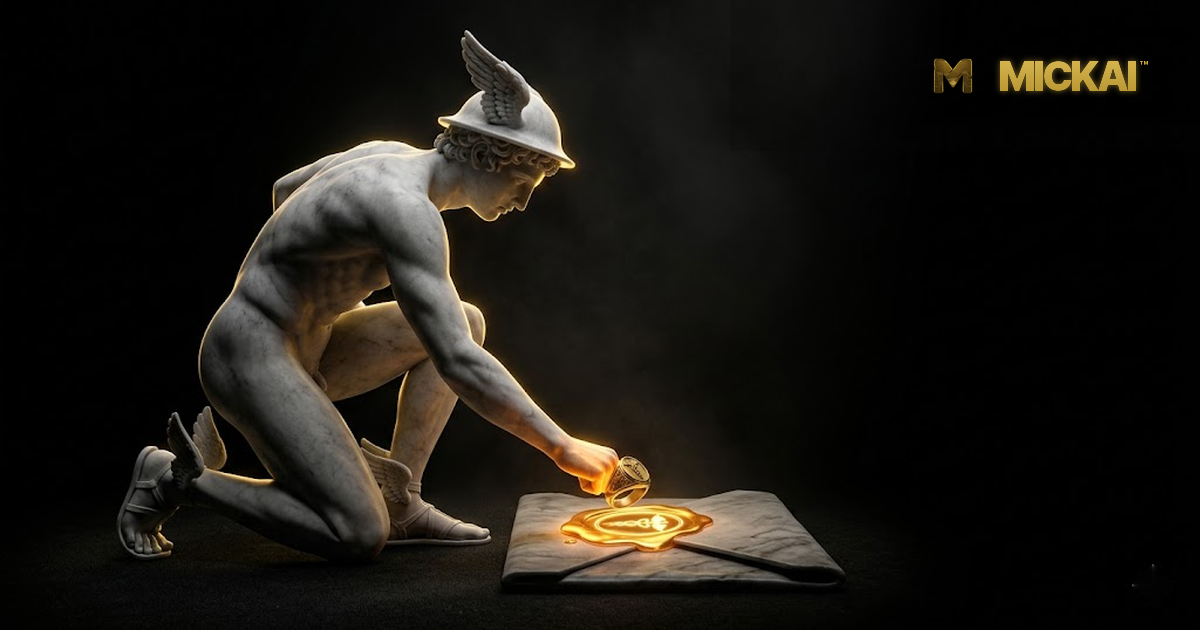
The Wax and the Letter
Consider Hermes carrying a sealed letter across the world. The messenger does not unroll the page at every gate. He shows the seal. The wax carries the impression of one ring, and anyone who knows that ring can confirm, without reading a word, that the document is whole, that it came from the right hand, and that nothing has been altered in transit. The letter stays private. The proof travels openly. That separation, between the thing said and the proof that it was said by a specific authority and never touched since, is the oldest idea in trust, and it is the architectural choice that defines Pantheon.
Pantheon is a sovereign Layer 1 blockchain built on the Mickai Sovereign Intelligence Operating System (SIOS). Its single most consequential design decision is what it refuses to store. It does not put model outputs on-chain. It does not put training data, prompts, documents, or reasoning traces on-chain. It anchors the fingerprint, the cryptographic hash, sealed under a post-quantum signature, and it keeps the data itself on sovereign hardware. The public ledger becomes a register of seals, not a warehouse of payloads. This is not a limitation worked around. It is the correct shape for a system whose job is to prove what artificial intelligence did, rather than to broadcast it.
Why the Payload Is the Wrong Thing to Anchor
A great deal of current thinking treats the blockchain as a place to put data so that the data becomes trustworthy. For financial transfers that instinct is defensible, because the transfer is the data: moving value is the entire act. Artificial intelligence breaks the instinct. The valuable artefact of an AI action is rarely the output alone. It is a clinical recommendation tied to a patient record, an intelligence assessment drawn from sensitive sources, a trading decision built on a proprietary model, a legal opinion grounded in privileged material. Publish any of these to a permanent, globally replicated ledger and you have not created trust. You have created an irreversible leak that no buyback, vote, or apology can recall.
There is a second, quieter problem. On-chain storage is the most expensive storage that has ever been built, because every full node on Earth keeps a copy forever. Pushing model outputs into that medium is uneconomic at the scale at which real AI systems operate, where a single subsystem can generate millions of decisions a day. A chain that tried to carry the payloads would either price itself out of use or quietly centralise, because only a handful of operators could afford to keep the state. Pantheon settles fees in PAN and stays light precisely because it never asks the world to remember the content. It asks the world to remember the proof.
The third problem is permanence cutting the wrong way. Data on a ledger cannot be corrected, redacted, or forgotten. Regulation across Europe and beyond increasingly demands exactly those capabilities. A design that anchors payloads is a design at war with the right to erasure. A design that anchors only a hash has no such conflict, because the hash reveals nothing and the underlying record lives where it can be governed, amended, and, where the law requires, destroyed, without breaking a single proof that was already sealed.
What a Sealed Hash Actually Proves
The objection writes itself: if the chain holds only a fingerprint, what has actually been proved? The answer is everything that matters for accountability, and nothing that compromises confidentiality. Every action inside the Mickai SIOS is sealed into the Open Audit Record (OAR), an append-only, hash-chained ledger. Each entry is signed under ML-DSA-65, the Module-Lattice Digital Signature Algorithm standardised in Federal Information Processing Standard 204 (FIPS 204), the United States National Institute of Standards and Technology post-quantum signature standard. The seal binds three things at once: the exact content (through its hash, so any later alteration is detectable), the authority (through the operator key that signed it), and the position in an unbroken chain (so no entry can be silently inserted, removed, or reordered).
From that seal, a verifier holding only the operator public key can establish, offline and forever, a precise set of facts. That a specific action occurred. That it was authorised under a specific key. That it sat in a specific place in history relative to every other sealed action. That the record presented now is byte-for-byte the record that was sealed then. What the verifier cannot do is read the content, unless the holder of the data chooses to disclose it and let the verifier recompute the hash. Confidentiality is the default. Proof is universal. The data and the proof are decoupled, and only the data is sensitive.
“Public blockchains record transactions but cannot attest to what produced them. Artificial intelligence acts but cannot prove, after the fact and offline, what it did, under whose authority, and with what reasoning. Pantheon seals the second of these into the first.”
Seal Before Consensus, Not Storage After
What separates Pantheon from a chain that merely lets a contract write a hash into storage is where the seal lives in the order of operations. Pantheon is built on the Polkadot SDK (Substrate) in Rust, a standalone sovereign proof-of-stake (PoS) chain using BABE and Aura for block production and GRANDPA for finality, the framework's audited consensus machinery. The OAR is not a contract bolted on top. It is a native runtime module, pallet-oar, which makes seals first-class objects of consensus rather than entries in some application's storage map. This is the property we call seal-before-own-consensus: the chain validates operator-sealed, post-quantum records before it orders them into a block.
The distinction is not academic. When a hash is merely written by a smart contract, the chain has agreed only that a transaction happened, not that the sealed record is well-formed, correctly signed, and chained. The attestation rides as opaque cargo. In Pantheon the attestation is the cargo the validators are agreeing about. The post-quantum signature is checked as part of the act of inclusion. The fingerprint is not a side effect of a transfer. It is the thing the network exists to settle. That is why Pantheon can describe itself as a chain whose attestation layer is post-quantum from genesis, not retrofitted, not optional, not a feature flag.
Fifteen application chains map to live Mickai subsystems: trading and decentralised finance, Trust Agent audit, knowledge and retrieval, PENELOPE for open-source intelligence, VIGIL for sky and airspace, civilisation and survival, the Vinis assistant, a marketplace, governance, HYGEIA for health, THEMIS for legal, compliance, identity, autonomous market tooling, and HELIOS for hardware. Each settles its sealed actions to the base layer in PAN. The more those subsystems run, the more settlement flows down to the base chain. None of them ships its payloads to the ledger. Each ships its proofs. The fingerprint model is what lets a system this broad settle to one chain without drowning it in content or leaking what the content was.
The Witness Outside the System
A fingerprint anchored only to its own chain still asks you to trust that chain's history. Pantheon adds an external witness. Periodically a Merkle commitment of the chain's OAR root is anchored to Bitcoin using OpenTimestamps, a free public timestamping proof. This places a single, tiny commitment to the entire sealed history into the most widely replicated and independently secured ledger in existence. Bitcoin is used only as a witness, at no protocol cost. Pantheon does not fork Bitcoin, does not depend on it for execution, and does not pay it for ordering. It borrows Bitcoin's permanence to make a statement that even Pantheon's own validators could not later rewrite without the discrepancy being externally provable.
This is the fingerprint principle taken one layer further out. Just as the chain anchors a hash of each action rather than the action, the Bitcoin anchor commits a hash of the chain's history rather than the history. At every level the design publishes the smallest possible proof and keeps the substance close. A sealed action proves itself to the chain. The chain proves itself to Bitcoin. The data proves nothing to anyone unless its holder elects to disclose it. Concentric rings of attestation, each one a wax impression and not the letter.
Why This Wedge Is Specific
The field of verifiable artificial intelligence is no longer empty, and the serious work in it deserves respect. EQTY Lab is the closest peer and is well-funded. Sahara AI, 0G, ORA, and Prove AI each pursue versions of provable machine intelligence. The architectural differences, though, are precise and they matter. The nearest comparators root their trust in vendor silicon, hardware trusted execution environments such as Intel TDX or NVIDIA enclaves, which means trusting a chip vendor's supply chain and firmware. They sign with classical cryptography, which a sufficiently capable quantum computer is expected to break, retroactively, against signatures recorded today. They anchor to Hedera or to their own chain rather than to an external witness like Bitcoin.
Pantheon's stack diverges at each of those joints. It seals in software, on commodity hardware, under FIPS 204 ML-DSA-65, so the proof does not depend on any vendor's enclave remaining unbroken. It runs its own consensus over operator-sealed records rather than treating attestation as contract data. It anchors to Bitcoin as an outside witness. It maps its own regulatory posture, through the OAR compliance mapper, to the European Union Artificial Intelligence Act (EU AI Act), the National Institute of Standards and Technology AI Risk Management Framework, and the International Organization for Standardization ISO 42001, generating signed evidence that the chain's governance is continuously auditable. And its token economics couple to attested usage rather than to emissions. No incumbent Layer 1 offers that combination, and the fingerprint-not-payload choice is what holds it together. You cannot map confidential AI actions to ISO 42001 evidence if you had to publish the actions to anchor them.
The Economy of Proof
The fingerprint model also shapes how value moves, because PAN, the native asset of the Pantheon Layer 1, is tied to the volume of sealed settlement rather than to inflation. PAN has a fixed supply of five billion (5,000,000,000), with no mint authority and no inflationary issuance. It also exists as an omnichain token across Ethereum, BNB Chain, Base, and Arbitrum through a lock-and-mint bridge of the LayerZero Omnichain Fungible Token (OFT) class, so one fixed supply spans every venue: sovereignty where the moat is, liquidity where the market is. PAN settles fees across the base layer and the fifteen application chains, bonds validator stake, and carries governance over parameters, treasury, and buyback policy.
Staking yield does not come from emissions, because there are none. It is funded by revenue buybacks. A governed share of protocol revenue purchases PAN on the open market and is split, indicatively and tunable by governance, roughly forty per cent to staker and validator yield, thirty per cent to permanent burn, and thirty per cent to a governance lock. A base-fee burn in the style of Ethereum Improvement Proposal 1559 (EIP-1559) removes part of every transaction fee, so genuine usage contracts supply rather than expanding it. Every buyback, every burn, and every lock is itself sealed into the OAR and verifiable on-chain. The proof discipline that governs AI actions governs the token's own machinery, which means the economy cannot quietly print or misreport what it claims to have done.
Participation in securing the chain stays open. Validators come in three tiers: software validators who run a single node binary on commodity hardware and stake PAN, delegators who nominate validators through nominated proof of stake (NPoS) and share rewards without running infrastructure, and Mickai hardware appliances, premium plug-in validators from the Mickai hardware lineup, shipping twelve months after funding. The hardware path is a premium, never a gate. The set stays open to software operators, targeting fifty to one hundred and fifty active validators, so the chain is credibly decentralised. Governance is two-keyed: PAN-holder referenda set direction, and beneath them a sealed execution-safety layer inherited from the SIOS requires a quorum of independent sovereign models to return ALLOW before a gated action runs, with every vote sealed and every reversal an append-only compensation that never deletes history.
What Is Built, and What Comes Next
Precision about status is part of the proof discipline, so here it is plainly. Pantheon is designed. The omnichain EVM contracts are built and smoke-tested on a local testnet. The Substrate Layer 1 is in build. The bridge mechanisms are covered by filed UK patent applications within the Pantheon bridge family, part of a portfolio of 104 filed UK patent applications and 2,340 claims owned by Mickai LTD, named inventor Micky Irons. Mainnet is gated by an independent security audit and by legal and securities clearance, not by code. The token generation event (TGE) is targeted for the first quarter of 2027. The raise is thirty million pounds under Ladder B, roughly twenty-four per cent of supply, via Simple Agreement for Future Tokens (SAFT) instruments to professional investors only, marketed in the European Union through the Markets in Crypto-Assets (MiCA) utility-token notification route, with no United Kingdom retail promotion.
Step back from the mechanics and the thesis is simple. The defining failure of the present moment is not that artificial intelligence acts. It is that artificial intelligence acts and cannot afterwards prove, offline and against a future adversary, what it did, on whose authority, and in what order. Pantheon answers that failure by treating the proof, not the payload, as the thing worth settling. It anchors the fingerprint and keeps the data sovereign. It seals before consensus rather than storing after. It signs under a post-quantum standard so that today's proofs survive tomorrow's machines. A messenger who shows the seal and keeps the letter has understood something the messenger who reads the letter aloud never will: that proof is what you publish, and the secret is what you protect, and a system that confuses the two has chosen the wrong thing to make permanent.