Project management as a studio, not another subscription
Run project management as a studio on your own sovereign OS, connected to your email, meetings, CRM and files instead of another rented tool.
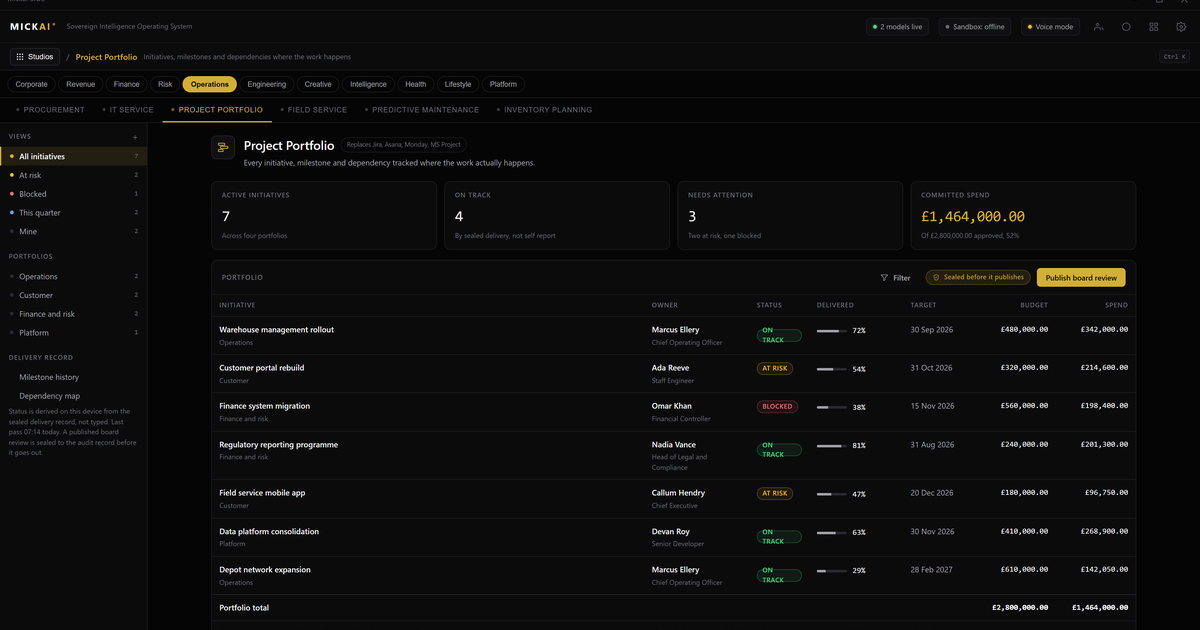
Project management should not be another tab you pay for on its own. On our sovereign operating system it is a studio that sits next to your email, meetings, CRM and files, so a project connects to the real work rather than sitting in a separate tool. You own it, it runs on your hardware, and the same assistant that reads your inbox can update your plan.
Most teams already run a project tool that knows nothing of the rest of the company. The plan lives in one place, the emails that move it live in another, the meeting where the decision was made lives in a third, and the client it is all for lives in a fourth. People spend their day copying between them. Our project management studio removes the copying, because the other systems are already on the same operating system.
Projects that connect to the work, not a separate island
A task in our project management studio can point at a real email thread, a real meeting, a real client record in the CRM and a real file, because all of those already live on the same operating system. Nothing is imported. Nothing is synced overnight and then drifts out of date.
That changes what a project view can show you. Open a piece of work and you see the last message from the client that relates to it, the meeting where scope was agreed, the document that was signed off and the deadline, together, from one source. When someone updates the plan, they are updating the same underlying data the rest of the company reads, not a private copy that has to be reconciled later.
This is the difference between a studio and a subscription. A subscription is a separate island with a paid bridge back to everything else. A studio is a room in a building you already own.
One assistant across every studio
We give a business one assistant that works across all of its studios, not a different bot per app. Because it can see your email, your meetings, your CRM and your project plan on the same operating system, it can do the joined-up work that project management actually needs.
It can turn a meeting into tasks with owners and dates. It can chase those owners over your own email when a date slips. It can update the plan when a client replies. It can tell you which projects have gone quiet because nothing has moved in the linked threads. None of that needs a marketplace of connectors, because there is nothing to connect. It is one operating system, and the assistant already has the context.
The cost case for owning instead of renting
Standalone project tools are sold per user per month, and the price rises as you add the paid tiers most teams end up needing. Take a published example. A common project management product lists a standard business tier at 10 US dollars per user per month when billed annually, as reported on its own public pricing page. For a 50 person team that is a worked figure of 50 users times 10 dollars times 12 months, which is 6,000 US dollars a year, for one tool.
That is the assumption stated plainly: 50 users, one published list price, twelve months. It is deliberately conservative, because it ignores the higher tiers, the add-ons and the seats that creep up over the year. Now set it beside the rest of the stack. The same team is very likely paying a separate per user per month subscription for email and office, another for meetings and chat, another for the CRM. Each of those is its own line, its own renewal, its own price rise.
Our position is different. These are studios on an operating system you run on hardware you own. The project management studio is not a separate rented product with its own per seat meter. We do not publish a MICKAI price, and we are not comparing one subscription to another. We are comparing renting many disconnected tools, forever, to owning one connected stack. The saving is not only the invoice. It is the time your people stop spending moving information between tools that were never meant to talk.
Sovereign by default, and provable
Private deployment where the vendor cannot see your data is our baseline, not our headline. The project management studio, like every studio, runs air-gapped by default on your own machines. Your plans, your client links and your commercial timelines do not leave the building.
On top of that baseline, every action is written to the Open Audit Record. Who created the task, who changed the date, who closed it, when, is recorded at the action level, not inferred from a change log. For a regulated firm that has to show how a decision was reached, a project history that is provable rather than merely visible is worth more than another feature.
This matters most for the firms the large vendors overlook. The regulated small and mid-sized business carries real compliance weight without a large IT department to stitch tools together. A connected, auditable stack that runs on its own hardware answers that need directly.
A studio, not a bolt-on
The platform spans 63 studios on one sovereign operating system, and project management is one of them. Clients onboard onto an initial focused set, usually the systems they touch every day, then bring more studios in as they need them. Because they all share the company's own data and the same assistant, adding project management does not mean adding another island. It means the work you already do gains a plan, and the plan gains the work.
That is the whole idea. Project management stops being a subscription you justify each renewal and becomes part of the software your company runs on, owned, connected and provable.
FAQ
How is a project management studio different from a standalone tool? It runs on the same operating system as your email, meetings, CRM and files, so a task can reference a real email, a real meeting and a real client record without integrations or exports.
Do we still pay per user per month? The studio is part of the operating system you run on hardware you own. We do not publish pricing, but the model is ownership of the stack rather than a per seat subscription per tool.
Can the assistant help run projects? Yes. One assistant works across every studio, so it can turn a meeting into tasks, chase owners over email and update the plan from your own data, not a third party's.
Where does our project data live? On your hardware, air-gapped by default. The vendor cannot see it. Every action is written to the Open Audit Record so you can prove who changed what.
How many studios are there? The platform spans 63 studios on one sovereign operating system. Clients onboard onto an initial focused set and add more as they need them.
Is this only for large enterprises? No. We focus on the regulated small and mid-sized firm that the heavyweight vendors leave behind, where a connected stack matters most and budgets are tight.
Frequently asked questions
How is a project management studio different from a standalone tool?
It runs on the same operating system as your email, meetings, CRM and files, so a task can reference a real email, a real meeting and a real client record without integrations or exports.
Do we still pay per user per month?
The studio is part of the operating system you run on hardware you own. We do not publish pricing, but the model is ownership of the stack rather than a per seat subscription per tool.
Can the assistant help run projects?
Yes. One assistant works across every studio, so it can turn a meeting into tasks, chase owners over email and update the plan from your own data, not a third party's.
Where does our project data live?
On your hardware, air-gapped by default. The vendor cannot see it. Every action is written to the Open Audit Record so you can prove who changed what.
How many studios are there?
The platform spans 63 studios on one sovereign operating system. Clients onboard onto an initial focused set and add more as they need them.
Is this only for large enterprises?
No. We focus on the regulated small and mid-sized firm that the heavyweight vendors leave behind, where a connected stack matters most and budgets are tight.