Procurement and supplier management you own
Run suppliers, purchase orders and approvals on hardware you own, wired to finance and inventory, with one assistant across all of it.
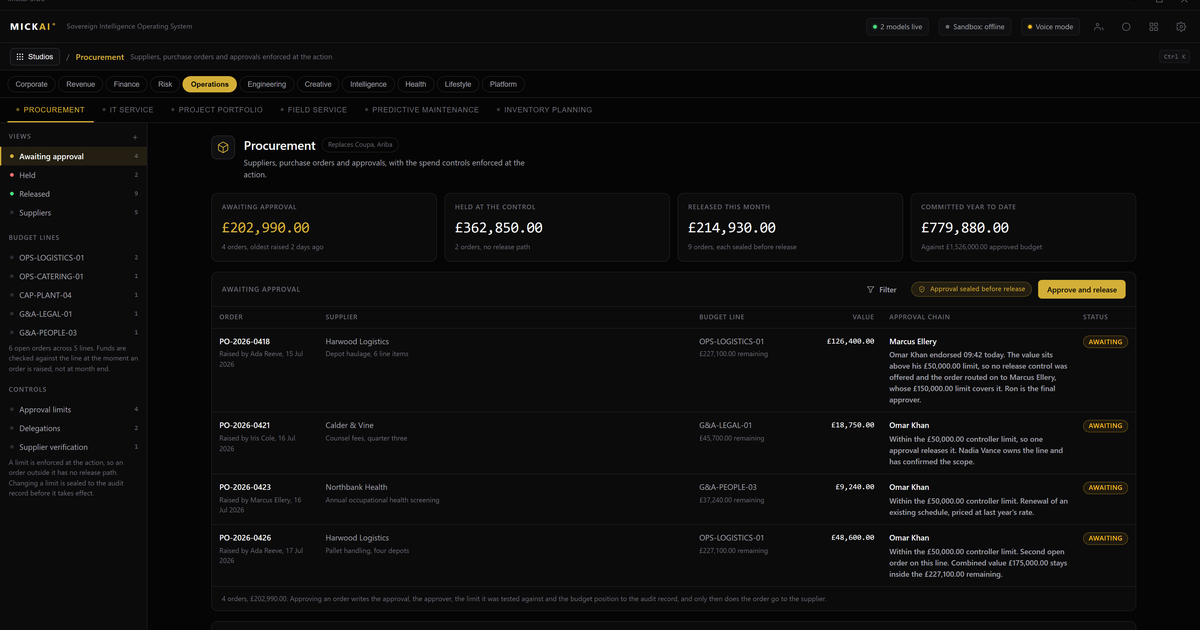
Procurement should live where your money and your stock already live. Our procurement studio puts suppliers, purchase orders and approvals on hardware you own, wired directly to finance and inventory, with one assistant reading across all of it. You buy the software once and run it on your own machines, instead of renting a spend platform per user per month.
The problem with rented procurement
Most procurement software is somebody else's cloud. Your supplier list, your prices, your payment terms and your approval history sit on a vendor's servers, priced per seat, and every year the seat count and the per-seat price both drift upward. The data that describes exactly who you buy from and what you pay is the most commercially sensitive record you keep, and it is the record you have the least control over.
The second problem is the seams. The procurement tool is one subscription, the finance system is another, the inventory system a third. A purchase order raised in one has to be exported, mapped and re-imported into the others, or held together by an integration that breaks quietly. Every seam is a place where numbers stop agreeing and where reconciliation work appears.
We remove both problems at once. The procurement studio is not a separate app you connect to your other apps. It is a studio on the MICKAI sovereign operating system, running on hardware you own, sharing one set of company data with the studios next to it.
What the procurement studio does
It runs the buy side end to end.
Suppliers. One record for each supplier: contacts, terms, tax details, lead times, price lists and the full history of what you have bought and what you have paid. No duplicate vendor records scattered across systems. The supplier you approve in procurement is the supplier finance pays.
Purchase orders. Raise a purchase order against a supplier and a price, send it, and track it from acknowledgement to receipt to invoice. Part deliveries, back orders and price variances are handled in the open rather than in a spreadsheet on someone's desktop.
Approvals. Spend routes to the right approver by value, category or budget line, with the limits and segregation of duties you set. Nobody approves their own request unless you decide they can. Every step is recorded.
Requests. Anyone who needs to buy raises a request against a budget. The studio checks it against existing stock, existing suppliers and existing spend before it becomes a commitment, so you stop paying twice for the same thing.
Connected to finance and inventory, not integrated with them
This is the part rented software cannot match. Because procurement, finance and inventory are studios on the same operating system, a purchase order is a single fact that all three see.
Raise a purchase order and finance sees a committed cost against a budget the moment it is approved, not at month end when someone keys it in. Inventory sees an expected receipt with a quantity and a date, so planning knows what is coming. When the goods arrive and are received against the order, the receipt updates stock, matches to the invoice and clears the commitment in one motion. Three-way matching between order, receipt and invoice happens because all three documents are already in the same place.
There is no export. There is no nightly sync. There is no integration to maintain and no window in which the three systems disagree. The numbers agree because there is one set of numbers.
The assistant across all of it
One assistant works across every studio on the operating system, and in procurement it earns its place.
Ask it to draft a purchase order from an approved request and it fills in the supplier, the agreed price and the delivery address. Ask which suppliers are running late and it reads the open orders and tells you, with the value at risk. Ask whether you are about to buy something you already hold and it checks inventory before you commit. It can flag when two departments are buying the same item from different suppliers at different prices, and it can draft the chase to a supplier who has missed a promised date.
It does this on your data, on your hardware. It reads across procurement, finance and inventory because it has permission to and because the data is all in one place. Nothing is sent to an outside service to be processed. The intelligence runs where the records run, and the records never leave the building.
What it costs to keep renting
The way to see the value is to price the incumbent honestly.
Take a procurement or spend-management platform charged per user per month. Suppose the published list price is fifty pounds per user per month, and you put fifty people on it across buying, finance and approvals. That is fifty users times fifty pounds times twelve months, which is thirty thousand pounds a year, every year, rising with both the seat count and the per-seat price. That is one platform. Add the finance system and the inventory system that it needs to talk to, each on its own per-seat subscription, and the annual figure multiplies.
We are not quoting your incumbent's exact price, because list prices move and yours may differ. The method is the point: users times the published per-user price times twelve, repeated for every platform, forever, is what renting the buy side costs. Owning the software on hardware you already run changes the shape of that number. We set our own pricing in a direct briefing rather than on a public page, because it depends on your scale and deployment. We do not put a MICKAI price on this page.
Owned, audited, air-gapped
Three things come from running procurement on your own operating system rather than someone else's cloud.
You own it. The supplier list, the prices, the terms and the approval history are on hardware you control. They are not a tenant on a shared platform and they are not leverage for a renewal conversation.
It is audited at the action level. Every approval, every change to a supplier record, every purchase order and every receipt is written to an Open Audit Record you hold. When a regulator or an auditor asks who approved a payment and on what basis, the answer is a query, not an archaeology project. This is action-level audit, not a login log.
It is air-gapped by default. The studio does not need an outbound connection to work. For a firm that treats its supplier terms and payment data as commercially sensitive, and most regulated small and mid-sized firms should, that default matters.
Beyond a private deployment
A private or single-tenant deployment of a cloud procurement tool is a reasonable baseline, and plenty of vendors now offer one. That is where we start, not where we finish.
You get the whole software stack, not a model or a service you have to integrate. The audit is at the level of individual actions, not sessions. It is air-gapped by default rather than as an expensive option. And it is built for the regulated small and mid-sized firm that has to prove control without the budget of a bank. Procurement is one of 63 studios on the same sovereign operating system, and the buy side is stronger for sitting next to finance, inventory and the assistant rather than bolted on from outside.
The record of who you buy from and what you pay is one of the most sensitive you keep. Keep it where you can see it, on hardware you own, wired to the money and the stock, with one assistant across all of it.
FAQ
Does the procurement studio need the internet? No. It runs on the sovereign operating system on your own hardware and is air-gapped by default. Suppliers, purchase orders and approvals stay inside your building whether or not there is a connection to the outside world.
How does it connect to finance and inventory? They are studios on the same operating system, sharing one set of company data. A raised purchase order becomes a commitment in finance and an expected receipt in inventory without an export, an integration or a sync job.
Do we still control approvals? Yes. Approval routes, spend limits and segregation of duties are yours to set. Every decision is written to an action-level Open Audit Record you hold, so an auditor can trace who approved what and when.
What does the assistant do here? It reads across procurement, finance and inventory to draft purchase orders, flag duplicate spend, chase late suppliers and answer questions in plain language. It works on your data on your hardware and does not send it anywhere.
How is this different from a private deployment of a SaaS procurement tool? Private hosting is our baseline, not our finish line. You own the whole software stack rather than a model to integrate, the audit is at the action level, it is air-gapped by default, and it is built for the regulated small and mid-sized firm.
What does it cost? We set pricing in a direct briefing rather than a public list, because it depends on scale and deployment. The saving comes from owning the software on hardware you already run, instead of paying per user per month, forever.
Frequently asked questions
Does the procurement studio need the internet?
No. It runs on the sovereign operating system on your own hardware and is air-gapped by default. Suppliers, purchase orders and approvals stay inside your building whether or not there is a connection to the outside world.
How does it connect to finance and inventory?
They are studios on the same operating system, sharing one set of company data. A raised purchase order becomes a commitment in finance and an expected receipt in inventory without an export, an integration or a sync job.
Do we still control approvals?
Yes. Approval routes, spend limits and segregation of duties are yours to set. Every decision is written to an action-level Open Audit Record you hold, so an auditor can trace who approved what and when.
What does the assistant do here?
It reads across procurement, finance and inventory to draft purchase orders, flag duplicate spend, chase late suppliers and answer questions in plain language. It works on your data on your hardware and does not send it anywhere.
How is this different from a private deployment of a SaaS procurement tool?
Private hosting is our baseline, not our finish line. You own the whole software stack rather than a model to integrate, the audit is at the action level, it is air-gapped by default, and it is built for the regulated small and mid-sized firm.
What does it cost?
We set pricing in a direct briefing rather than a public list, because it depends on scale and deployment. The saving comes from owning the software on hardware you already run, instead of paying per user per month, forever.