


Part 145 record keeping: from asserted compliance to provable
Repair stations become provably compliant when every maintenance record is sealed, signed and verifiable offline at the moment the work happens.
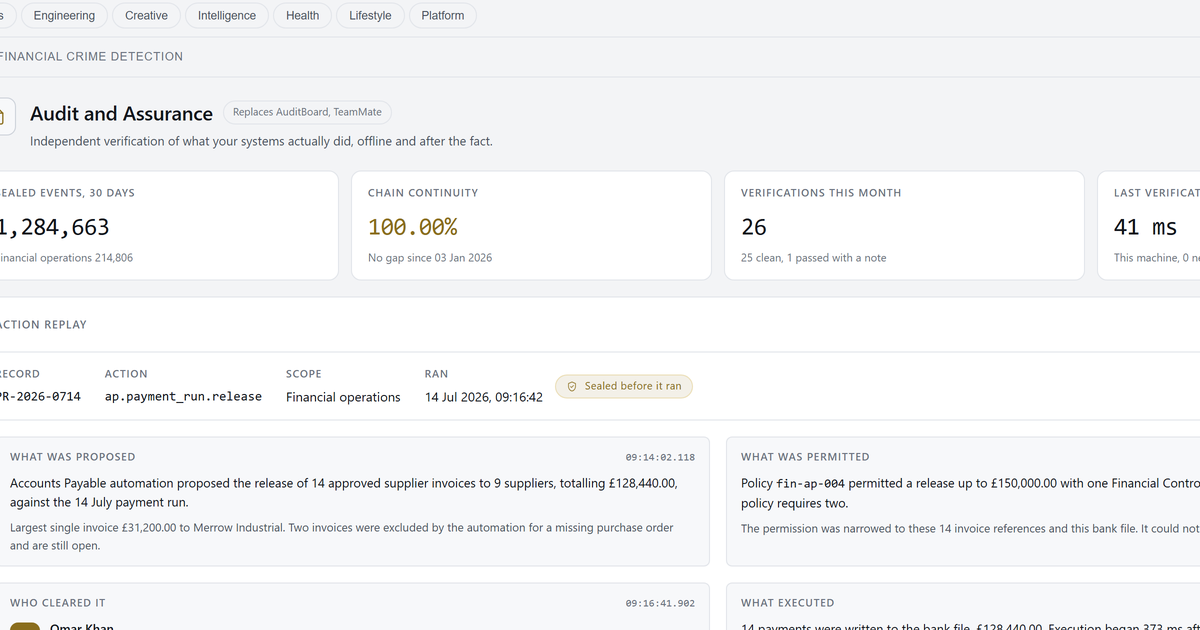
A Part 145 repair station moves from asserted compliance to provable compliance when every record of work is created, cross referenced and sealed at the moment the work happens, in a form an inspector can verify independently years later. 14 CFR 145.219 requires certificated repair stations to keep records demonstrating compliance, to retain them for at least two years, and to make them available to the Federal Aviation Administration and the National Transportation Safety Board. The regulation does not ask an organisation to say that it complied. It asks it to show it, on demand.
Most repair stations satisfy the letter of that rule with task cards, release certificates, scanned signatures and shared drives. That is a filing system. What an inspector, an insurer or an accident investigator eventually wants is evidence, and the gap between the two only becomes visible under pressure.
What does 14 CFR 145.219 actually require of a repair station?
It requires records that demonstrate compliance, retained for at least two years from the date the article was approved for return to service, and made available to the FAA and the NTSB. Demonstrating compliance means the record has to stand on its own. It has to show what work was performed, against what data, by whom, and that the article was properly approved for return to service. A record that exists but cannot be trusted, because it could have been edited, backdated or replaced without trace, demonstrates very little. Two years is also a minimum, and questions from investigators, lessors and buyers routinely arrive far later than that.
Why is a filing system not the same thing as evidence?
Because a conventional record can be altered after the event, and there is usually no way to prove that it was not. Paper gets re-signed, files get regenerated, and modification dates mean nothing under scrutiny. Asked whether a record has changed since the day of the work, the honest answer is usually that the organisation believes it has not. Belief is not demonstration. Evidence grade record keeping requires the integrity of the record to be a property of the record itself, checkable by an outside party without taking the organisation's word for anything.
How does sealing a record before the action change the position?
Sealing first means the record of what is about to happen is written, signed and locked before the action runs, so the record can never be a tidied up reconstruction. This is how our Open Audit Record works inside Mickai. Every review, every disposition and every consequential action is sealed into a cryptographically signed, tamper evident record before it executes, and consequential actions then wait for a person's clearance. The signatures are post quantum, and the record verifies offline, which matters in a hangar, a records room or a hearing with no internet connection. If anyone alters the record afterwards, the alteration is visible.
““ A record you can only vouch for is an assertion. A record that proves its own integrity, offline, years after the work, is evidence. The two look identical in a filing cabinet and behave very differently in front of an investigator. ” Mickai”
Can a repair station use AI on maintenance records without sending them to the cloud?
Yes, if the system runs entirely on the repair station's own hardware, on premise and air gapped, so that no record, prompt or output ever leaves the building. That is the shape of our document review capability. The platform reads work packages, cross references release certificates against the records behind them, drafts routine compliance paperwork for review, and holds anything anomalous for a person instead of passing it through. The engineer keeps disposition and sign off on every item, and nothing is released on the machine's judgement alone. Applied to the Part 145 record keeping obligation, the working pattern looks like this.
- Every incoming work package is read in full, and each release certificate is cross referenced against the records behind it
- Gaps, undated entries and broken traces are surfaced while the work is current, not two years later under inspection
- Routine compliance paperwork is drafted for the certifying engineer to review, correct and sign
- Anomalies are held for a person, and consequential actions wait for explicit clearance
- Every review and every disposition is sealed into the Open Audit Record before it runs, signed and verifiable offline
What changes when the FAA or NTSB actually asks for records?
The request becomes a query rather than a project. Because every action was sealed as it happened, the records demonstrating compliance already exist in final, verifiable form, and producing them is a matter of retrieval rather than reconstruction. An inspector can verify the record independently, offline, without trusting the repair station's systems. The two year retention requirement of 145.219 becomes the floor rather than the finish line, because a sealed record costs nothing extra to keep for ten. And when the question comes from an accident investigator rather than a routine audit, the organisation answers from evidence rather than from memory.
We expect evidence grade record keeping to become the norm across aviation maintenance, not because regulators rewrite the rules but because the parties downstream of every release, lessors, buyers, insurers and investigators, keep raising the standard of proof they will accept. Repair stations that can demonstrate compliance cryptographically will find audits shorter, disputes rarer and their releases worth more. We built Mickai so that an organisation can reach that position on hardware it owns, under a hardware held root of trust it controls, without asking anyone's permission to prove its own work.
Frequently asked questions
What records must a Part 145 repair station keep?
Under 14 CFR 145.219, a certificated repair station must keep records that demonstrate compliance for the work it performs and approves for return to service, retain them for at least two years, and make them available to the FAA and the NTSB on request.
How long must Part 145 maintenance records be retained?
At least two years from the date the article was approved for return to service. In practice most organisations keep records far longer, because lessors, buyers and investigators ask questions on much longer horizons and a missing record is treated as a missing history.
Does AI review change who is responsible for a maintenance release?
No. The certificated repair station and its certifying staff remain responsible. In our architecture the platform performs the first pass reading, cross referencing and drafting, holds anomalies, and seals every action, while the engineer keeps disposition and sign off on every release.
What makes an audit record tamper evident?
The record is cryptographically signed and sealed before the action it describes runs, so it cannot be a reconstruction, and any later alteration breaks the signature and becomes immediately visible. Our Open Audit Record uses post quantum signatures and verifies offline, so an inspector can check integrity without trusting the organisation's systems or needing a connection.
Can this run in a hangar with no internet connection?
Yes. Mickai runs on the customer's own hardware, on premise and air gapped by design. Review, drafting, sealing and verification all work fully offline, which is precisely the environment aircraft maintenance records live in.
What is MICKAI?
MICKAI is a Sovereign Intelligence Operating System (a SIOS) that runs entirely on the customer's own hardware, on premise and air gapped. It coordinates a cooperative multi model consensus substrate, gates consequential actions behind human clearance, and seals every action into the Open Audit Record, a cryptographically signed, post quantum, tamper evident record that is verifiable offline. It comprises 63 studios, with fourteen production ready at launch and 49 in development, and is protected by 104 filed UK patent applications across 2,340 claims, filed rather than granted.