


Borrowing the Oldest Ledger: How Pantheon Anchors AI Records to Bitcoin
How OpenTimestamps anchoring of the Open Audit Record root turns the oldest chain into the immutability backstop for the newest evidence.
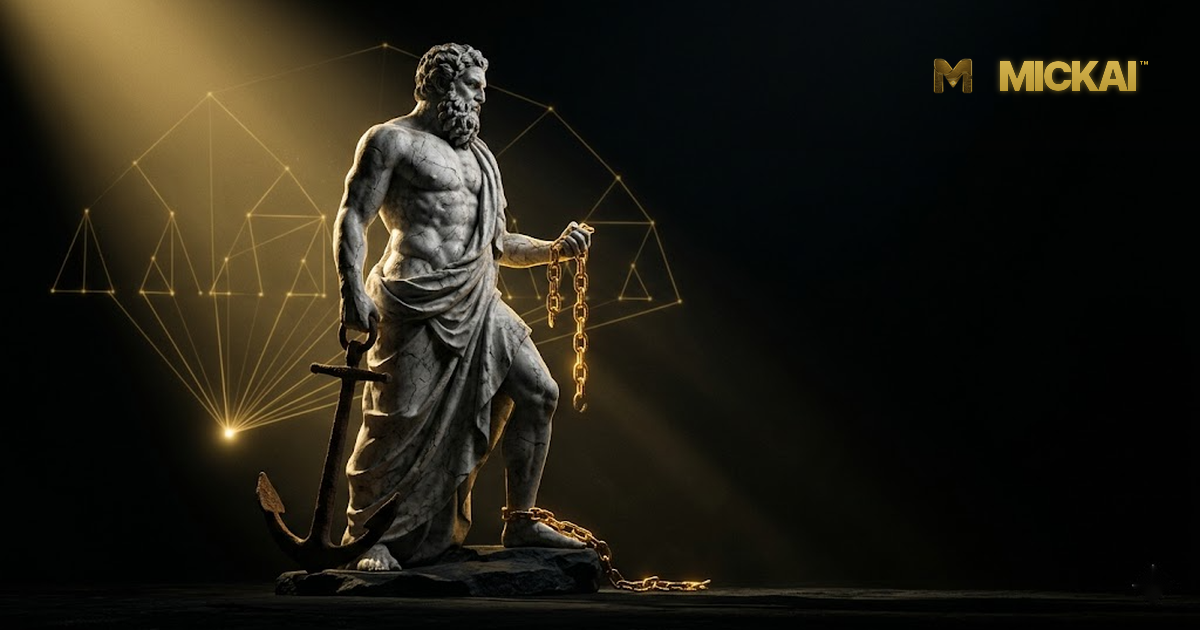
The Witness That Cannot Be Bought
Suppose a regulator, ten years from now, asks Pantheon to prove that a particular artificial-intelligence action settled on a particular day, under a particular authority, with a particular chain of reasoning behind it. Suppose the institution that built Pantheon no longer exists, the servers are gone, the staff have scattered. What remains? A hash, a few hundred bytes, embedded in a Bitcoin block mined years earlier and replicated across tens of thousands of independent machines that no one controls. That fragment cannot be edited, backdated, or quietly revised, because doing so would require rewriting the most expensive computational history on Earth. Pantheon does not ask anyone to trust its own records. It borrows the oldest, most stubborn ledger in existence to witness them.
This is the quiet idea at the centre of Pantheon's anchoring design, and it is easy to underrate. Pantheon is a sovereign Layer 1 blockchain built on the Mickai Sovereign Intelligence Operating System (SIOS). Its defining property is that every settled action carries an Open Audit Record (OAR) seal, signed under ML-DSA-65 (the post-quantum digital-signature standard published as Federal Information Processing Standard 204, FIPS 204) before it reaches consensus. A chain, though, can attest to its own history only as far as its own validators stay honest and its own keys stay uncompromised. To reach beyond that boundary, Pantheon periodically commits a single fingerprint of all its sealed records to Bitcoin, the one chain that has never required Pantheon's permission to keep existing.
How a Whole Day Fits Into One Hash
The mechanism is a Merkle tree, the same structure that underpins Bitcoin's own blocks. Every OAR seal that Pantheon writes is a leaf. Those leaves are hashed in pairs, the pairs hashed together, and so on up the tree until a single value remains at the top: the OAR root. That root is a cryptographic summary of every sealed action beneath it. Change one byte in one seal anywhere in the tree, and the root changes completely. This is what lets Pantheon make an enormous claim with a tiny artefact. Whether the chain sealed ten thousand actions in a period or ten million, the commitment that travels to Bitcoin is the same fixed size: one root.
Pantheon anchors that root to Bitcoin using OpenTimestamps, a free and open public timestamping protocol. OpenTimestamps does not write a fresh Bitcoin transaction for every document it stamps. It aggregates many independent commitments from across the world into its own Merkle tree, and only the top of that aggregate tree is written into a Bitcoin transaction. The result is a proof that the OAR root existed no later than the moment that Bitcoin block was mined. To verify it, a holder needs nothing from Pantheon: only the OpenTimestamps proof, the OAR root, and a view of the Bitcoin blockchain. The proof walks from the root, up through the aggregation tree, into the block, and the block's own proof of work does the rest.
The economy of this is the point. One Bitcoin confirmation can witness an entire epoch of Pantheon activity, because the cost of anchoring is amortised across every seal in the tree and, through OpenTimestamps, across every other party stamping at the same time. The marginal cost to Pantheon of proving that a given action existed by a given block approaches zero.
Free at the Protocol Level, Priceless at the Evidence Level
It is worth being precise about cost, because the word free is usually a warning sign. Pantheon pays nothing at the protocol level for this guarantee. OpenTimestamps is a public good: its calendar servers absorb the negligible Bitcoin fees of the periodic aggregate transactions, and the protocol asks for no token, no licence, and no relationship. Pantheon does not fork Bitcoin, does not depend on Bitcoin for execution, and does not pay Bitcoin miners directly. Bitcoin is used strictly as an external witness, never as a settlement layer or a dependency. Pantheon's own consensus, the audited machinery of the Polkadot SDK (Substrate) running BABE/Aura block production and GRANDPA finality, continues to order and finalise transactions without ever waiting on a Bitcoin confirmation.
What that near-zero cost buys is disproportionate. It converts a claim that currently rests on Pantheon's institutional survival into a claim that rests on the continued existence of the most defended ledger humanity has built. An internal audit log, however well signed, asks a verifier to assume the signer was honest and the storage untampered. A Bitcoin anchor removes that assumption for the dimension that matters most in disputes: time. No one, including Pantheon itself, can plausibly claim a record was sealed earlier than it was, or insert a record after the fact and pretend it was always there. The anchor fixes ordering against the one clock that cannot be wound back.
Why the Oldest Chain Backstops the Newest Evidence
There is a deliberate asymmetry in pairing the two systems. Pantheon is the newest kind of ledger, designed to record what artificial-intelligence systems did and under whose authority, sealed against an adversary holding a future quantum computer. Bitcoin is the oldest live chain, designed to do one narrow thing and to do it without trusting anyone. By committing to Bitcoin, Pantheon inherits a property it could never manufacture on its own timeline: a decade and a half of accumulated, distributed, irreversible proof of work, replicated across an adversarial global network with no central operator. Immutability of that depth cannot be bought or coded into a young chain. It can only be borrowed, and OpenTimestamps is the lending mechanism.
This matters because the OAR is built to outlive the systems that wrote it. Mickai runs fifty specialised brains under sealed governance, twenty-five domain and twenty-five operational, and each sealed action is meant to be verifiable offline, forever, by anyone holding the operator public key. Forever is a demanding word. It implies a verifier in a future where the original hardware is dust and the original institution may be a footnote. The Bitcoin anchor is the part of the design that takes forever seriously. It places the immutability backstop outside Pantheon's own control surface, so that the integrity of an AI decision record does not depend on the integrity, or even the existence, of the institution that produced it.
“A chain can prove its own honesty only to the edge of its own trust boundary. Anchoring to Bitcoin extends that boundary to the one ledger no operator can rewrite, including the operator who built the anchor.”
Two Layers of Proof, One Continuous Chain of Custody
It helps to see the full path a single action travels, because the Bitcoin anchor is the last link in a chain of custody that begins inside the SIOS, not a bolt-on at the end. The sequence is what makes the guarantee end to end.
- An action is taken by a Mickai subsystem and sealed into the OAR, signed under ML-DSA-65 (FIPS 204) before it is ordered. This is seal-before-own-consensus: the post-quantum signature exists before the network agrees on sequence.
- The seal becomes a first-class object of Pantheon's consensus through the native runtime module pallet-oar, not a contract storage entry. The chain validates the operator-sealed record as part of ordering it.
- Across an epoch, every seal feeds the Merkle tree whose summit is the OAR root, a single value standing in for the entire period's history.
- That root is submitted to OpenTimestamps and, via the protocol's aggregation, committed into a Bitcoin block, where proof of work makes its timestamp practically irreversible.
- Any holder verifies the whole path offline: the ML-DSA-65 signature on the seal, the seal's place in the Merkle tree, and the tree's anchor in Bitcoin, with no online service required at any step.
Each layer answers a different question. The post-quantum signature answers who authorised this and whether it was tampered with. The native OAR pallet answers whether this was validated as part of consensus rather than smuggled into contract storage afterward. The Bitcoin anchor answers the question that neither signature nor consensus can settle from inside the system: did this genuinely exist by this time, provably, to someone who trusts nothing about Pantheon at all. Together they form a continuous custody record from the moment of action to a public, permanent witness.
The Difference From Everyone Else Anchoring to Something
Anchoring is not unique to Pantheon, and honesty about the landscape sharpens the distinction. A number of projects working on verifiable artificial intelligence, including well-funded peers such as EQTY Lab, root their trust somewhere external. The common patterns are to rely on vendor silicon (hardware trusted execution environments such as Intel TDX or NVIDIA enclaves), to sign with classical cryptography, and to anchor to a permissioned ledger such as Hedera or to a project's own chain. Each of those choices is defensible, and EQTY Lab in particular is a serious peer whose work deserves respect.
Pantheon's combination is what differs. It seals in software on commodity hardware, so the root of trust is not a chip from a single vendor. It signs under a post-quantum standard, FIPS 204 ML-DSA-65, implemented and offline-verifiable, rather than classical signatures that a future quantum computer could forge. It runs its own consensus over operator-sealed records, rather than treating attestation as application data on someone else's chain. And for the external witness it reaches not to a permissioned ledger run by a consortium, but to Bitcoin, a public chain with no operator to subpoena, persuade, or compromise. The witness is chosen precisely because no one, Pantheon included, can lean on it.
What This Means When the Builder Is Gone
Pantheon today is designed and filed, not finished. The bridge and anchoring mechanisms are covered by filed UK patent applications within the Pantheon family, part of a portfolio of 104 filed UK patent applications, 2,340 claims, owned by Mickai LTD, named inventor Micky Irons. The Ethereum Virtual Machine (EVM) contracts are built and smoke-tested on a local testnet, the Substrate Layer 1 is in build, and mainnet is gated by an independent security audit and legal clearance rather than by code, with a token generation event (TGE) targeted for the first quarter of 2027. The architecture described here is the design as drawn and protected, stated in the forward voice it deserves.
The deeper claim survives that caveat, because it is architectural rather than promotional. Most systems ask you to trust the institution behind them. Pantheon is built so that the most important property of its records, that they existed when they say they did and have not been altered since, is guaranteed by a ledger the institution does not own and cannot rewrite. The newest evidence in the world, sealed against the cryptography of a future that has not yet arrived, is backstopped by the oldest and most stubborn proof of work ever assembled. When the servers are gone and the question is finally asked, the answer will already be sitting in a Bitcoin block, waiting, witnessed by everyone and owned by no one.