


PAN Is Utility for a Machine Economy, Not a Speculative Token
Five billion fixed, secured by revenue buybacks instead of inflation, and required to settle every action in a sixteen-chain machine economy: the PAN token thesis.
The coin that cannot be inflated away
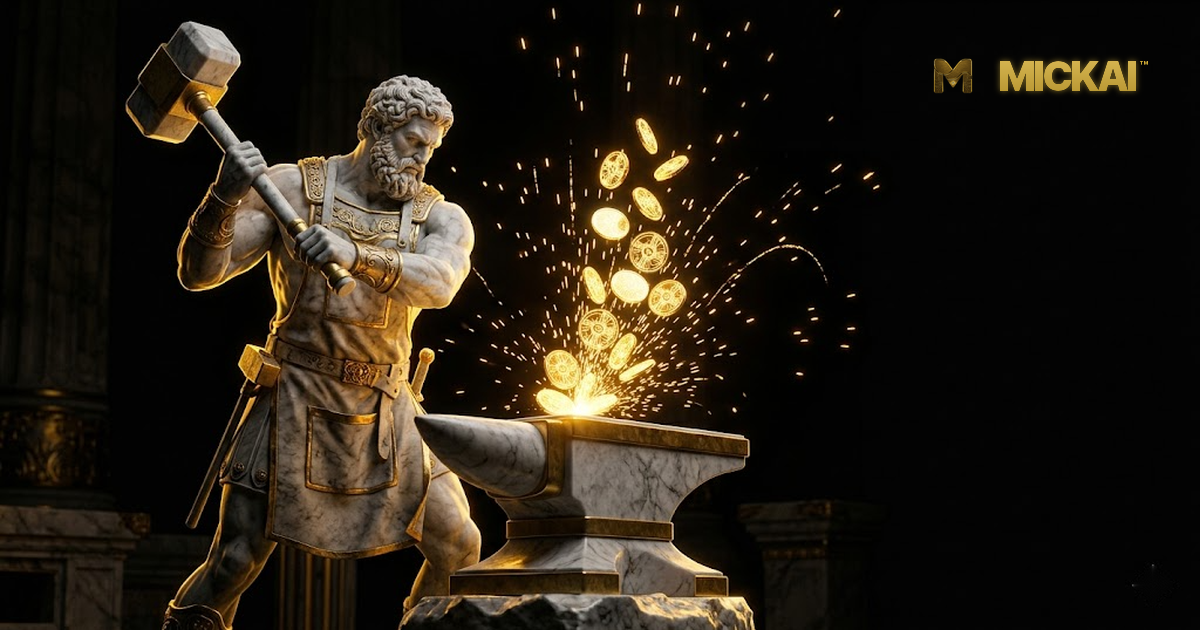
Picture a forge in the dark. Hephaestus does not strike new metal from nothing; he reshapes what already exists, every coin accounted for, every blow recorded. Most blockchain economies were built the opposite way. A mint authority conjures fresh tokens to pay the people who secure the network, and those people sell what they are paid. The reward is real, the dilution is real, and the chart bleeds down while the protocol calls it security spending. PAN, the native asset of Pantheon, is designed against that pattern from genesis. The supply is fixed at five billion. There is no mint authority. There is no inflation. What secures the network is not freshly printed tokens but a share of the revenue the network actually earns, used to buy PAN back from the open market. That is the whole thesis in one line, and the rest of this piece is what it means in practice.
Pantheon is a sovereign Layer 1 (L1) blockchain built on Mickai, a Sovereign Intelligence Operating System (SIOS), with one defining property: its attestation layer is post-quantum from genesis. Every settled action carries a seal from the Open Audit Record (OAR), signed under ML-DSA-65 (FIPS 204, the United States National Institute of Standards and Technology, or NIST, post-quantum digital-signature standard) before it reaches consensus, verifiable offline by anyone holding the operator public key. PAN is the asset that prices, secures, and governs that machinery. It is utility for a machine economy, not a governance meme, and the difference shows up in the supply schedule, the rewards engine, and the sinks.
Five billion, fixed, with no hand on the lever
The first design decision is the one most easily skipped over. PAN has a fixed supply of five billion (5,000,000,000) units. There is no inflation, no emission curve, and no mint authority encoded in the runtime. This is not a marketing line about scarcity; it is a structural constraint on what the protocol can ever do to its own holders. A chain that retains the power to mint retains the power to dilute, and any promise of restraint is only a promise. Pantheon removes the power rather than promising not to use it. The number that exists at the token generation event (TGE), targeted for the first quarter of 2027, is the number that exists thereafter, minus whatever the burn destroys.
That single supply also spans every venue where the market actually trades. PAN is native to the Pantheon L1, and it also exists as an omnichain token of the Ethereum Virtual Machine (EVM) class, using a LayerZero lock-and-mint bridge (an omnichain fungible token, or OFT, design) on Ethereum, BNB Chain, Base, and Arbitrum. Tokens are locked on one side and minted as a representation on the other, so the global supply never exceeds five billion regardless of how many chains list it. Sovereignty lives where the moat is, on Pantheon's own consensus. Liquidity lives where the market is, on the venues traders already use. One fixed quantity, many surfaces, no quiet inflation hiding in a bridge.
The rewards engine: buybacks, not emissions
Here is where Pantheon departs hardest from convention. Most proof-of-stake (PoS) chains pay validators in newly minted tokens. That funding is invisible inflation: the staker earns a yield denominated in a currency the protocol is simultaneously debasing. Pantheon funds yield from the other direction. A governed share of protocol revenue is used to buy PAN on the open market, and that purchased PAN is then split. The split is indicative and tunable by governance, but the design target is roughly forty per cent to staker and validator yield, thirty per cent to permanent burn, and thirty per cent to a governance-controlled lock.
Read that split carefully, because each leg does distinct work. The forty per cent pays the people who secure the chain, but it pays them in PAN bought at market price, which means the reward is backed by demand rather than created from supply. The thirty per cent burn permanently removes tokens from existence, so genuine network usage makes PAN scarcer over time. The thirty per cent lock places tokens under governance control, building a treasury that holders direct rather than a foundation spends. No leg of that engine prints anything. The yield a staker receives is, in effect, a redistribution of revenue the network earned, not a tax on every other holder.
A base-fee burn sits underneath all of this, in the manner of the Ethereum fee-market reform commonly called Ethereum Improvement Proposal 1559 (EIP-1559). A portion of every transaction fee is destroyed at the moment of settlement. So there are two deflationary forces, not one: the buyback burn funded by protocol revenue, and the base-fee burn funded by raw network throughput. The more the chain is used, the more PAN disappears. And because every buyback, every burn, and every lock is itself sealed into the OAR and verifiable on-chain, none of this is a claim a marketing team makes in a blog post. It is an auditable fact a sceptic can check with the public key alone.
Sixteen places the token is mandatory
A token survives not on narrative but on whether the system genuinely needs it. Pantheon's demand does not depend on speculators choosing to hold; it is wired into how the network operates. The base layer settles the sealed actions of fifteen application chains, each mapped to a live Mickai subsystem, and the L1 itself is the sixteenth venue. Every one of them settles its fees in PAN.
- Trading and decentralised finance (DeFi) settlement
- Trust Agent audit settlement
- Knowledge and retrieval-augmented generation (RAG) settlement
- PENELOPE open-source intelligence (OSINT) settlement
- VIGIL and Sky observation settlement
- Civilisation and Survival settlement
- Vinis assistant settlement
- Marketplace settlement
- Governance settlement
- Health (HYGEIA) settlement
- Legal (THEMIS) settlement
- Compliance settlement
- Identity settlement
- Autonomous Marketing Team (AMT) settlement
- Hardware (HELIOS) settlement
- Pantheon base-layer settlement and staking
This is the part that makes PAN utility rather than a governance token wearing a utility costume. Each subsystem that runs produces sealed actions, and each sealed action must settle to the base layer, and each settlement is denominated in PAN. The demand for the token is therefore a function of how much real machine activity the network carries, not how many people are speculating on it in a given week. The more the subsystems run, the more settlement flows to the base layer, the more fees are paid and partly burned, and the more revenue feeds the buyback engine. Usage and token demand are the same curve.
What the token actually does
Stripped to function, PAN carries four loads. It is the settlement asset: every application chain pays its fees to the base layer in PAN, which is the demand floor described above. It is the staking asset: validators bond PAN to secure consensus, and the bond is what they stand to lose for misbehaving, which is what makes the security economic rather than merely procedural. It is the governance asset: holders vote on parameters, on the treasury, and on the buyback policy itself, including that forty-thirty-thirty split, which is a parameter rather than a promise. And it is the value-accrual asset: the burn and the buyback concentrate the benefit of network usage into the fixed supply that holders already own.
Governance is two-keyed, and that shape matters to anyone holding the token. PAN-holder on-chain referenda decide direction, and beneath them sits a sealed execution-safety layer inherited from the SIOS, which requires a quorum of independent sovereign models to return ALLOW before a gated action executes. Every vote is sealed to the OAR. Every reversal is an append-only compensation that never deletes history. Alongside that, the OAR compliance mapper produces signed evidence against the European Union Artificial Intelligence Act (EU AI Act), the NIST Artificial Intelligence Risk Management Framework, and the International Organization for Standardization 42001 (ISO 42001) standard, so the chain's own regulatory posture is continuously auditable rather than asserted.
Validators enter through three open tiers, and the openness matters to the token thesis because a gated validator set would concentrate rewards and undermine the claim that yield is broadly earned. Software validators download a single node binary, run it on commodity hardware, and stake PAN. Delegators nominate validators through nominated proof of stake (NPoS), running no infrastructure and sharing in rewards. Mickai hardware appliances, premium plug-in validators from the Mickai hardware lineup shipping twelve months after funding, are a path and never a gate. The set stays open to anyone with the binary and the stake, with a target active set of fifty to one hundred and fifty validators, so the chain is credibly decentralised and the yield is credibly distributed.
“Sovereignty where the moat is, liquidity where the market is, and one fixed supply across both. Usage shrinks the float; revenue, not inflation, pays the guard.”
Designed against the dump
Put the pieces in one frame and the intent is unambiguous. The supply cannot grow, so there is no dilution. The validators are paid from revenue buybacks, so there is no structural sell pressure from freshly minted rewards hitting the market every block. Two burn mechanisms, the base-fee burn and the buyback burn, mean that usage actively reduces the float. Sixteen mandatory settlement sinks mean demand is a function of machine activity rather than sentiment. And governance, rather than a foundation, holds the lever on the treasury and the split. This is what it looks like to design a token against the dump instead of around it. The raise that funds the build reflects the same discipline: thirty million pounds (Ladder B), roughly twenty-four per cent of supply, offered through Simple Agreement for Future Tokens (SAFT) instruments to professional investors only, with European marketing via the Markets in Crypto-Assets (MiCA) utility-token notification route and no United Kingdom retail promotion. Pantheon issues no stablecoin; PAN is a single utility and governance asset.
None of this is a claim about price, and it is deliberately not investment advice; the buyback split and the burn rates are design targets a governing body of holders can tune. What can be stated plainly is the architecture. Public blockchains record that a transaction happened but cannot attest to what produced it. Artificial-intelligence systems act but cannot prove, after the fact and offline, what they did and under whose authority. Pantheon settles the second class of fact under post-quantum signatures, on its own consensus, and prices the whole machine in a single fixed-supply asset. The bridge mechanisms that carry PAN across venues are covered by filed United Kingdom patent applications within a wider portfolio of 104 filed UK patent applications, 2,340 claims, owned by Mickai LTD, named inventor Micky Irons. The chain is designed, the EVM contracts are built and smoke-tested on a local testnet, and the Substrate L1 is in build. Mainnet is gated by an independent security audit and legal clearance, not by code, with the token generation event targeted for the first quarter of 2027. The forge is lit. What comes out of it is accounted for, to the last coin.