Order management and fulfilment you own
One record from quote to cash. Our orders studio runs order to fulfilment on hardware you own, wired to CRM, inventory and finance.
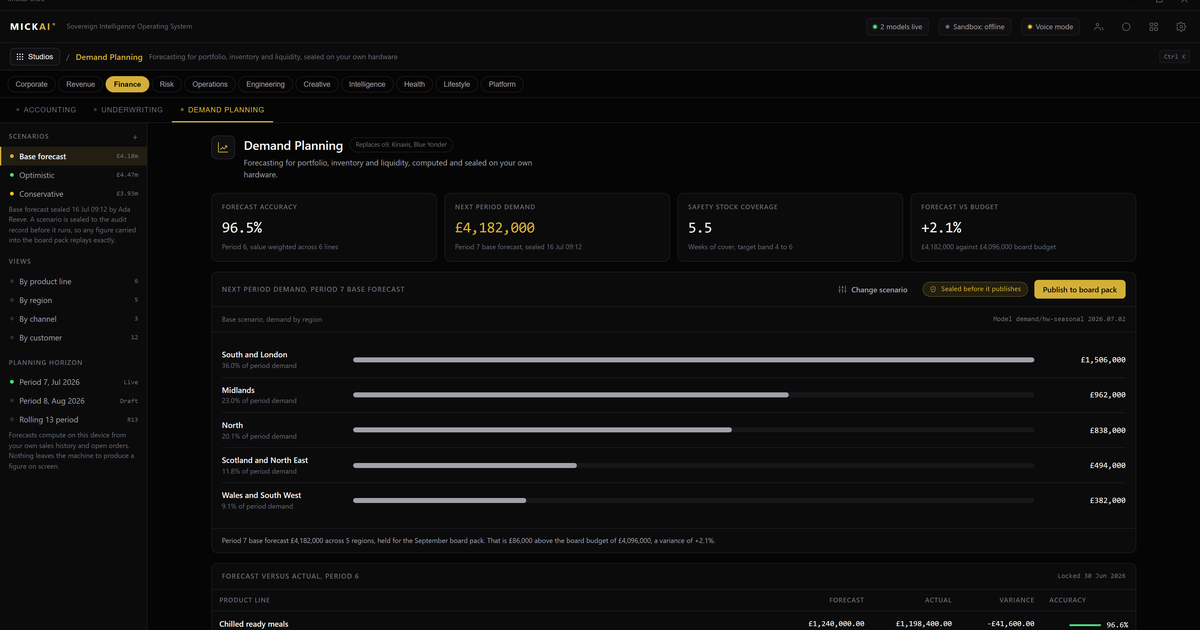
Order management should be one record that runs from the quote a salesperson sends to the cash that lands in the ledger. Our orders studio does exactly that, on hardware you own, wired directly to your CRM, inventory and finance. No rekeying, no export files, no waiting for two systems to agree.
Most firms run orders across four or five tools that were never built to talk to each other. The quote lives in one place, the order in another, stock in a third, the invoice in a fourth, and someone spends their week copying numbers between them. We removed the copying. There is one order record, and every part of the business looks at the same one.
One record, from quote to cash
A quote is the start of the record, not a separate document that dies once it is accepted. When the customer says yes, the same record becomes an order. It reserves stock in the inventory studio, it schedules a despatch, it draws stock down when the goods leave, and it posts an invoice to finance. Throughout, it keeps the same identifier.
That matters because the three questions that cause most order disputes all have one answer. What did we quote. What did we ship. What did we bill. When those are three systems, the answers drift, and someone reconciles the difference by hand at month end. When they are one record, they cannot drift. Finance is looking at the order the warehouse picked and the salesperson quoted.
Wired to CRM, inventory and finance by default
The orders studio is not a standalone application that we later bolt onto your other systems. It is a studio on the sovereign operating system, and it shares the company's own data with the CRM, inventory and finance studios directly.
When you raise an order, the customer is the same customer the CRM holds, with the same credit terms and the same contacts. The stock you commit is the same stock the inventory studio is counting, so you cannot promise what you do not have. The invoice you raise is the same figure the finance studio posts, against the same nominal codes. There is no nightly sync, no integration middleware to maintain, and no window where two systems disagree because one has updated and the other has not.
This is the practical difference between studios on one operating system and separate apps joined by connectors. Connectors move copies of data between systems and hope they stay aligned. Studios read and write the same data. There is nothing to keep in step because there is only one version.
What the orders studio does
The studio covers the working parts of order management that a growing firm actually needs, rather than a long feature list nobody uses.
- Quotes and order capture, with pricing, discounts and terms pulled from the customer record.
- Stock commitment and back-order handling against live inventory, so promised dates mean something.
- Picking, packing and despatch, with notes and labels produced from the order itself.
- Part shipments, returns and credits, each written against the original order so the history stays whole.
- Invoicing straight into the finance ledger, with the tax and nominal treatment already set.
- Credit control holds and releases, visible to sales and finance at the same time.
Every one of those actions happens against the single order record, and every one is recorded.
The money you stop renting
Order management, CRM and finance are usually rented per user per month, from several vendors at once. Those subscriptions are a standing cost that rises with headcount and with each annual increase, and you own none of it at the end.
We will not quote a false figure for any incumbent, because published prices change and vary by plan and region. Use the method instead. Take the list price the vendor publishes, per user per month. Multiply by the number of people who need a seat. Multiply by twelve. That is one year for one system. Add the CRM subscription, the finance subscription and the order tool subscription, then add the integration cost that keeps them talking, and you have the annual bill for renting a stack that still leaves your data in other companies' clouds.
A worked example, using the method rather than a claimed price. If an order and CRM stack is listed at a given price per user per month, a forty person firm pays that price times forty times twelve, every year, for one layer. Put the vendor's own current list price into that calculation and the number is usually larger than people expect, because the per user figure is small and the multiplication is not.
Owning the studios changes the shape of that cost. You run them on hardware you own, and the operating system is one stack rather than a shelf of separate subscriptions. We do not publish our pricing here, and we would rather show you the sum against your own headcount than print a figure that means nothing without your numbers.
Air-gapped by default, audited at the action level
Order data is commercial data. It shows who your customers are, what they pay, what you buy and what your margins look like. On a rented cloud stack, that sits in several third-party systems by default, and you spend effort keeping it private.
Our position is the other way round. The operating system is air-gapped by default. Order capture, picking, despatch and invoicing run with no external network at all. Nothing leaves your building unless you decide it should, such as a carrier label lookup or a payment file to the bank, and those are choices you make one at a time, not a default you have to switch off.
Private deployment is the baseline, not the achievement. The value is above it. Every action against an order is written to an Open Audit Record. Not a system log for engineers, but a plain record at the level of the action: who changed a price, who released a credit hold, who authorised a return, who amended a despatch, and when each happened. When a customer disputes what was agreed, or an auditor asks how a credit was approved, you read the record. You are not asking a vendor to retrieve a log from a platform you cannot see.
For a small or mid-sized firm in a regulated sector, that is the difference between an order system you can stand behind and one you have to take on trust.
One assistant across the whole stack
There is one assistant, and it runs across every studio on the operating system, orders included. Because it works on the same records the studios use, it does real work rather than describing it.
Ask it which orders are stuck on credit hold and how much they represent. Ask it to draft the despatch notes for today's picks. Ask it to reconcile a short shipment against the original order and raise the credit. Ask it what changed on an order and who changed it. It answers from your own data, inside your own walls, and every action it takes is written to the same audit record as any person's would be. We do not name the model underneath, because what matters is what it does for the studios, not what it is built on.
What you own at the end
Rent an order stack and after five years you have five years of invoices and no asset. Own the studios and after five years you have a working operating system, on your own hardware, holding your own quote-to-cash record, that you have already paid for.
MICKAI holds 104 filed UK patent applications covering 2,340 claims across the operating system and its studios. Filed, not granted. We mention it because it sits under the whole stack, not because it changes how an order gets picked. The orders studio is one of 63 studios on the same sovereign operating system, and it shares its data with all of them.
The order that a salesperson quotes, the warehouse picks and finance bills should be one record you own, not three subscriptions you rent. That is what we built.
Frequently asked questions
How is this different from a hosted order management SaaS?
The orders studio runs on hardware you own, not a vendor's cloud. The order record, the customer data and the ledger stay inside your building. You are not renting access to your own operating data, and you are not exposed to another company's outage or price change.
Does it connect to our CRM, inventory and finance, or is it another silo?
It is not a separate app. The orders studio is one studio on the sovereign operating system, sharing the same company data as the CRM, inventory and finance studios. A quote, an order, a stock movement and an invoice are views on one record, not copies passed between tools.
What does 'one record from quote to cash' actually mean?
A quote becomes an order, an order reserves stock, a despatch draws it down, and an invoice posts to the ledger, all against the same identifier. Nobody rekeys anything. Finance sees the same order the warehouse is picking and the salesperson quoted.
Can it run without an internet connection?
Yes. The operating system is air-gapped by default. Order capture, picking, despatch and invoicing work with no external network. You choose what, if anything, reaches the outside, such as a carrier label service or a payment file.
How do we prove what happened to an order during an audit or dispute?
Every action against an order is written to an Open Audit Record at the action level: who changed the price, who released the hold, who authorised the credit, and when. It is a plain record you can read and export, not a log buried in a vendor's platform.
Does the assistant work across orders as well?
Yes. One assistant runs across every studio. Ask it for orders stuck on credit hold, or to draft a despatch note, or to reconcile a short shipment, and it acts on the same records the studios use, inside your walls.