


The Oracle Problem in Reverse: Getting Trustworthy Artificial Intelligence Output Onto a Chain
Oracles import data you must trust; Pantheon's seal-before-consensus design makes an artificial-intelligence output prove itself the moment it lands on-chain.
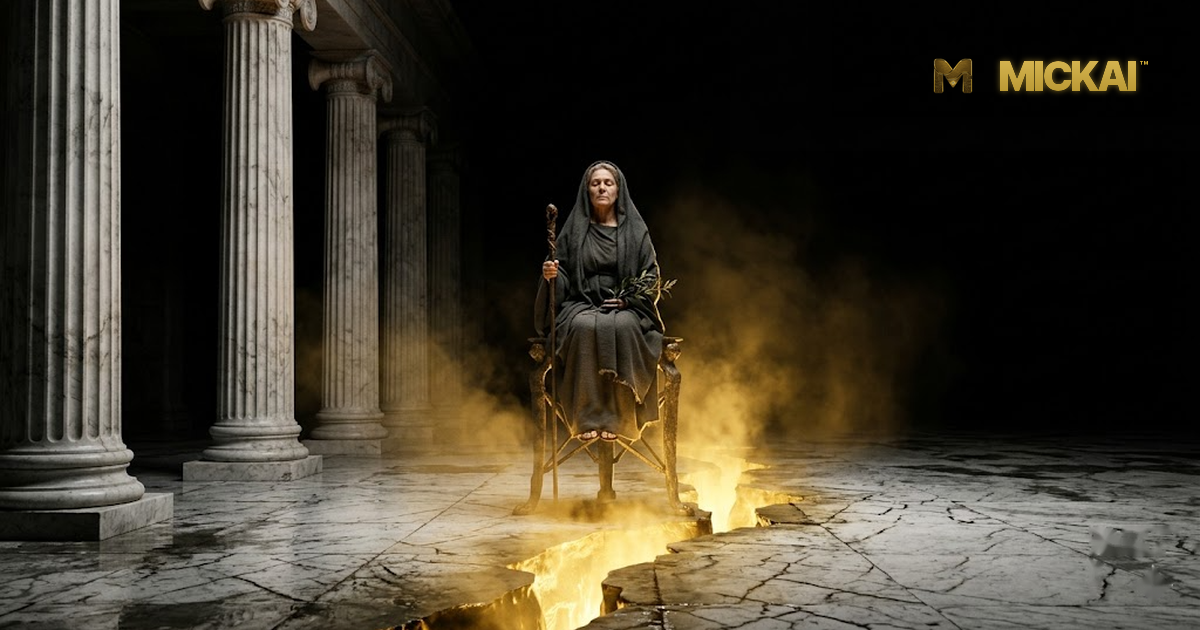
The Pythia Sat Over a Crack in the Rock
At Delphi, supplicants travelled for days to put a question to the Pythia, the priestess who spoke for Apollo from a tripod set over a fissure in the temple floor. Vapours rose, she answered, and the answer was treated as truth because of where it came from, not because anyone could check it. You trusted the oracle, or you went home. That structure, an authoritative source you cannot independently verify, is the oldest problem in the transmission of knowledge, and it is also a central unsolved problem in connecting blockchains to the world. The modern name for it is the oracle problem. The classical version runs in one direction: external data needs to come on-chain, and a smart contract has no way to know whether the price feed, the weather report, or the election result it received is honest. Whole industries of oracle networks exist to soften that trust, with staking, reputation, and aggregation, but the residue never disappears. You are still trusting a reporter. Pantheon, the sovereign Layer 1 blockchain built on the Mickai Sovereign Intelligence Operating System (SIOS), approaches the problem from the opposite end. The question it asks is what happens when you run the arrow backwards: not how do we trust data arriving from outside, but how does an artificial-intelligence output prove itself as it lands on-chain, with no trusted reporter in the loop at all.
What an Oracle Actually Cannot Do
A conventional blockchain oracle attests to a fact: the price of an asset was X at time T. It cannot attest to a process. When an artificial-intelligence system produces an output, a risk score, a trade recommendation, a moderation decision, a medical triage, the interesting question is rarely just what the answer was. It is what produced it: which model ran, under whose authority, against which policy, with what reasoning, and whether a governance check approved the action before it executed. No price oracle carries that payload. It was never designed to. So when teams bolt an artificial-intelligence model onto a chain through an oracle, they import the model's output as a bare number or string and discard everything that would let anyone, later and offline, reconstruct whether that output should be believed. This is the gap that public ledgers expose without closing. A blockchain records that a transaction happened. It does not record what produced the instruction behind it. For ordinary payments that is fine, the intent is the signature. For artificial-intelligence-driven action it is a void. The system acted, the chain logged the effect, and the reasoning, the authority, and the safety check evaporated. Anyone auditing the decision afterwards is back at Delphi, asked to trust the priestess because of where she sat.
Inverting the Oracle: Self-Proving Output
Pantheon's inversion rests on a single architectural decision made one layer down, inside the Mickai SIOS. Every action a Mickai brain takes is sealed into the Open Audit Record (OAR), an append-only, hash-chained ledger. Each entry is signed under ML-DSA-65, the post-quantum digital-signature algorithm standardised by the United States National Institute of Standards and Technology as Federal Information Processing Standard 204 (FIPS 204). The seal binds the output to the model that produced it, the authority it ran under, the inputs, and the governance verdict, then chains it to everything sealed before. The signature is verifiable offline by anyone holding only the operator's public key. No server, no vendor, no network call. The consequence for the chain is the whole point. When a sealed artificial-intelligence output reaches Pantheon, it does not need an oracle to vouch for it, because the proof of provenance travels inside the object itself. A verifier checks the ML-DSA-65 signature and the hash chain and learns, with cryptographic certainty and without trusting any reporter, that this exact output was produced by this exact authority under this exact policy. The trusted intermediary that every oracle network exists to approximate is simply removed from the design. The output is self-proving. The arrow has reversed: instead of importing a fact you must trust, the chain admits a record that proves itself.
Seal Before Consensus, Not Contract Storage
The reason this is more than a clever data format is where the seal lives in the protocol. Pantheon is built on the Polkadot software development kit (Substrate) in Rust, a standalone sovereign proof-of-stake (PoS) chain using the framework's audited machinery, BABE and Aura for block production, GRANDPA for finality. It is not a fork of Bitcoin and not a rollup tenant renting space on Ethereum. Critically, the OAR is a native runtime module, pallet-oar, which means seals are first-class objects of consensus rather than data parked in a contract's storage. That distinction is the mechanism. Call it seal-before-own-consensus: the chain validates operator-sealed post-quantum records before it orders them into a block. Most attempts to put trustworthy artificial-intelligence output on-chain treat the proof as application data, a blob a smart contract chooses to store and which the consensus layer never inspects. Pantheon makes the seal part of what consensus is agreeing about. The validators are not just ordering transactions, they are ordering proven records, and an unsealed or invalid record is not a transaction the network will finalise. The trustworthiness is constitutional, not opt-in.
“An oracle asks you to believe a reporter. A seal-before-consensus record asks you to check a signature. One is a relationship, the other is mathematics.”
Fifteen Subsystems, One Settlement Layer
This is not a thought experiment waiting for traffic. Fifteen application chains map to live Mickai subsystems, among them Trading and decentralised finance, Trust Agent audit, Knowledge and retrieval, PENELOPE for open-source intelligence, VIGIL for sky and airspace, Civilisation and Survival, the Vinis assistant, the Marketplace, Governance, HYGEIA for health, THEMIS for legal, Compliance, Identity, AMT, and HELIOS for hardware. Each runs real work, and each settles its sealed actions down to the base layer in PAN, the native token. The settlement is the load-bearing detail: every one of those subsystems is a producer of sealed artificial-intelligence outputs, and every output it settles arrives on the base layer already proven. So the inverted oracle is not a single feature, it is the default behaviour of an entire operating system writing to its own chain. The more the subsystems run, the more proven settlement flows to the base layer, and the denser the verifiable record becomes. A conventional design would need an oracle contract per data source, each its own trust assumption. Pantheon needs none, because the producers seal at source and the chain admits the seal as consensus. To witness the record externally, Pantheon periodically anchors a Merkle commitment of its OAR root to Bitcoin through OpenTimestamps, a free public timestamp proof. Bitcoin is used only as an outside witness, at no protocol cost, and Pantheon neither forks it nor depends on it for execution.
Why Post-Quantum, and Why It Is the Whole Argument
A self-proving record is only as durable as the signature that proves it. Here the field divides sharply. The nearest peers in verifiable artificial intelligence, EQTY Lab among them as the most serious and best-funded, root their trust in vendor silicon, hardware trusted execution environments such as Intel TDX or NVIDIA enclaves, sign with classical cryptography, and anchor to Hedera or their own ledger. Classical signatures are breakable by future quantum hardware. A record sealed today under a classical scheme is a record whose proof has an expiry date the moment a sufficiently capable quantum computer exists, and a hash chain of expired proofs proves nothing in retrospect. Pantheon is post-quantum from genesis. Every settled action carries an OAR seal signed under FIPS 204 ML-DSA-65 before it reaches consensus, verifiable offline forever. The claim is stated precisely on purpose: not a vague gesture toward being quantum-safe, but a named, standardised, implemented signature algorithm whose verification anyone can run. The architectural separation matters too. Trust rooted in a chip is trust in a vendor's supply chain and firmware. Pantheon seals in software on commodity hardware, which means the proof does not inherit a hardware manufacturer's threat model, and it runs its own consensus over those operator-sealed records rather than borrowing another chain's.
The Token That Pays for Proof Without Printing It
A chain that settles proven artificial-intelligence work needs an economy that rewards security without diluting the asset that secures it. PAN is the native token of the Pantheon Layer 1, fixed supply five billion (5,000,000,000), no inflation, no mint authority. It also exists as an omnichain token of the lock-and-mint class on Ethereum, BNB Chain, Base, and Arbitrum, so one fixed supply spans every venue: sovereignty where the moat is, liquidity where the market is. PAN settles fees across the Layer 1 and its fifteen Layer 2s, bonds validators, and carries governance. The reward engine is the part that distinguishes Pantheon from emission-driven designs, and it is deliberately the opposite of printing tokens to pay stakers. There are no emission-based staking rewards and no inflation sell pressure. Validator and staker yield is funded by revenue buybacks: a governed share of protocol revenue buys PAN on the open market and is split, indicatively and tunable by governance, roughly forty per cent to staker and validator yield, thirty per cent to permanent burn, thirty per cent to a governance lock. A base-fee burn in the style of Ethereum Improvement Proposal 1559 (EIP-1559) burns part of every transaction fee, so network usage shrinks supply. Every buyback, burn, and lock is itself sealed into the OAR and verifiable on-chain, which closes the loop: the economy that pays for proof is, in turn, proven.
Open Validators and a Two-Keyed Hand on the Switch
Decentralisation is not a slogan a self-proving chain can skip, because a record is only credibly neutral if no single party controls who finalises it. Pantheon opens validation in three tiers. Software validators download a single node binary, run it on commodity hardware, and stake PAN. Delegators nominate validators through nominated proof of stake (NPoS), taking on no infrastructure and sharing rewards. Mickai hardware appliances, premium plug-in validators from the Mickai hardware lineup, ship twelve months after funding as a path, never a gate. The set stays open to software operators, the active target sits between fifty and one hundred and fifty validators, and the chain is decentralised on commodity machines rather than gated behind a vendor's box. Governance is two-keyed. PAN-holder on-chain referenda decide direction: parameters, treasury, buyback policy. Beneath them sits a sealed execution-safety layer inherited from the SIOS, which requires a quorum of independent sovereign models to return ALLOW before a gated action executes. Every vote is sealed to the OAR, and every reversal is an append-only compensation that never deletes history. Above this, the OAR compliance mapper generates signed evidence against the European Union Artificial Intelligence Act, the National Institute of Standards and Technology Artificial Intelligence Risk Management Framework, and ISO 42001, so the chain's own regulatory posture is continuously auditable. No incumbent Layer 1 offers that.
What Is Built, and What the Gate Is
Precision about status is part of the argument, not a footnote to it. Pantheon is designed in full. The omnichain EVM contracts are built and smoke-tested on a local testnet. The Substrate Layer 1 is in build. The bridge mechanisms are covered by filed United Kingdom patent applications in the Pantheon bridge family, part of a portfolio of one hundred and four filed United Kingdom patent applications, 2,340 claims, owned by Mickai LTD, with named inventor Micky Irons. Mainnet is gated by an independent security audit and by legal and securities clearance, not by code. The token generation event (TGE) is targeted for the first quarter of 2027. The raise is thirty million pounds on Ladder B, roughly twenty-four per cent of supply, sold through Simple Agreement for Future Tokens (SAFT) instruments to professional investors only, marketed in the European Union via the Markets in Crypto-Assets (MiCA) utility-token notification route, with no United Kingdom retail promotion. Pantheon issues no stablecoin; PAN is a single utility and governance asset. None of this is a claim that mainnet is live or that PAN trades today. It is a description of an architecture that is designed, partly built, and filed.
The Oracle You No Longer Have to Trust
Return to Delphi. The enduring lesson of the Pythia is not that oracles lie, it is that an oracle's authority can never be checked from the outside, so it must be taken on faith. Every blockchain oracle since has been an attempt to launder that faith through economics: stake enough, aggregate enough, slash enough, and the residue of trust grows small but never reaches zero. Pantheon's contribution is to notice that for artificial-intelligence output the residue can reach zero, because the producer can seal its own proof and the chain can make that seal a condition of consensus. The reporter is removed because the record reports on itself. Public blockchains record what happened but cannot attest to what produced it. Artificial-intelligence systems act but cannot prove, after the fact and offline, what they did, under whose authority, and with what reasoning. Pantheon is designed to close both gaps at once and to seal the closure under a post-quantum signature that does not expire when classical cryptography does. That is the oracle problem run in reverse, and it is the opening no incumbent Layer 1 currently occupies: not a better priestess over the fissure, but a record that any traveller can verify alone, with nothing but a public key and the willingness to check the mathematics.