One login, one set of data: the end of app sprawl
A dozen disconnected subscriptions duplicate your data and split your context. One sovereign OS where every studio shares one company data store.
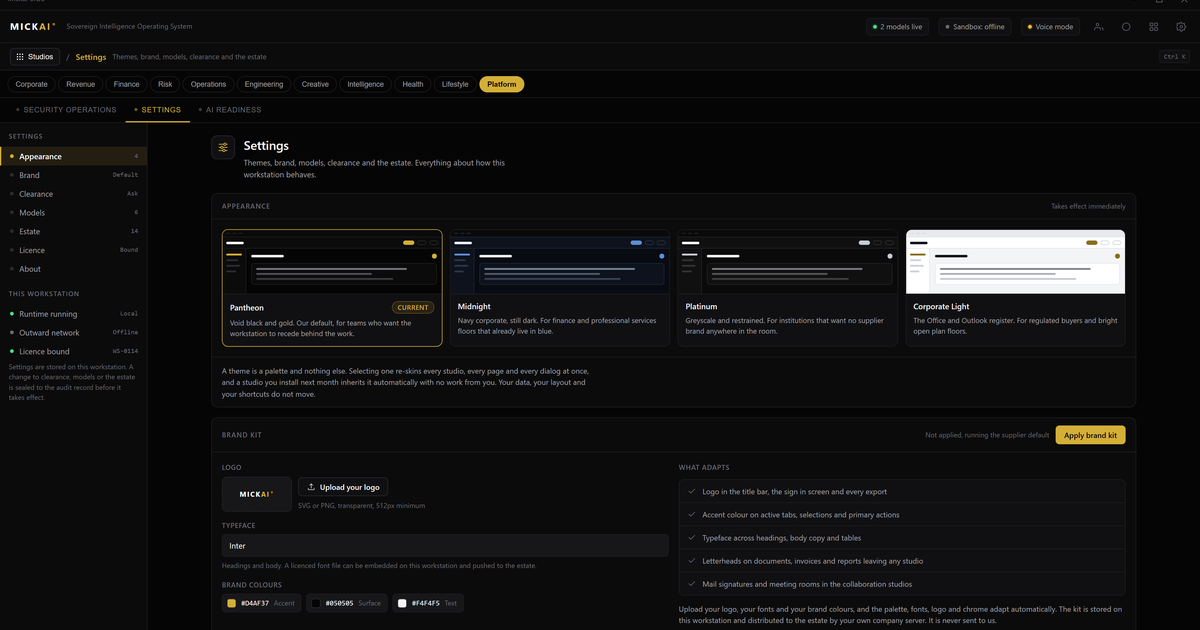
App sprawl is the state most companies drift into: a dozen disconnected subscriptions, each holding its own copy of your people and your records, none of them agreeing, all of them billing you every month. The alternative is one login and one set of data. Our studios run on the MICKAI sovereign operating system, on hardware your company owns, sharing a single company data store, with one assistant across all of them. You stop renting a stack of separate clouds and start owning a system that already knows itself.
What app sprawl actually costs you
The bill is the obvious part. Email is one subscription, chat is another, meetings a third, then the CRM, the documents and storage, the help desk, the analytics, the project tracker. Each is sold per user per month and each recurs forever. But the money is only the visible cost.
The hidden cost is duplication. Your customer exists as a contact in the CRM, a name in the mailbox, an attendee in the calendar, a row in the billing tool and a handle in the chat app. Five copies, five sources of truth, none of them the same. Somebody changes a phone number in one place and the other four stay wrong. Multiply that across every customer, every supplier and every member of staff and you have a company whose own record of itself is permanently out of date.
The second hidden cost is missing context. No single tool can see the whole picture, because the picture is scattered across tools that do not share a store. The support agent cannot see the sales history. The account manager cannot see the open tickets. The finance lead cannot see the meeting where the discount was agreed. Everyone works from a fragment, and the joins between fragments are done by hand, in someone's head, on a good day.
The third cost is the glue. To make a dozen apps behave like one, you buy connectors and integrations, license middleware, and pay someone to keep the sync jobs alive. Each connector is another vendor, another subscription and another place your data is copied to and held.
One data store, shared by every studio
Our answer is not a better connector. It is to remove the need for connectors at all. The studios on the operating system are not separate products with separate databases. They read and write one company data store on your own hardware.
A customer is one record. The email system, the CRM, the meetings platform, the billing studio and the assistant all read the same record. Update the phone number once and it is correct everywhere, because there is only one copy to correct. There is no sync job, no integration to license and no window where two systems disagree, because there are not two systems. There is one operating system with many studios on it.
This is what we mean by taking the whole software stack rather than a model to integrate. You are not wiring email into chat into the CRM across three clouds. Email, chat, meetings, the CRM, documents, the help desk and the rest are studios on the same foundation, running on your kit, sharing your data.
One login, one assistant, one audit trail
Because it is one operating system, a person signs in once. There is no separate password for the mailbox, the meeting room, the CRM and the wiki. One identity, one set of permissions, one place to grant and revoke access when someone joins or leaves.
There is also one assistant, and it works across every studio rather than being bolted onto a single app. Ask it what is happening with an account and it reads the CRM record, the email thread, the meeting notes and the open tickets together, because they are in one store. Ask it to draft the follow-up, update the deal and set the next task and it does so across the studios in one move. The value is not a clever model in someone else's cloud. It is a capable assistant that can see the whole picture precisely because the whole picture is in one place you own. For any question about the reasoning layer, the point is what it does for the studios, not what runs underneath.
And there is one audit trail. Every action across every studio is written to the Open Audit Record on your own hardware. In a sprawl of separate clouds, answering "who saw this customer's data" means pulling logs from a dozen vendors in a dozen formats, if they give you logs at all. With one operating system, views, edits and exports are logged at the action level in one record you hold.
The saving, measured honestly
We do not publish MICKAI pricing. What we can do is show you how to size the recurring bill you already pay, so you can measure it against owning one system instead.
Every incumbent in the sprawl publishes a price per user per month, billed every year, forever. The method is the same for all of them. Take the seat count for that tool. Multiply by the vendor's published price per user per month. Multiply by twelve. Do that for every subscription you run, then add them up.
A worked example on a stated assumption. Take a 40 person firm. Suppose it runs a productivity and email suite at a published list price of 20 pounds per user per month, a chat and meetings tool at 12, a CRM at 100 and a support desk at 40. That is 40 times 12 months times each price: 9,600 pounds for the productivity suite, 5,760 for chat and meetings, 48,000 for the CRM and 19,200 for the support desk. The recurring total is 82,560 pounds a year, and that is before the connectors and add-ons that link them. Those figures are illustrative and built on the assumption above, not a quote. Put in your real seat counts and the real current list prices for the editions you actually buy, and you have your own number.
Now hold that recurring total against the shape of what we offer: one operating system, running on hardware your company owns, with the studios already sharing one data store and no per app subscriptions to renew in perpetuity. We are not going to print our price here. We are saying: add up every rental line you pay across the whole sprawl, year after year, and measure it against owning the system.
Built for the regulated small and mid-sized firm
Sprawl hits the regulated small and mid-sized firm hardest. The practice, the broker, the clinic, the manufacturer with a compliance duty ends up with the same dozen multi-tenant clouds as everyone else, none of the leverage of a very large buyer, and all of the exposure. When a regulator or a client asks where the company's data sits and who can see it, "spread across a dozen vendor clouds in regions we do not control" is a difficult answer.
One operating system on your own hardware gives a straight answer instead. The data is here, in one store, in your building. Private deployment where a vendor cannot see your data is the baseline; we go further. The system is air-gapped by default, so an outside connection is not a condition of reaching your own tools, and every action across every studio is logged at the action level in one Open Audit Record. To be clear about what we do not claim: we hold no SOC 2, ISO or Cyber Essentials certification. What we give you is architectural control and one action level audit trail on kit you own, which is what most of these questions are really about.
The wider platform
The end of app sprawl is not one clever app. It is the operating system underneath all of them. There are 63 studios on that foundation, and clients onboard onto a focused initial set rather than switching everything at once. The count is not the point. The point is that email, chat, meetings, the CRM, documents, the help desk, analytics and the assistant are the same system, sharing your data, running on your hardware, behind one login. You stop renting a dozen disconnected clouds, and you own one that already knows itself.
Frequently asked questions
What is app sprawl? It is the state most firms end up in: a separate subscription for email, chat, meetings, CRM, documents, storage and more, each holding its own copy of the same people and the same records, none of them agreeing, all of them billing you every month.
How is one operating system different from a suite of connected apps? A suite is still separate products stitched together with connectors, each with its own store. Our studios are not separate products. They run on one operating system and read and write one data store, so there is nothing to sync and nothing to reconcile.
How do you model the saving against our current tools? Take each incumbent's published price per user per month, multiply by your seat count, multiply by twelve, and add them up across every subscription you run. That recurring total is what you measure against owning one system on your own hardware.
Does everything still work when the internet is down? Yes. The operating system is air-gapped by default and runs on hardware you own, so every studio stays available with no connection to the outside.
Is this one finished product or a collection of early builds? It is one operating system with 63 studios on it. Clients onboard onto a focused initial set of studios rather than switching everything at once.
Who can see what staff do across all these studios? You can. Every action across every studio is written to one Open Audit Record on your own hardware, so views, edits and exports are logged at the action level in one place.
Frequently asked questions
What is app sprawl?
It is the state most firms end up in: a separate subscription for email, chat, meetings, CRM, documents, storage and more, each holding its own copy of the same people and the same records, none of them agreeing, all of them billing you every month.
How is one operating system different from a suite of connected apps?
A suite is still separate products stitched together with connectors, each with its own store. Our studios are not separate products. They run on one operating system and read and write one data store, so there is nothing to sync and nothing to reconcile.
How do you model the saving against our current tools?
Take each incumbent's published price per user per month, multiply by your seat count, multiply by twelve, and add them up across every subscription you run. That recurring total is what you measure against owning one system on your own hardware.
Does everything still work when the internet is down?
Yes. The operating system is air-gapped by default and runs on hardware you own, so every studio stays available with no connection to the outside.
Is this one finished product or a collection of early builds?
It is one operating system with 63 studios on it. Clients onboard onto a focused initial set of studios rather than switching everything at once.
Who can see what staff do across all these studios?
You can. Every action across every studio is written to one Open Audit Record on your own hardware, so views, edits and exports are logged at the action level in one place.