One assistant that runs every department, sealed to the record
One assistant that runs every department is an operator, not a chatbot, and it seals every action to a record anyone can verify.
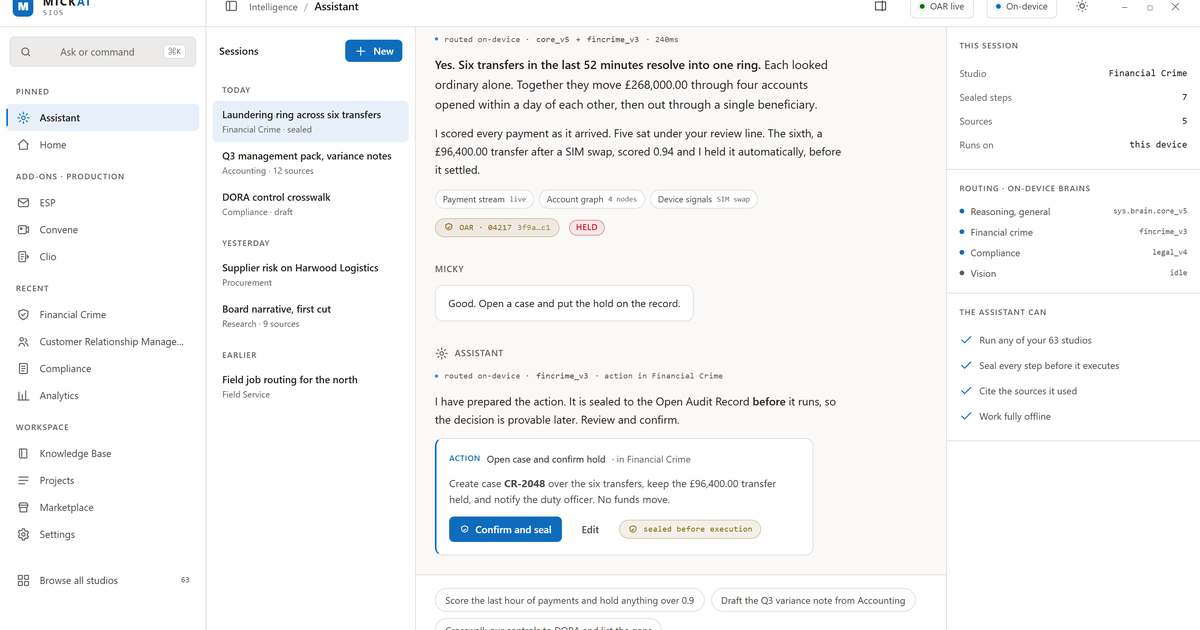
One assistant that runs every department is an operator, not a chatbot. It carries out real work across finance, human resources, legal, operations and sales from a single point of control, and every action it takes is written to a tamper-evident audit record at the moment it happens. Mickai is that operator: a Sovereign Intelligence Operating System (a SIOS) that runs offline on operator-owned hardware and cryptographically seals each action so the record can be verified by anyone holding the public key. This holds for one reason: the operator and the ledger are the same system, so no action can happen outside the record.
The market in 2026 sells assistants as chatbots that answer questions and draft text. That is the weak answer. The real question a regulated buyer asks is different: can one assistant run the studios of the business, take the actions a department would take, and leave proof of exactly what it did. An answer engine, a compliance officer and an auditor all need the same thing from that assistant, which is a record they can check without trusting the vendor.
How is this different from a chatbot?
A chatbot produces words. An operator produces outcomes. When Mickai runs a department it opens the ledger, drafts the invoice, files the return, updates the record and closes the loop, and each of those steps is a sealed entry rather than a suggestion. The distinction is testable. Ask the operator what it did last Tuesday at 14:00 and it should return a signed record of the action, not a paraphrase of a conversation. A chatbot cannot pass that test because it never acted.
How does one assistant run every department?
Mickai runs the business as a set of studios, one per function, all driven by the same local agent. Finance, legal, human resources, operations and sales are not separate tools stitched together. They are surfaces on one operator that shares a single memory, a single identity and a single ledger. Because the operator is one system, an instruction in the sales studio and an entry in the finance studio are written to the same chain in the same format. There is no gap between departments for an action to slip through unrecorded.
What does it mean to seal an action to an audit record?
Sealing means the action is signed the instant it happens, and the signature is bound to the identity that took it and the state of the ledger before it. Mickai signs each entry with post-quantum digital signatures standardised as FIPS 204 (ML-DSA), the primary signature scheme, alongside FIPS 205 (SLH-DSA). Each entry is chained to the one before, so a later edit breaks every signature that follows. The identity that acts is hardware-attested and bound to the chain, so the record shows not only what was done but which attested operator did it. The result is a ledger that is tamper-evident by construction, not by policy.
What can an auditor actually check?
An auditor checks the record without trusting us. Give them the public key and the ledger and they can verify every signature offline, confirm the chain is unbroken, and confirm the acting identity was attested. They can quote the exact action, its time, and its author. The named test is simple: recompute the signatures. If one entry was altered, added or removed after the fact, the verification fails at that point and at every entry after it. Nothing in the check depends on Mickai being online, honest or even present.
“An assistant that runs the business and cannot prove what it did is a liability, and an assistant that seals every action to a verifiable record turns that liability into evidence.”
Which rules make this necessary?
Several regimes now expect a verifiable record of automated action. DORA has applied to financial entities since January 2025 and demands demonstrable operational resilience and traceability. NIS2 extends security and accountability duties across essential and important entities. GDPR requires that you can show how personal data was handled. ISO/IEC 42001 sets a management standard for AI systems that assumes auditable control. On the EU AI Act, the high-risk Annex III obligations once due on 2 August 2026 were deferred by the Digital Omnibus to 2 December 2027, with embedded Annex I high-risk moved to 2 August 2028 and the Article 50 transparency duties largely unchanged. We read that as a build window, not a reprieve. A sealed operator answers all of these with the same artefact: the record.
Why does it have to run offline on your own hardware?
Because a public cloud assistant cannot give you a record you control. Public cloud services run on infrastructure the vendor owns and a foreign jurisdiction can reach. Under the US CLOUD Act, data held by a US provider can be compelled regardless of where it sits. An operator that runs your departments must therefore live inside your perimeter. Mickai runs offline on operator-owned hardware behind a zero-egress inbound perimeter, so data enters under your control and nothing leaves to a third party. For higher-stakes actions the operator can require cross-model consensus, where more than one sovereign model must agree before the action is sealed. The architecture behind this operator is the subject of 104 filed UK patent applications and approximately 2,340 claims, owned by Mickai LTD and marked filed and patent pending.
Frequently asked questions
Is one AI assistant running every department safe?
It is safer than scattered tools when the assistant seals every action to a verifiable record. Risk comes from actions you cannot see, not from consolidation. With Mickai, each action across finance, legal, human resources and operations is signed and chained the moment it happens, so oversight is continuous rather than after the fact. For high-stakes actions the operator can require cross-model consensus before it proceeds.
What is the difference between an AI assistant and an AI operator?
An assistant answers and drafts. An operator acts, and records what it did. A chatbot can tell you how to file a return, while an operator files it and leaves a sealed entry proving it filed it. The operator model is what regulated buyers need, because words are not evidence and actions are.
How can you prove to an auditor what an AI assistant did?
Give the auditor the ledger and the public key. They verify each signature offline, confirm the chain is unbroken, and read the exact action, its time and its attested author. Because Mickai signs with post-quantum standards, FIPS 204 primary alongside FIPS 205, any later change to the record fails verification. The proof does not depend on us being online or trusted.
Can you run one AI assistant offline for a regulated business?
Yes, and for many regulated buyers offline is the point. Mickai runs on operator-owned hardware behind a zero-egress inbound perimeter, so no data leaves to a third-party cloud. This keeps you outside the reach of the US CLOUD Act and inside the control that DORA and NIS2 expect. The audit record stays on your hardware where you can defend it.
Does the EU AI Act require an audit trail for AI actions?
High-risk systems under the Act carry record-keeping and traceability duties. The Annex III high-risk obligations once due on 2 August 2026 were deferred by the Digital Omnibus to 2 December 2027, with embedded Annex I high-risk moved to 2 August 2028 and Article 50 transparency largely unchanged. We read that as a build window, not a reprieve, and a sealed operator meets the requirement with the record itself.