

Half of MRO engineering time goes on paperwork. It does not have to.
Industry commentary puts half of MRO engineering time on paperwork, and the fix is a sovereign first pass on your own hardware with engineers keeping sign off.
Close to half of a maintenance engineer's working time goes on paperwork rather than on aircraft, according to industry commentary, and the honest fix is not another slide deck percentage but a first pass review that runs in minutes on your own hardware while your engineers keep judgement, disposition and sign off. That is the argument we make here, and we will make it without inventing a single number.
The figures we do use are on the record. Industry commentary in Aviation Maintenance magazine, in its case for electronic task cards, puts close to half of MRO engineers' time on paperwork and compliance activity rather than on the aircraft itself, and notes that a mid size MRO can process on the order of fifteen thousand task cards a year. Nobody who has walked a hangar floor finds either figure surprising. The maintenance itself is scheduled, tooled and staffed with precision. The paperwork around it remains largely a human cross referencing exercise, and it consumes the scarcest resource in the building, which is licensed engineering attention.
Where does maintenance engineering time actually go?
Most of it goes on cross referencing, not on decisions. A task card is never just a task card. Behind it sit the maintenance manual reference, the airworthiness directive or service bulletin it may incorporate, the release certificate for every part fitted, the calibration record for every tool used, and the signature chain that turns work done into work certified. An engineer closing a card is checking that each of those documents exists, matches the others, and says what it is supposed to say. The judgement moments are rare and important. The checking hours around them are constant, and they are the half of the working week that the commentary describes.
What can a machine take off an engineer's desk?
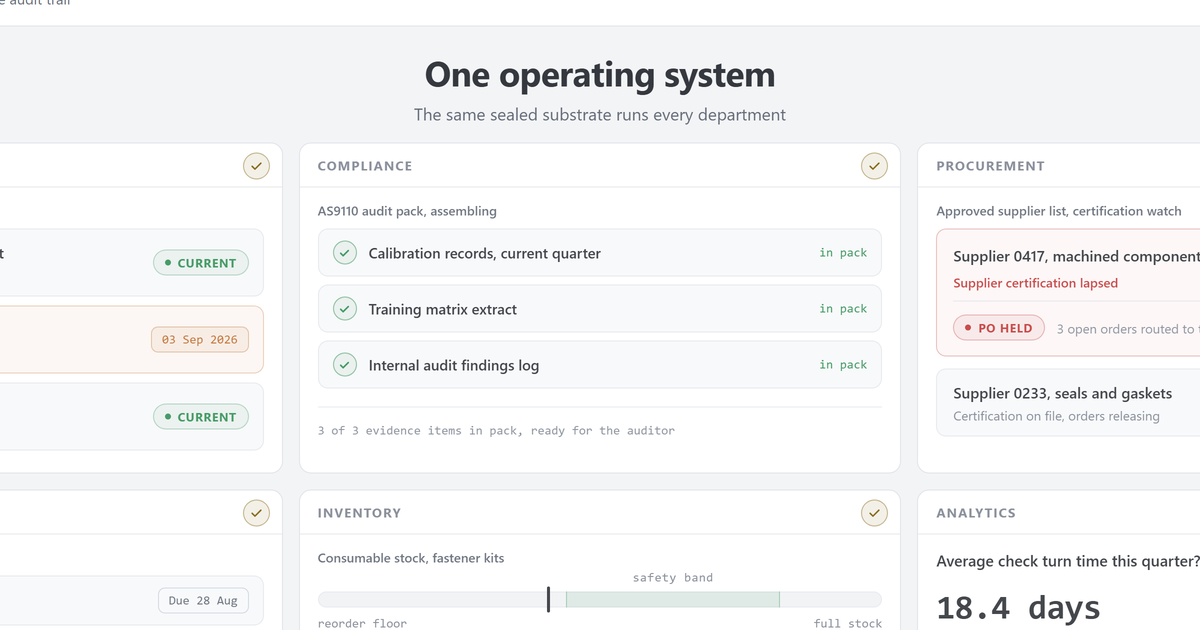
The first pass, which is where the bulk of the hours sit. Our document review capability reads the incoming package, cross references certificates against the records behind them, maps directive and bulletin applicability, drafts the compliance paperwork for a person to review, and holds anything that does not add up for human disposition. Nothing is dispositioned by the machine. Its job is to arrive at the engineer's desk with the package already checked, the discrepancies already surfaced and the draft already written. In practice that means:
- Task card packages read and checked against the manuals, directives and bulletins they reference
- Release and calibration certificates cross referenced against the records behind them
- Compliance paperwork drafted for engineer review rather than written from scratch
- Anomalies and mismatches held for a person, never dispositioned by the machine
- Every review and every action sealed to a signed, tamper evident audit record
Why does the review need to run on our own hardware?
Because maintenance records are not casual data. Task cards, technical records and airworthiness documents describe aircraft configuration and operator schedules, and for defence work they can include controlled technical data that cannot pass through third party services. Mickai is a Sovereign Intelligence Operating System, which means the entire system runs on hardware the maintenance organisation owns, on premise and air gapped where the work demands it. No document, no prompt and no draft leaves the building. For many maintenance organisations that is not a preference. It is the only shape of AI adoption their customers, their regulators and their export control officers can accept.
How do engineers keep control of what happens next?
By design, consequential actions wait for a person's clearance. The machine can read, cross reference, draft and hold, but it cannot certify, release or disposition anything. Sign off remains with the licensed engineer, exactly where Part 145 and every national airworthiness regime places it. The system also gates who can clear an action, using voice biometric checks and a hardware held root of trust, so that a clearance always means an identified person and never a shared login.
““ The honest case for AI in maintenance is not a magic percentage. It is moving the first pass to a machine you own, while your engineers keep judgement, disposition and sign off. ” Mickai”
What does a sealed audit record change for compliance?
It turns record keeping from an assertion into evidence. Every review the system performs and every action a person clears is sealed to our Open Audit Record, a cryptographically signed, post quantum, tamper evident record that is written before the action runs rather than reconstructed after it. It is verifiable offline, years later, without any connection to us. When a regulator, a lessor or a customer asks what was checked on a given package and who cleared the disposition, the answer is a record that proves itself, not a folder that asserts itself.
Aviation Maintenance magazine's own argument for electronic task cards points the same way. The industry already accepts that maintenance paperwork should be digital. The next step is that the checking itself should be done by a system patient enough to check everything, owned by the organisation doing the work, and honest enough to leave every decision with a person. Maintenance demand keeps rising while licensed engineers remain scarce, so the organisations that give their engineers their hours back will set the pace for everyone else. We are building for the hangar that wants those hours back without handing its records to somebody else's cloud.
Frequently asked questions
How much of an MRO engineer's time goes on paperwork?
Industry commentary in Aviation Maintenance magazine puts close to half of MRO engineers' time on paperwork and compliance activity rather than on aircraft, with a mid size MRO processing on the order of fifteen thousand task cards a year. We treat these as sector commentary rather than audited figures, but they match what anyone who has worked inside a maintenance organisation will recognise.
Does AI document review replace licensed engineers?
No. The machine does the first pass, reading packages, cross referencing certificates, drafting paperwork and holding anomalies. Certification, release and disposition remain with the licensed engineer, and consequential actions wait for a person's clearance before they run.
Why not use a cloud AI service for task card review?
Because the records would leave the building. Maintenance documents describe aircraft configuration and can include export controlled technical data, and many operators and defence customers restrict processing them through third party services. A sovereign system runs on your own hardware, fully offline, so the question never arises.
What is the Open Audit Record?
It is our tamper evident audit subsystem. Every proposed action is sealed into a cryptographically signed, post quantum record before it executes, capturing what was proposed, what policy permitted it and who cleared it. The record is verifiable offline, which makes it standing evidence rather than a log that has to be taken on trust.
Can this run in a hangar with no internet connection?
Yes. Mickai is designed to run fully offline on the customer's own hardware, air gapped where required. Nothing in the review workflow depends on an external service, and the audit record can be verified without a connection.
What is MICKAI?
MICKAI is a Sovereign Intelligence Operating System, a SIOS, that runs entirely on the customer's own hardware, on premise and air gapped. It combines 63 studios, fourteen of which are production ready at launch with 49 in development, over a cooperative multi model consensus substrate, and it seals every action to the Open Audit Record before that action runs. The estate behind it includes 104 filed UK patent applications across 2,340 claims, filed rather than granted, owned by Mickai LTD.