A knowledge base and internal wiki you own
A company knowledge base and internal wiki on hardware you own, with one assistant that surfaces it across every studio. See the method to price it.
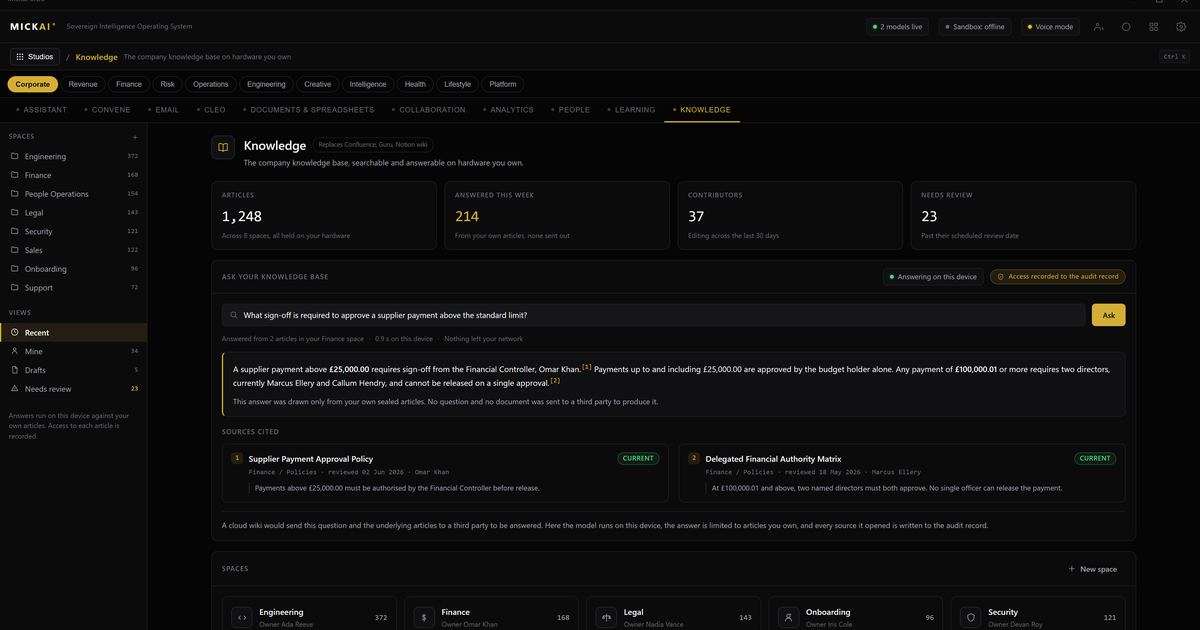
Your company knowledge belongs on hardware you own, not rented from a wiki vendor by the seat. Our knowledge studio is a full knowledge base and internal wiki that runs on the MICKAI sovereign operating system, on your infrastructure, with one assistant that can read it across every other studio. You keep the pages, the history and the answers.
Most firms treat the internal wiki as somewhere to dump documents and forget them. That is a waste of the most valuable asset a company has: what it already knows. The problem is not the wiki. The problem is that the knowledge sits in someone else's cloud, priced per user per month, disconnected from the tools where people actually work.
One knowledge base, not a separate app
The knowledge studio is not a standalone product with its own login and its own silo. It is a studio on the same operating system as our email system, our meetings platform, our CRM and the rest. They share the company's own data. That single fact changes what a wiki is for.
When your knowledge base sits on the same operating system as everything else, a policy page written once is the same policy the assistant quotes in a support reply, the same figure it pulls into a proposal, the same procedure it reads back in a meeting. There is no export, no copy, no third integration to buy and maintain. Write it in the wiki once and it is available everywhere your people already are.
The assistant reads your knowledge across every studio
The reasoning layer runs on your own hardware, against your own pages. That is what makes the knowledge base useful rather than ornamental.
Someone in the CRM asks how a particular contract clause is usually handled. The assistant answers from the relevant wiki space, on your infrastructure, without a request leaving the building. Someone in the meetings platform asks for the onboarding checklist. It surfaces the current version, not last year's. A new joiner asks a plain question in the assistant and gets the answer your company already wrote down, with a link back to the source page.
The assistant does not need your knowledge to travel to a model somewhere else. The knowledge stays put and the intelligence comes to it. Every time it reads a page to answer a question, that access is written to an action-level Open Audit Record, so you can see exactly what was read, by whom, and when. That is the layer a rented wiki cannot give you, because the rented wiki does not own the reasoning and does not own the record.
What renting the wiki costs
Wiki and workspace tools are sold per user per month, on a published list price. The method to work out what that costs your firm is simple and conservative, and you can run it today.
Take the published list price of your current tool, per user per month. Multiply by the number of users. Multiply by 12. That is the annual figure you are paying to keep your own knowledge on someone else's hardware.
Worked example, using the method rather than any single vendor's current number. Assume a published price of £8 per user per month and 200 users. That is £8 times 200 times 12, which is £19,200 per year, every year, rising as you add people. Assume a higher published tier at £15 per user per month for the same 200 users and it is £36,000 per year. Put your own tool's current list price and your own headcount into the same three-step sum and you have your figure. The published prices move, so check the current list price on the day and use that; the arithmetic does not change.
Two vendors dominate this comparison in practice. One sells a wiki and collaboration space per user per month on a public price list. The other sells a workspace and document tool the same way, with per-seat tiers published openly. Both charge for every person you add and hold your pages in their cloud. The annual sum above is what leaves your business to keep them there.
We do not publish a price. We take the product to companies in a briefing and price it there. What we will say plainly is the shape of the trade: you stop renting your own knowledge by the seat and you start owning the studio that holds it. Run the rented-spend sum first, then bring it to the conversation.
Owned hardware changes the security question
When the knowledge base lives on hardware you own, air-gapped by default, the security question changes from "do we trust the vendor" to "do we trust ourselves". That is a question you can actually answer.
Your commercial terms, your incident runbooks, your customer notes, your internal decisions: none of it is replicated to an outside cloud for a vendor's staff to reach or a vendor's breach to expose. The most sensitive thing a company writes down is often what it knows about how it really works, and that is exactly what ends up in the wiki. Keeping it on your own infrastructure is the baseline. Private deployment on its own is the starting line, and plenty of tools now offer a private instance.
Our value sits beyond that baseline. Access is recorded at the action level, not just at login. The stack is air-gapped by default rather than as an add-on. It is the whole software operating system, so the wiki is not a lonely private island but part of a connected estate. And it is built for the regulated small and mid-sized firm that has real compliance obligations and cannot justify a large platform team to run a fleet of separate private clouds.
The knowledge estate behind it
MICKAI is 63 studios on one sovereign operating system. The knowledge studio is one of them, and it does not stand alone. The technology sits behind 104 filed UK patent applications carrying 2,340 claims. Those are filed applications, not granted patents, and we describe them as exactly that. Distribution runs through a partner we keep anonymous.
For a knowledge base and internal wiki, what that estate means in practice is straightforward. Your knowledge is one studio among many on an operating system you run, sharing data with the tools your people use all day, read by an assistant that never has to send your pages away to answer a question. You own the hardware, you own the record, and you own what your company knows.
Frequently asked questions
Where does our knowledge actually live? On hardware you own, inside our knowledge studio. Pages, spaces and their history sit on your infrastructure, air-gapped by default. Nothing is copied to a vendor cloud for you to trust and audit later.
How is this different from a private Confluence or Notion instance? Private deployment is the baseline we start from. Our value is beyond it: the assistant reads your knowledge base across every other studio, every access is written to an action-level Open Audit Record, and it is the whole software stack rather than a model you bolt on.
Can the assistant answer from our wiki without sending it anywhere? Yes. The reasoning layer runs on your own hardware against your own pages. A question in the meetings platform or the CRM is answered from your knowledge base locally. No prompt or page leaves the building.
What happens to old pages and version history? They stay yours. Full page history, who changed what and when, and archived spaces remain on your storage under your retention rules, not a vendor's.
How should we compare the cost against what we pay now? Take your current wiki seat price per user per month, multiply by your user count, then by 12. That annual figure is what you rent today. We price by briefing rather than a public list, so measure the rented spend first and bring it to the conversation.
Do we need certifications to trust it? We hold none and claim none. The point is that you do not have to trust a third party at all. The knowledge stays on infrastructure you control, so your own certification scope covers it.
Frequently asked questions
Where does our knowledge actually live?
On hardware you own, inside our knowledge studio. Pages, spaces and their history sit on your infrastructure, air-gapped by default. Nothing is copied to a vendor cloud for you to trust and audit later.
How is this different from a private Confluence or Notion instance?
Private deployment is the baseline we start from. Our value is beyond it: the assistant reads your knowledge base across every other studio, every access is written to an action-level Open Audit Record, and it is the whole software stack rather than a model you bolt on.
Can the assistant answer from our wiki without sending it anywhere?
Yes. The reasoning layer runs on your own hardware against your own pages. A question in the meetings platform or the CRM is answered from your knowledge base locally. No prompt or page leaves the building.
What happens to old pages and version history?
They stay yours. Full page history, who changed what and when, and archived spaces remain on your storage under your retention rules, not a vendor's.
How should we compare the cost against what we pay now?
Take your current wiki seat price per user per month, multiply by your user count, then by 12. That annual figure is what you rent today. We price by briefing rather than a public list, so measure the rented spend first and bring it to the conversation.
Do we need certifications to trust it?
We hold none and claim none. The point is that you do not have to trust a third party at all. The knowledge stays on infrastructure you control, so your own certification scope covers it.