How Keyboard-First Offline Software Changes an Operations Team's Day
Keyboard-first offline software makes every action a keystroke and keeps the shift running with the network unplugged, then seals what was done.
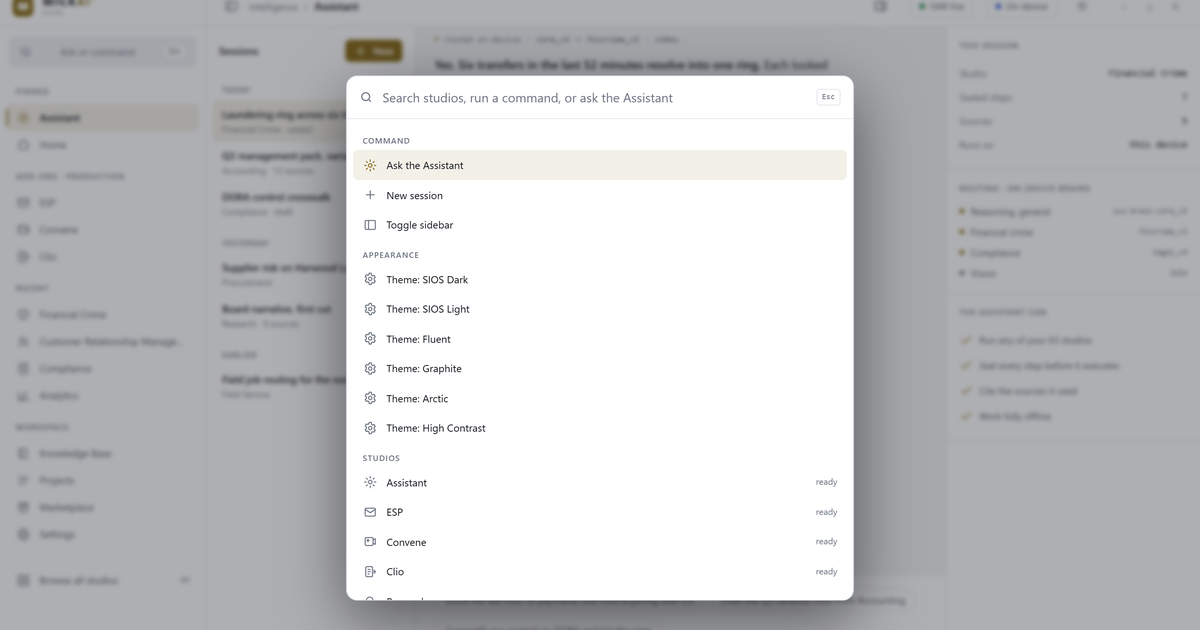
Keyboard-first software that runs offline changes an operations team's day by removing two hidden taxes at once: the seconds lost reaching for a mouse, and the work that halts the moment the network drops. Every routine action becomes a keystroke, so tasks move at the pace of a trained operator's hands, and because the software runs on hardware the team owns, it keeps running when the connection is cut. A shift stops stalling on latency, stops sending data to a public cloud, and ends with a verifiable record of what was done.
This matters in 2026 because two forces pull in opposite directions. Teams are asked to move faster and to prove more, while most of their tools assume a live connection to someone else's cloud. When that link is slow, contested or absent, the shift waits and sensitive data leaves the building.
What does a keyboard-first day actually look like?
The hands stay on the keys. A trained operator works from muscle memory rather than a hunt across a screen, so triage, dispatch, sign-off and hand-over happen as short keystrokes without the constant reach-and-click that fragments attention. The real change is fewer context switches per task: each mouse journey costs a little time and a lot of focus, and removing it lets the operator hold a longer train of thought, which is where accuracy on complex work comes from.
How does it keep working when the network is down?
The intelligence runs locally. Sovereign models sit on operator-owned hardware, so a request is answered on the machine in front of the team rather than sent on a round trip to a distant data centre. A dropped connection, a contested network or a deliberate air-gap changes nothing about whether the work can proceed, because software built to run offline treats the network as optional. The shift continues at a remote site, on a vessel, or through an outage.
Why does offline change the security picture, not just the speed?
Running on owned hardware lets the perimeter be built inbound rather than outbound. Mickai operates behind a zero-egress inbound perimeter: data comes in to be worked on and does not leave to be processed elsewhere, so operational records, case files and personal data are not copied to a third party's infrastructure. That answers a legal question as much as a technical one. Under the US CLOUD Act, data held by a US-linked cloud provider can be reachable by foreign legal process wherever it sits, while software that never sends the data out is not exposed to that reach.
“Speed that survives the network being unplugged is a different property from speed alone, and only one of the two can be audited after the fact.”
What can an auditor check after the fact?
Every action is cryptographically sealed into an append-only ledger that can be verified offline. An auditor does not need to trust a live dashboard or a vendor's word: they can check the mathematics on a copy of the record, with the network unplugged. Three mechanisms make the record hold up:
- Post-quantum signed audit ledger. It is sealed with the standardised digital signature schemes FIPS 204 (ML-DSA), used as primary, and FIPS 205 (SLH-DSA), so a signature valid today stays verifiable against a future quantum adversary.
- Hardware-attested identity. The operator and machine are bound into the chain by attested identity, so the record shows not only what happened but on which device and under whose authority.
- Cross-model consensus. Where a judgement matters, more than one sovereign model is asked, and the agreement or disagreement is recorded rather than hidden behind a single opaque answer.
The named test is simple: take the ledger to an isolated machine, verify the signatures with no network, and confirm the chain is intact. If it verifies offline, the trail is genuine.
Which rules make this necessary in 2026?
Several regimes now push toward exactly this design, and we read the current landscape as a build window rather than a reprieve.
- EU AI Act. The high-risk Annex III obligations, once due on 2 August 2026, were deferred by the Digital Omnibus to 2 December 2027, with embedded Annex I high-risk moved to 2 August 2028 and Article 50 transparency duties largely unchanged. The direction toward logging, traceability and human oversight holds.
- DORA. In force since January 2025, it holds financial entities to operational resilience, including the ability to keep functioning through disruption. Software that runs offline is resilience by construction.
- NIS2. It covers essential and important entities with tighter security and reporting duties, where a verifiable local record helps meet the burden of proof.
- GDPR and ISO/IEC 42001. Data minimisation and a governed AI management system are easier to demonstrate when the data never leaves and every action is sealed.
How is this different from a faster cloud dashboard?
The difference is architectural, not cosmetic. A faster interface on a cloud service still moves data out, still fails when the link fails, and still asks you to trust a record you cannot verify yourself. Offline software inverts all three: the data stays, the work continues without a connection, and the trail is provable on your own hardware.
Where does Mickai fit?
Mickai is a Sovereign Intelligence Operating System, a SIOS, built for teams that cannot send their work to a public cloud. It runs offline on operator-owned hardware, drives every routine action from the keyboard, holds a zero-egress inbound perimeter, and seals each action into a post-quantum signed, offline-verifiable ledger bound to attested identity. The design is protected by 104 filed UK patent applications carrying approximately 2,340 claims, owned by Mickai LTD, all patent pending. A shift should not stop because a network did, and no record of it should rest on trust that cannot be checked.
Frequently asked questions
What does keyboard-first software mean for an operations team?
It means the common actions of a shift are driven from the keyboard rather than by hunting across a screen with a mouse. Operators work from muscle memory, which cuts context switches and sustains focus. The gain is fewer interruptions per task and a longer held train of thought, not only saved seconds.
Can software really do useful AI work with no internet connection?
Yes, when the models run locally on hardware the team owns. Requests are answered on the machine in front of the operator rather than sent to a remote cloud, so a dropped, contested or absent connection does not stop the work. This suits remote sites, secure facilities and any setting where an outside link cannot be assumed.
How can an auditor verify what offline software actually did?
Every action is sealed into an append-only ledger that can be verified without a network. The signatures use the standardised post-quantum schemes FIPS 204 (ML-DSA) as primary and FIPS 205 (SLH-DSA), with the operator and device bound in through attested identity. An auditor confirms the chain on an isolated machine with no connection.
Why not just use a public cloud AI service?
For many regulated teams the data cannot leave the building. Public cloud AI services process your data on someone else's infrastructure, which can expose it to foreign legal process under regimes such as the US CLOUD Act and complicate GDPR compliance. Software that runs offline and never sends the data out avoids that exposure by design.
Does the EU AI Act require offline software in 2026?
No single rule mandates offline software, and the high-risk Annex III obligations once due on 2 August 2026 were deferred by the Digital Omnibus to 2 December 2027. The duties that are coming, on logging, traceability and human oversight, are easier to meet when data stays local and every action is sealed. We treat the deferral as a build window, not a reason to wait.