


Keep the Logs. Now Prove They Were Not Edited.
An ordinary log is a story the operator can rewrite. Mickai's validation layer turns it into proof an outsider can check, without trusting the operator at all.
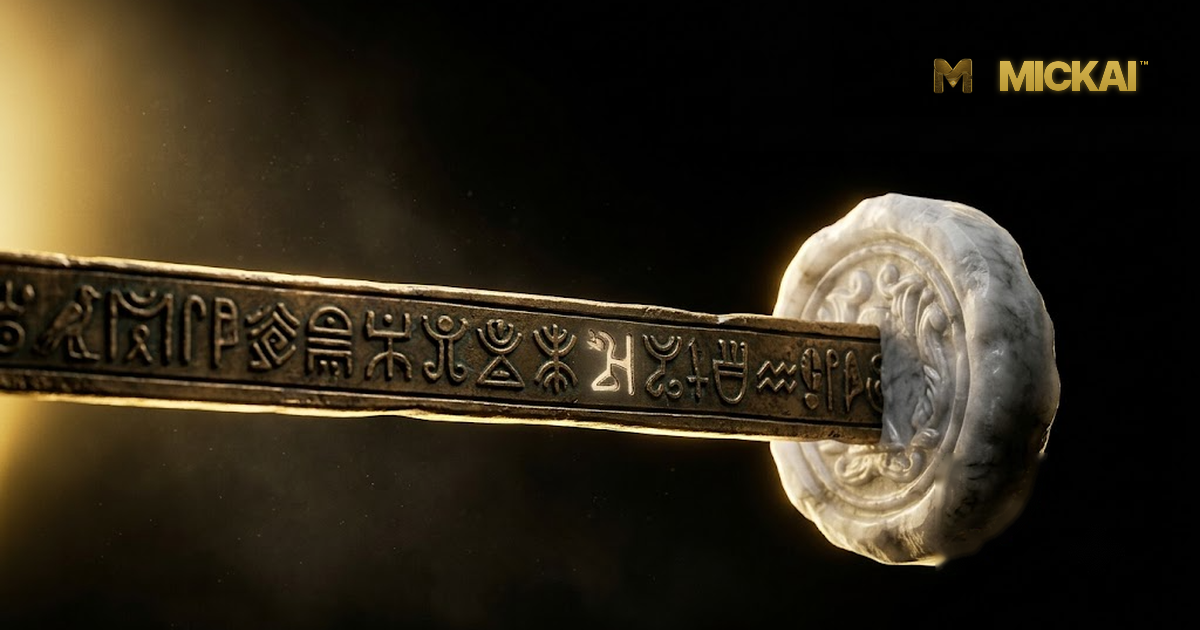
Keep the Logs. Now Prove They Were Not Edited.
A subhead for the age of accountable machines: the question regulators, courts and customers are about to ask is no longer whether your AI kept a record, but whether anyone can prove that record was never touched.
It is two in the morning in a data centre somewhere, and a model is making decisions no human will read until something goes wrong. It approves, it denies, it routes, it flags. Each action lands in a log file, a tidy line of text with a timestamp, an input, an output. The team sleeps soundly. The logs are there. The logs are always there. That is the comfort everyone has lived on for a decade, and it is the comfort that is about to fail.
Because a log is only as honest as the people who hold it. Open the file. Change a word. Move a timestamp by ninety seconds. Delete the line that does not flatter you and write a kinder one in its place. Save. Nothing in an ordinary log resists any of this. It was built to be written and rewritten, and that is exactly the property you do not want the day a customer, an auditor or a court asks what your system actually did.
This is the quiet weakness at the centre of the artificial intelligence boom. We have spent years asking models to explain themselves, and they oblige with fluent, plausible accounts of their own reasoning. The trouble is that an explanation is a story a model tells about itself, generated after the fact, and a story can be wrong, flattering or simply invented. It is not proof. What an auditor, a regulator or a wronged customer actually needs is something colder and far more useful: tamper evident, independently checkable proof of what a specific system actually did, confirmed unedited. Mickai calls that AI validation, and it is a different thing entirely from explainability.
Why "keep the logs" was always only half the instruction
Every compliance regime in the world tells you to keep records. Almost none of them, until now, could tell you how to prove those records were never edited. The instruction was always half written. Keep the logs, yes, and then trust that the people who keep them did not change them. For most of computing history that gap did not matter much, because the stakes were small and the records were boring. With autonomous systems making consequential decisions at machine speed, the gap is the whole problem.
Consider what a tampered record costs. A lender's model declines an applicant, the applicant alleges bias, and the only evidence is a log the lender controls and could have rewritten. A clinical decision tool recommends one path over another, harm follows, and the record of why sits on a server the defendant owns. In each case the holder of the record is also the party with the most to gain from changing it. That is not a small flaw. It is the flaw that makes the record worthless precisely when it matters most.
Mickai's answer starts from an old and unfashionable idea. Blockchain's durable purpose was never speculation and never coins traded for the thrill of it. Its durable purpose was an immutable, independently verifiable record of truth, a way for strangers to agree on what happened without trusting any single one of them. Strip away the noise of the last decade and that is the engineering contribution that survives. The boom that is coming is not built on appetite. It is built on obligation: audit, disclosure, regulation, the slow tightening of rules around systems that act on their own. Mickai got there first, and holds the filed patents to show for it.
Three layers, no privileged access, no need to trust the operator
The fix is not a slogan. It is an architecture, and it has three layers that fit together so that an outside auditor can verify the whole chain in three steps without ever being let inside the building.
First, seal the record. When a Mickai system takes a consequential action, that action is written into an Open Audit Record, the OAR, and the record is sealed and signed with FIPS 204 ML-DSA-65, the published NIST post-quantum signature standard. Mickai adopts that standard, it did not invent it, which is precisely the point: the proof rests on cryptography the wider world already trusts and can check, not on a private scheme you are asked to take on faith. The signature means any later edit, however small, breaks the seal in a way anyone can detect.
Second, anchor the proof. Mickai commits a hash of the sealed record to Bitcoin through Pantheon, its own sovereign, Bitcoin anchored Layer 1 with a native token, PAN, and a fixed supply of five billion. A hash is a short fingerprint of the record. Once that fingerprint is committed to Bitcoin, the record is fixed in time and independently verifiable by anyone, because no one can quietly rewrite Bitcoin's history. Read this part carefully, because it is the part most people get wrong. Pantheon does not move Bitcoin and Pantheon is not a Bitcoin Layer 2. It writes a fingerprint, not a payment. Anchoring is not spending.
Third, run it on sovereign hardware. Mickai is a Sovereign Intelligence Operating System, fifty specialised AI brains running on the operator's own machines, fully offline capable. The record is produced and sealed on hardware the operator controls, not handed to a third party cloud that becomes its own point of trust and its own point of failure. The whole architecture is designed so that proof does not depend on anyone's good word, least of all the operator's.
A worked example: the decision, the dispute, the three step check
Make it concrete. A bank runs a Mickai brain to assess loan applications. On a Tuesday morning the system declines an application. The applicant believes the decision was unfair and, months later, brings a complaint. In the old world the bank reaches for its logs, and the applicant's lawyer immediately asks the only question that matters: how do we know those logs were not edited after the complaint landed? In the old world there is no good answer.
In the Mickai world the sequence is different. At the moment of the decision, the system wrote an Open Audit Record: the inputs the model saw, the policy it applied, the output it produced, all sealed and signed with FIPS 204 ML-DSA-65. A hash of that record was anchored to Bitcoin through Pantheon within the normal anchoring window. Months later, when the dispute arrives, an independent auditor does three things and needs no privileged access to do them. One, check the signature on the record and confirm the seal is intact, which proves the bytes have not changed since the moment of sealing. Two, recompute the hash of the record and confirm it matches the fingerprint anchored to Bitcoin, which proves the record existed in that exact form at that earlier time. Three, confirm the record was produced on the operator's sovereign hardware under the declared configuration. If all three hold, the bank cannot have rewritten the record after the fact, and crucially the auditor reaches that conclusion without trusting the bank at all.
That is the difference between a story and a proof. The bank no longer asks to be believed. It offers something an outsider can check. And the applicant, for the first time, is not arguing against a record the other side could have quietly improved.
“For ten years the industry's answer to accountability was, in effect, trust us, we kept the logs. That answer is about to stop working. The moment you can independently prove what a system did, without being let inside, the conversation changes from belief to evidence. We built the layer that makes that possible, and we filed the patents while everyone else was still arguing about chatbots.”
The boom built on obligation, not appetite
There is a reason this is the next boom and not a niche. The last technology cycle was pulled forward by appetite, by what people wanted to try. This one is pushed forward by obligation, by what institutions are about to be required to prove. Regulators are writing rules for autonomous systems. Courts are meeting their first cases. Customers are learning to ask harder questions. Every one of those pressures points at the same need: not a better explanation from the machine, but a record of the machine's actions that an outsider can verify and that no one, including the operator, can edit after the fact.
Markets that run on obligation behave differently from markets that run on appetite. They are slower to start and far harder to dislodge, because the demand does not evaporate when fashion moves on. Once a regulator requires verifiable records, the requirement stays. Mickai's position rests on getting there before the requirement arrived: 104 filed UK patent applications, 2,340 claims, owned by Mickai LTD, with Micky Irons named as inventor. The portfolio is the first mover moat and the defensibility. It is evidence of how early and how deliberately this was built, not a headline to wave around.
It helps to name the thing precisely, because the industry keeps blurring it. Explainability looks inward and produces a narrative: here, roughly, is why I did what I did. Validation looks outward and produces evidence: here is tamper evident proof of what I actually did, confirmed unedited, checkable by someone with no access to my internals and no reason to trust me. The first is a comfort. The second is a fact. As the stakes rise, comfort stops being enough.
What it means to anchor a record without ever spending a coin
The single most common misunderstanding deserves its own moment, because getting it wrong undermines the whole idea. When Mickai anchors a record to Bitcoin, it is not transacting in Bitcoin, not custodying anyone's coins and not running a payment network bolted to the side of one. Pantheon is Mickai's own Layer 1. It takes the hash, the short fingerprint of a sealed record, and commits that fingerprint so it inherits Bitcoin's permanence. The record itself never leaves the operator's hardware. No value moves. Anchoring is not spending.
The benefit of borrowing Bitcoin's permanence is that the proof does not depend on Mickai continuing to exist, behave or cooperate. Years from now, an auditor can recompute a hash and check it against what was anchored, and the maths either matches or it does not. Mickai's goodwill is not part of the calculation. That is the whole design intent of sovereign infrastructure: to remove the operator, and the vendor, from the list of parties you are forced to trust.
Start now, because the proof has to exist before the question is asked
Here is the part that turns architecture into urgency. Verifiable proof cannot be added in hindsight. You cannot wait for the dispute, the audit or the regulation and then go back and seal records that were written months earlier in an ordinary file, because by then there is nothing to prove they were not edited in the meantime. The seal has to be applied at the moment of the action. The anchor has to be committed while the record is fresh. The proof has to exist before anyone thinks to ask for it, or it does not exist at all.
So the instruction at the top of this piece is not a slogan, it is a deadline. Keep the logs, by all means. Everyone already does. The work that distinguishes the organisations that will be ready from the ones that will be exposed is the second half of the sentence, the half that has been missing: now prove they were not edited. The teams that begin sealing and anchoring their records today will, when the hard question finally lands, simply hand over proof. The teams that waited will be left holding a file and a promise, and a promise is exactly what is about to stop being accepted.
The validation layer is not a feature you switch on later. It is a posture you adopt now, or wish you had. Mickai built it as the spine of a Sovereign Intelligence Operating System rather than as an add on, because proof that can be removed is not proof, and trust that can be asked for is not evidence. The next era of artificial intelligence will be defined less by how clever the models are and more by whether anyone can verify what they did. On that question, the answer is already being written, one sealed record at a time.
About Mickai
Mickai is a Sovereign Intelligence Operating System, fifty specialised artificial intelligence brains that run on the operator's own hardware, fully offline capable. Every consequential action is sealed in an Open Audit Record and signed with FIPS 204 ML-DSA-65, the published NIST post-quantum signature standard, then anchored to Bitcoin through Pantheon, Mickai's own sovereign Layer 1 (native token PAN, fixed supply five billion), so the record is permanent and independently verifiable by anyone. Pantheon commits a hash of the record, it does not move Bitcoin and is not a Bitcoin Layer 2: anchoring is not spending. Mickai's portfolio of 104 filed UK patent applications, 2,340 claims, is owned by Mickai LTD, with Micky Irons named as inventor. Mickai is held privately by its founder, Micky Irons.