Is your AI provider about to become a UK critical third party?
Possibly: FSMA 2023 lets HM Treasury designate providers critical to UK finance, and AI services concentrate exactly the way cloud does.
Possibly, and the direction of travel points that way. The Financial Services and Markets Act 2023 created a critical third parties regime: HM Treasury can designate a third-party service provider as critical to the UK financial sector, which places the provider itself, not just the firms using it, under direct oversight by the Bank of England, the PRA and the FCA. The operational-resilience requirements for designated critical third parties took effect from 1 January 2025. Which providers have been or will be designated is for HM Treasury and the regulators to announce; the machinery of the regime is settled.
The question matters in 2026 because financial entities are wiring AI services into credit, fraud, onboarding and customer processes, and those services concentrate exactly the way cloud infrastructure does: many firms, few providers. The regime exists because concentration in a handful of previously unregulated suppliers became a stability question.
What is the UK critical third parties regime?
A mechanism for regulating the supplier rather than only the buyer. Under FSMA 2023, HM Treasury can designate a third-party provider whose services matter so much to the sector that failure or disruption would raise systemic concerns. Once designated, the provider comes under the direct oversight of the Bank of England, the PRA and the FCA for the services it supplies to the sector. The regime recognises a gap: outsourcing rules aimed at regulated firms never reached the handful of suppliers the whole sector now stands on.
Why would an AI provider meet the bar?
Concentration. The regime was built with cloud providers as the obvious first candidates, and AI services concentrate the same way: a small number of providers embedded in many firms at once, supplying a capability that is hard to substitute quickly. An AI service woven into fraud screening or credit workflows across much of the sector has the same systemic shape as a cloud region. Whether and when any AI provider is designated is a matter for HM Treasury and the regulators, and no designation should be assumed; the shape of the dependency is what makes the question worth asking now.
Does designation take the responsibility off your firm?
No, and this is the point most easily missed. Designation regulates the provider; it does not transfer the firm's own responsibility for its services. A firm cannot answer its supervisor by pointing at the oversight of its supplier. Operational-resilience expectations still require the firm to know which important business services depend on which providers, to set impact tolerances and to test against them. Concentration risk remains the firm's problem: a regulated dependency is still a dependency.
What should a financial entity check about its AI dependencies?
A short list answers most of it.
- Mapping: which important business services have an AI service in the critical path, including AI embedded inside other vendors' products.
- Substitutability: how long a switch to an alternative would take, and whether prompts, evaluations and integrations would carry across.
- Data retrievability: what the provider holds, and how quickly it could be returned or evidenced during an incident.
- Incident visibility: whether the firm would learn of degradation from the provider or only from its own monitoring.
Firms that cannot answer these for AI services can usually answer them for every other critical supplier, which is the tell that AI adoption ran ahead of third-party risk management.
Can a firm simply wait for designation to solve the problem?
No. Designation is aimed at the stability of the system, not at any single firm's resilience. Oversight gives the sector a regulator with visibility of the supplier; it gives an individual firm no new control over its own dependency, no faster exit and no better evidence during an incident. The EU reached a similar conclusion in DORA, in force since 17 January 2025: a regime for critical providers sits alongside each entity's own responsibility, it does not absorb it. Waiting for designation is waiting for someone else to manage a risk that stays on the firm's own books.
What if the AI layer is not a third party at all?
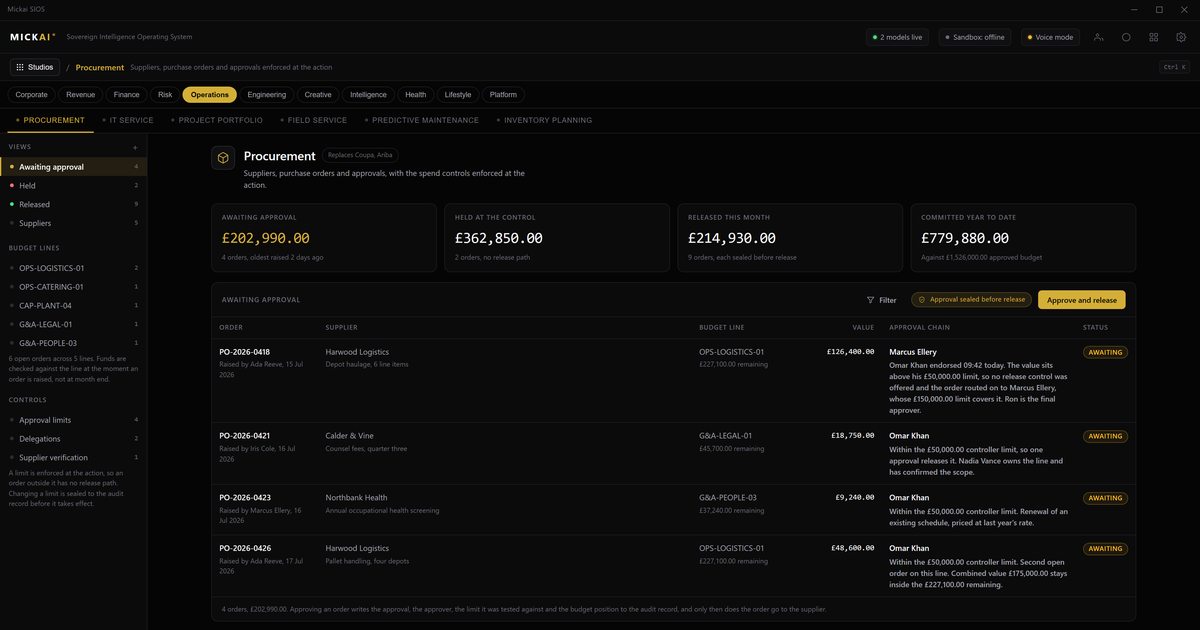
Then the analysis changes shape. An AI capability the firm owns and operates on its own hardware is not a third-party service: there is no hosted dependency to designate, no shared region to model, no exit plan to write for the running system. That is the structural answer a sovereign deployment gives. Mickai is a Sovereign Intelligence Operating System that runs offline on operator-owned hardware behind a zero-egress perimeter, with every action sealed to a post-quantum signed audit ledger bound to hardware-attested identity. A vendor relationship remains for software and support, and ordinary supplier management covers our part; the service itself, and the data inside it, sit within the firm's own boundary, where operational-resilience evidence is the firm's to produce rather than a provider's to promise.
“Designation regulates a critical dependency; ownership removes the dependency from the analysis altogether.”
The architecture that brings the AI layer inside the firm's own boundary is set out at /sovereign-ai, and the film at /film shows that system operating with no external dependency in the loop.
Frequently asked questions
Has my cloud AI provider already been designated as a critical third party?
Designations are announced by HM Treasury and the regulators, and firms should check official sources rather than assume any provider's status. The regime's requirements for designated critical third parties took effect from 1 January 2025, so the machinery is live; which providers hold the designation at any time is for the authorities to state.
If my provider is designated, can I rely on that oversight instead of my own checks?
No. The regime regulates the provider for the benefit of the sector and leaves each firm's responsibility for its own services untouched. Supervisors will still expect the firm to map its dependencies, set impact tolerances, test its resilience and manage concentration risk, whoever oversees the supplier.
Does the UK critical third parties regime cover EU entities in my group?
No. It is a UK regime created by FSMA 2023 for the UK financial sector. EU entities sit under the EU's separate operational-resilience framework, DORA, in force since 17 January 2025. Groups operating in both markets must satisfy both, which raises the value of dependencies that are simple to evidence in either regime.
How do I reduce concentration risk from AI services?
Three routes exist: diversify across providers, which adds cost and complexity; strengthen exit plans and substitutes, which shortens recovery; or bring the capability inside the firm's own boundary, which removes the hosted dependency for the running service. The routes are not exclusive, and the right mix depends on which business services are critical.
Is on-premise AI still a third-party dependency?
The software and models have a vendor, so supplier risk management still applies to updates, support and licences. The difference is that the running service and its data operate on the firm's own infrastructure: an outage at the vendor does not stop inference, and the evidence of what the system did belongs to the firm rather than to a provider.