Is air-gapped AI less capable than cloud AI?
For most enterprise work no, for a narrow set of frontier tasks yes, and regulated buyers should know which.
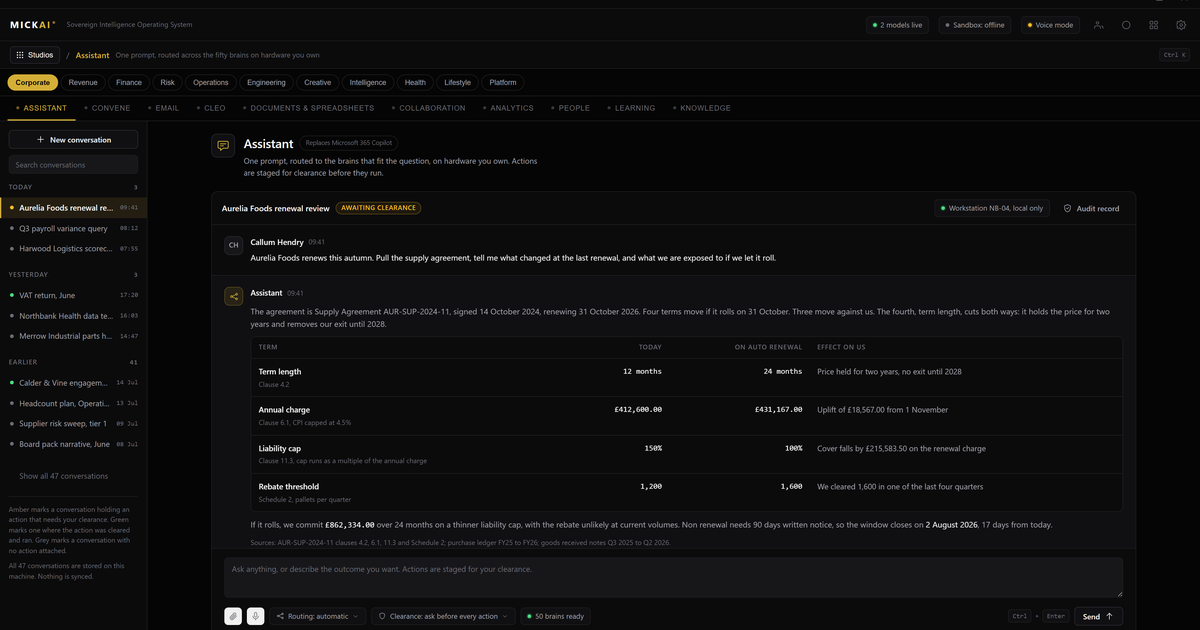
For most enterprise work, no, and no longer materially. Current-generation models running on operator-owned hardware handle drafting, extraction, summarisation, retrieval and structured analysis at production quality. For a narrow set of frontier tasks the answer is yes, and a regulated buyer should know exactly which tasks sit in that set before deciding anything.
The question matters in 2026 because regulated organisations are choosing between public cloud services they cannot use for certain data, such as ChatGPT, Claude, Gemini and Microsoft 365 Copilot, and sovereign deployments they control. The choice should rest on a precise account of the trade, not on an assumption that disconnected means diminished.
What can air-gapped AI actually do at production quality?
The workloads that fill an enterprise day. Drafting and revising documents in house style. Extracting structured fields from contracts, claims and correspondence. Summarising long records into decision-ready briefs. Retrieval-augmented answering over internal document stores. Classification, triage and structured analysis of case files. Current-generation sovereign models handle these on a single capable machine, and inference is selectable between CPU and GPU, so drafting and retrieval workloads can run on hardware many organisations already own.
What do you give up when you disconnect?
Three things, and it is worth being exact about them.
- The largest frontier models: the very top of the capability range remains cloud-hosted, and the gap shows on open-ended reasoning at the frontier of difficulty.
- Always-current knowledge: an offline model knows nothing published after its training date unless the material is imported.
- Elastic burst capacity: a fixed installation cannot rent ten times its compute for one afternoon.
What you do not give up is accuracy on your own documents, because retrieval over an internal corpus depends on the corpus, not on the cloud.
When does the capability gap actually matter?
When the task is open-ended research at the edge of model capability, when it depends on what happened on the public web this morning, or when demand arrives in rare and enormous spikes. Most regulated workloads have the opposite shape: repeatable tasks, internal knowledge, steady volume, and a duty to show the working afterwards. A buyer who lists actual workloads usually finds the frontier set is small, and that the tasks in it are rarely the ones involving regulated data.
What do you gain that cloud AI cannot offer?
Provability. Data that never leaves the building, behind a zero-egress perimeter with no outbound routes. Deterministic versioning: the model that ran in March is bit-for-bit the model that can be rerun in November, a guarantee multi-tenant services do not generally offer. And a sealed audit trail: on Mickai, a Sovereign Intelligence Operating System, every action is sealed to a post-quantum signed audit ledger bound to hardware-attested identity, and the record verifies offline, without trusting the operator's network or ours. A cloud contract can promise some of these properties, and a contractual promise is not a technical guarantee.
How do you keep an offline system current?
Deliberately. Curated corpora, regulatory texts and reference material are imported through a controlled inbound perimeter on a schedule, reviewed and versioned before use. Zero egress restricts what leaves, not what may be deliberately brought in, so currency becomes a managed property rather than an ambient one. Retrieval then does the daily work, because most questions an enterprise asks are answered by its own documents, which no public model has ever seen. Model updates arrive the same way, as signed and versioned artefacts, so every change of capability is itself an auditable event.
How does cross-model consensus change the single-model question?
A sovereign deployment is not committed to one model. Mickai runs cross-model consensus: material outputs can be cross-checked by more than one sovereign model, and disagreement is surfaced instead of averaged away. For regulated work this converts a capability question into a reliability control. An error one model makes and another catches leaves a sealed record of both, and the classes of task where consensus disagrees are exactly the classes that deserve human review.
What should a buyer test before deciding?
Run the substitution test. Take one week of real workload from one team, anonymised where needed, and run it through a sovereign deployment on operator hardware. Score the outputs blind against the incumbent process on accuracy, revision effort and turnaround. Then apply the second filter: for each task where the cloud wins, ask whether that task involves data the organisation is permitted to send to the cloud at all. Capability a buyer cannot lawfully use is not capability, it is temptation.
“For regulated work the constraint that matters is provability, not benchmark points.”
How the full architecture fits together is set out at /sovereign-ai, and the film at /film shows the interface in operation.
Frequently asked questions
Can air-gapped AI match ChatGPT for my business writing?
For drafting, revision and summarisation in a defined house style, current-generation sovereign models produce comparable output, and retrieval over internal documents often makes them stronger on organisation-specific content. The visible differences concentrate in open-ended frontier reasoning, which is rarely what business writing requires.
How does an offline model stay up to date with regulation?
Through controlled imports. Regulatory texts and guidance are brought in through an inbound-only perimeter, then versioned and indexed for retrieval. This is often stronger than cloud currency, because the deployment records exactly which version of which text informed each answer, and can prove it afterwards.
Do I lose model quality by running inference on CPU instead of GPU?
Quality no, speed sometimes. The same model produces the same class of output on either; CPU inference trades throughput for deployability. Drafting, extraction and retrieval run acceptably on modern CPUs for many team sizes, which is why we make inference selectable between CPU and GPU rather than assuming accelerators at every site.
Is air-gapped AI overkill if my data is only commercially sensitive?
That is a risk decision, not a capability decision. The question is what an egress event would cost the organisation, and whether a contractual assurance is enough. Organisations subject to DORA, GDPR or professional confidentiality duties increasingly conclude that data which never leaves needs no assurance at all.