Inventory and stock control on your own operating system
Run stock, locations and reorder on hardware you own, wired to orders, procurement and finance on one sovereign operating system.
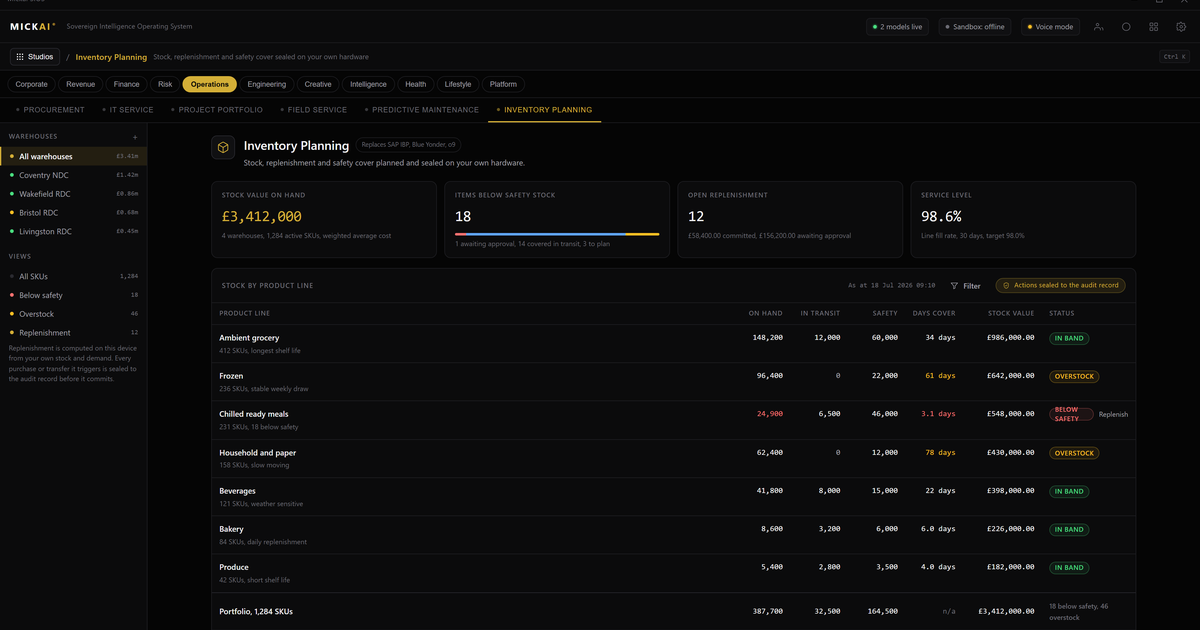
Your stock, your locations and your reorder rules can run on hardware you own, on one operating system, connected to orders, procurement and finance. The inventory studio is not a separate app you bolt on and sync overnight. It is a studio on the MICKAI sovereign operating system, sharing the same company data as everything else you run.
That is the whole idea. Most firms rent inventory software by the seat, keep it in a vendor cloud, and then pay again to wire it to their orders and their accounts. We put inventory on an operating system you own, next to the studios it needs to talk to, so the wiring is already there.
What the inventory studio actually does
The inventory studio holds the things every operations team needs and nothing it does not.
You track stock by item, by variant and by location. You hold multiple locations at once, a main warehouse, a van, a shop floor, a bonded area, and see the true position across all of them. You set reorder points and reorder quantities per item per location, so a line that drops below its threshold raises a suggested purchase rather than a surprise stockout.
You receive goods against a purchase, book them in, and the counts update in place. You pick and pack against an order, and the counts fall as stock leaves. You count and adjust with a reason on every change, so shrinkage, breakage and correction are recorded rather than absorbed. You move stock between locations with a transfer that debits one and credits the other.
Barcodes and handheld scanners work as they are. You keep your labels, your printers and your scanners, and point them at software you own.
One operating system, not five apps
The reason inventory is painful in most companies is not the counting. It is the seams. Orders live in one tool, stock in another, purchasing in a third, and finance in a fourth, each with its own login, its own copy of the product list, and a nightly job that tries to keep them agreeing.
On the MICKAI operating system there are no seams to maintain, because there is one set of company data underneath all the studios.
A dispatched order in the orders studio decrements stock in the inventory studio in the same moment. An item that falls below its reorder point raises a draft purchase in the procurement studio, already filled with the supplier, the quantity and the last price you paid. When the goods arrive and you book them in, the receipt posts to the finance studio against the right account. The product you sell, the product you count and the product you buy are the same record, not three records that a sync tries to reconcile.
The assistant runs across all of it. You can ask it which lines will stock out this week given open orders, what your holding value is by location, or which supplier is slowest to fulfil, and it answers from your own data because it sits on the same operating system as the studios. It is not a chatbot bolted to the side. It is one assistant across the whole stack.
We are describing what the reasoning layer does for the studios, not the model underneath it. What matters to your operations team is that the answers come from your own live stock position, on your own hardware.
The money you stop renting
Inventory and stock software is usually sold per user per month, in a vendor cloud, on a subscription that never ends. The cost is easy to underrate because it is small each month and large across the year and across the team.
Here is the method, because the method is the honest part. Take the published list price of the inventory or operations software you rent, per user per month. Multiply by the number of people who need a seat. Multiply by twelve. That is one year of renting the software before you count the separate connectors, the integration work and the storage.
A worked example, conservative and clearly assumed. Say a mid-sized operation puts 40 people on inventory and operations seats. Say the published list price you are paying is 30 pounds per user per month, which sits inside the range that inventory and operations tools are openly listed at. Then the yearly figure is 40 times 30 times 12, which is 14,400 pounds a year, every year, for the software alone. Put 80 people on it and the same method gives 28,800 pounds a year. Change the inputs to match your own contract and the arithmetic holds.
State your own numbers into that formula and you have your figure. The point is not the exact pounds. The point is that it recurs forever and it is rent on software you will never own.
We do not publish a MICKAI price in this article. What we are showing is the recurring cost you are carrying today, and the fact that when inventory runs on hardware you own, that per seat meter is not the model you are on.
Air-gapped by default, audited by design
A warehouse is a hard place for cloud software. Connectivity is patchy, the work does not stop, and a dropped link should never stop a pick.
The operating system is air-gapped by default. The inventory studio scans, picks, counts and reorders on the local hardware whether or not there is a connection to anything else. A link to head office or to a supplier is a choice you make deliberately, not a dependency the software forces on you to function at all.
Every movement is written to an action-level Open Audit Record. This is not a login log. It is a record of the actual actions, the receipt, the adjustment, the transfer, the reorder, with who did it and when. When an auditor asks how a count was corrected, or a customer asks when their order left the building, you answer from your own records rather than raising a ticket with a vendor.
Private deployment is the baseline here, not the headline. Plenty of vendors will run their software in your tenancy. Our value is past that line. The whole software stack runs on hardware you own, the audit is at the level of the action, the default is air-gapped, and the focus is the regulated small and mid-sized firm that has to prove what happened, not just assert it.
Built as one of many studios
The inventory studio is one of 63 studios on the same sovereign operating system. Email, meetings, orders, procurement, finance, the assistant, all of them run on one operating system, on hardware the customer owns, sharing the company's own data. Inventory is not a standalone product with a bridge to the rest. It is a studio among studios, which is why the connection to orders, procurement and finance is native rather than integrated.
The platform is backed by 104 filed UK patent applications carrying 2,340 claims. Those are filed applications, not granted rights, and they sit behind the product rather than in front of it. What you buy and run is the operating system and its studios. The patents describe how it is built.
If you run stock today across a rented inventory tool, a rented orders tool and a rented finance tool, wired together by nightly jobs and paid for by the seat, the inventory studio replaces the rent and removes the seams in one move. You own the hardware, you own the data, and you run stock, locations and reorder on one operating system with everything they need to talk to already in the same place.
FAQ
Where does our stock data live? On hardware you own. Stock levels, locations and supplier records stay on your own machines. Nothing is copied to a vendor cloud to make the software work.
Does it connect to orders, procurement and finance? Yes. They are studios on the same operating system, sharing one set of company data. A dispatch decrements stock, a low level raises a purchase, and a receipt posts to finance, with no export between separate apps.
Can it work with no internet connection? Yes. The operating system is air-gapped by default, so a warehouse with poor connectivity still scans, picks and reorders locally.
Do we have to replace our barcodes and scanners? No. It reads standard barcodes and works with common handheld scanners, so you keep your labels and hardware.
Who can see what changed and when? Every movement, adjustment and reorder is written to an action-level Open Audit Record you can show an auditor or a customer from your own records.
Is there a per user monthly fee? We do not publish MICKAI pricing here. The comparison in this article is the recurring per seat cost of rented inventory software, which you stop paying when the software runs on hardware you own.
Frequently asked questions
Where does our stock data live?
On hardware you own. The inventory studio runs on the MICKAI sovereign operating system inside your own building or rack. Stock levels, locations and supplier records stay on your machines. Nothing is copied to a vendor cloud to make the software work.
Does it connect to orders, procurement and finance?
Yes. Inventory is a studio on the same operating system as orders, procurement and finance, sharing one set of company data. A dispatched order decrements stock, a low level raises a purchase, and the receipt posts to finance, without a nightly export between separate apps.
Can it work with no internet connection?
Yes. The operating system is air-gapped by default. A warehouse with poor connectivity still scans, picks and reorders locally. When a link exists it is a choice you make, not a requirement the software imposes.
Do we have to replace our barcodes and scanners?
No. The inventory studio reads standard barcodes and works with common handheld scanners. You keep your labels and hardware and point them at software you own instead of software you rent.
Who can see what changed and when?
Every stock movement, adjustment and reorder is written to an action-level Open Audit Record. You can show an auditor or a customer exactly what happened, who did it, and when, from your own records.
Is there a per user monthly fee?
We do not publish MICKAI pricing here. The point of the comparison in this article is the recurring per user per seat cost of rented inventory software, which you stop paying when the software runs on hardware you own.