Introducing Pantheon: proof, not promises
Mickai is bridging sovereign artificial intelligence to its own blockchain. Pantheon settles every sealed AI action on a chain the operator controls and anchors the proof to Bitcoin, so a regulator can verify what an AI did, offline, without trusting the vendor. This is blockchain used for the purpose it was invented for, applied to the accountability problem of the AI era.
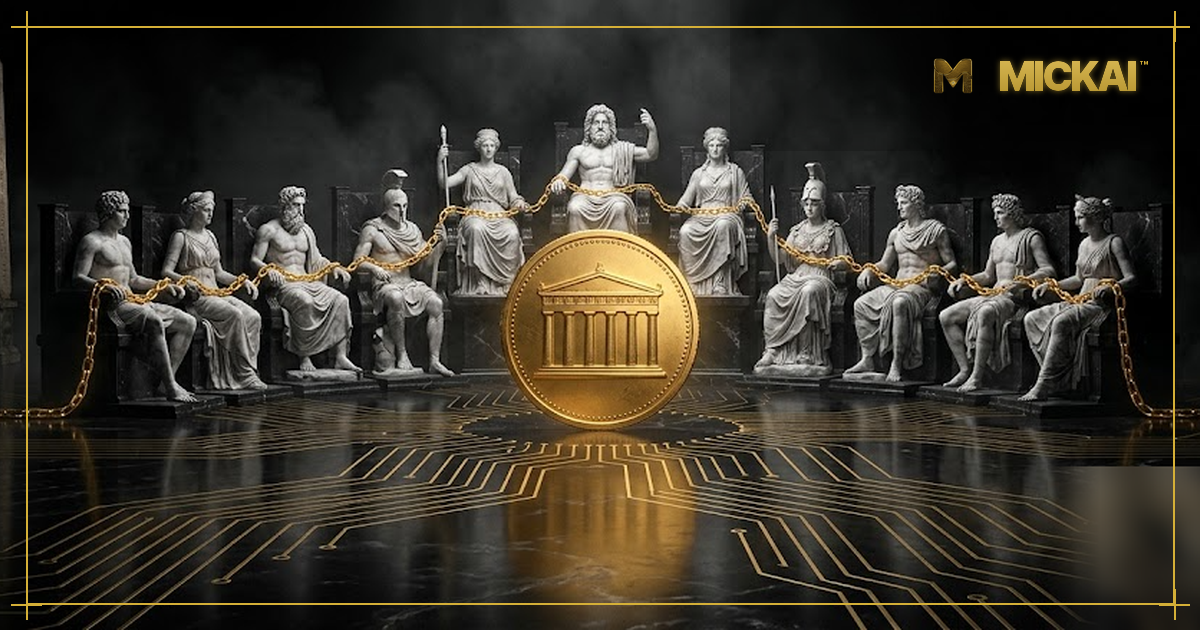
Today Mickai is announcing Pantheon, a sovereign blockchain built to do one thing the rest of the artificial intelligence industry cannot do. Make every action an AI takes provable to a regulator, a court, or a counterparty who does not have to trust the company that built it. Pantheon settles the sealed record of an AI decision on a chain the operator controls, and anchors the proof of it to Bitcoin. The result is a timestamped, publicly verifiable record of what a machine did, that no administrator can quietly edit and no vendor can withdraw.
This is not a token in search of a use. It is blockchain used for the exact purpose it was invented for, a record anyone can verify and no one has to trust, pointed at the defining accountability problem of the AI era. That is the line that separates Mickai from the giants, and it is the reason a regulator should care.
What blockchain was built for
Blockchain was built to remove the trusted intermediary. It made the ledger itself the proof: append only, hash linked, checkable by any party from first principles. The coins took the headlines. The property underneath, a record that carries its own proof, was always the point.
Artificial intelligence has arrived at exactly the problem that property solves. An AI makes a decision that touches a patient, a defendant, a claimant, or a citizen. Later, someone has to verify what it did, and they cannot be asked to simply trust the vendor that built it. Most of the industry's answer is a log, held in the provider's tenancy, writable by the provider's staff, and presented on request. A log an administrator can edit is not proof. It is a promise.
Proving it on hardware is only half the answer
Mickai already seals every AI action at the moment it happens, under a post-quantum signature, on hardware the operator owns. That solves integrity on the machine. It does not, on its own, let an outsider verify the record without coming to the machine. Proving something privately on your own hardware is one thing. Being able to publicly verify it, against a timestamp anchored to the most adversarially tested chain in existence, is another thing entirely. Pantheon is how the private proof becomes a public one.
The trust chain: seal, settle, witness
Pantheon works as three independent layers of evidence, and the strength of the design is that no single one of them has to be trusted on its own.
- The seal. On the operator's own machine, an AI action is sealed under FIPS 204 ML-DSA-65, the post-quantum signature scheme the National Cyber Security Centre names for the migration, before it executes its consequences. The Open Audit Record captures the input, the model snapshot, the retrieval set, the policy state, the decision, and the time, in one write.
- The settlement. The sealed record settles to the Pantheon Layer 1 in the native token, where a stake-weighted validator set re-verifies the seal and its hash-chain linkage as a condition of block validity. The chain does not decide what is true. It orders what was already proven. This is a filed invention.
- The witness. A 32-byte Merkle fingerprint of the audit root is anchored to Bitcoin via timestamp proofs. No payload, no wallet, no validators, no protocol cost. The oldest chain testifies that the history existed, unaltered, at a point in time. This is a filed invention too.
A regulator, a counterparty, or a court can check any action against all three, none of which require trusting Mickai, the operator, or each other. Proof, not promises.
The Layer 1: Pantheon
Pantheon is a standalone sovereign solochain built on the Polkadot SDK, the Substrate framework. No relay chain, no parachain slot, no third-party token dependency. The choice is not aesthetic. The SDK is Rust, so Mickai's existing post-quantum Open Audit Record code becomes the chain's native attestation layer rather than being rewritten. The runtime makes the audit record a first-class object of consensus, so a block is valid only if every action record in it was sealed under ML-DSA-65 before it reached consensus. The central claim is literally true on-chain.
Block production and finality use the framework's audited machinery, nominated proof-of-stake with finality in seconds, stock and unmodified. Years of external audits are inherited rather than re-earned, so the engineering effort goes where the moat is, the attestation layer and the application chains. The runtime is organised as a small set of purpose-built modules: a native asset module holding a fixed supply with no mint authority, the ported Open Audit Record as signed extrinsics, staking that pays rewards from a pre-allocated pool rather than by inflation, governance, a settlement fee engine, a buyback-and-lock module that locks rather than burns, and an anchor module that commits the audit root to Bitcoin on a cadence.
The Layer 2s
Pantheon's Layer 2 is a family of fifteen application chains, one for each live subsystem of the Mickai operating system, from audit and trading to knowledge, health, legal, compliance, identity, and hardware. Each executes its own workload and settles its sealed actions down to the Layer 1 in the native token. They launch as runtime modules with no bridge risk on day one, and graduate into separate chains only when throughput demands it, the same staged path the major rollup ecosystems took, without inheriting a landlord. The tradeable form of the token is an omnichain asset, lock-and-mint bridged to the Layer 1 through a post-quantum, egress-gated bridge that is itself a filed invention, so the amount minted on any external venue can never exceed the amount locked, and one fixed supply spans every chain.
Why Bitcoin
Mickai does not fork Bitcoin or build on it. Bitcoin has no smart contracts and no application chains, which makes it the wrong tool for settlement and the right tool for witnessing. Anchoring the audit root to Bitcoin costs nothing, needs no wallet and no validators, and buys the one thing money cannot manufacture: time. A fingerprint placed on Bitcoin today can be checked in 2035 against the most durable public record humanity has built. For a public-sector audit that has to survive a change of government, a change of vendor, and the arrival of quantum computing, that durability is the whole point.
The token: PAN
Pantheon's native token is PAN. It is the unit the network runs on, not a coupon for speculation. Every application-chain action settles its fee in PAN to the base layer. Validators bond PAN to secure the chain and earn from a pre-allocated staking pool, never from new issuance. PAN holders govern the parameters, the treasury, and the lock policy by referendum. And a defined share of real protocol revenue buys PAN on the open market and locks it, so genuine usage of the system reduces the circulating supply over time. Locking, never burning.
The total supply is fixed at 5,000,000,000 PAN, set at genesis, with zero inflation and no mint authority anywhere in the runtime. The supply that exists on the first day is the supply that exists for the life of the chain. This is a deliberate contrast with networks whose economics depend on printing more of the asset to pay for their own security.
Open to anyone
Securing Pantheon is open. Anyone can download the validator software, run it on a machine or a server, bond PAN, and earn. Holders who would rather not run anything can delegate their stake to a validator and share the reward. And every machine in the Mickai hardware lineup ships pre-configured as a validator appliance, hardware-attested and earning from first boot, so the same box that runs your sovereign AI also helps secure the chain that proves it. The set is designed to be large enough to be credibly decentralised and open enough that a serious individual can join.
What this means for the public sector
This is the part that matters to a regulator, and it is the part the design was built around. The operator's records stay sealed and private under their own key. Nothing sensitive is ever placed on a public chain. Only the proof, the 32-byte fingerprint, is anchored. The contract address that lets an auditor check a report against the chain is given to regulated auditors, not broadcast to the world. So when an auditor receives a report from a department, a bank, or a hospital, they check it against the on-chain anchor. A match means the record was not altered after it was sealed. A mismatch means it was. The auditor never has to trust the vendor or the operator, and never has to see inside the sealed record to know it is intact.
The Open Audit Record format is published as an open standard, so any third party, a regulator, a court, an opposition, or an allied government, can verify a sealed action offline with no permission from Mickai. That turns AI audit, compliance evidence, and regulatory reporting from a matter of vendor assurance into a matter of arithmetic. It is the difference between a pipeline that asks the public to trust the supplier and one that lets the public check the supplier.
How this is different from the giants
The large AI companies are building offices and data centres, and that investment is real. But the operator who rents their intelligence still does not hold the keys, the audit chain, or a full independent copy of their own data. The provider does. What they can offer for accountability is a log inside their own perimeter. Mickai offers a proof outside everyone's perimeter, settled on a chain the operator controls and witnessed by Bitcoin. One is a promise. The other is evidence. That is what it looks like to use blockchain for what it was designed for, and it is value the giants structurally cannot match without giving up the control their business depends on.
The intellectual property
Pantheon is not a whitepaper of intentions. The architecture is filed. The Pantheon bridge family is eleven UK patent applications, GB2613386.8 to GB2613404.9, covering the post-quantum anchoring of an audit root to a public proof-of-work chain, the consensus admission and ordering of operator-sealed action records, the settlement of sealed AI actions in a native token, the selective-disclosure proof that a sealed record satisfies a compliance rule against an on-chain anchor, and the post-quantum cross-chain bridge with egress gating. They sit inside a wider portfolio of 104 filed UK patent applications, 2,340 claims, owned by Mickai LTD, named inventor Micky Irons.
Conversations
The Mickai Sovereign Intelligence Operating System is built, live, and production-ready today. Pantheon is its proof layer taken public, and we are now bringing it to mainnet. We welcome conversations with professional, sophisticated, and high-net-worth investors, and with partners and advisers who understand sovereign infrastructure and the public-sector opportunity it serves. If that is you, the door is open. Reach us through mickai.co.uk.
This article is information about technology. It is not an offer of securities, a solicitation, or a financial promotion, and nothing in it is an inducement to invest or a recommendation. Any future participation would be made available only to qualified investors, on terms provided through the appropriate regulated channels. The value of investments can fall as well as rise.
Blockchain spent its first decade looking for a problem worthy of its one real property. AI accountability is that problem. The Mickai operating system is built and already proving it. Pantheon takes that proof public, for the reason chains were invented, to make the record the proof. That is Pantheon.