Internal chat and departments you own: our alternative to Slack
Our team chat and departments studio runs on hardware you own. Messages, files and history stay in the company and feed the assistant.
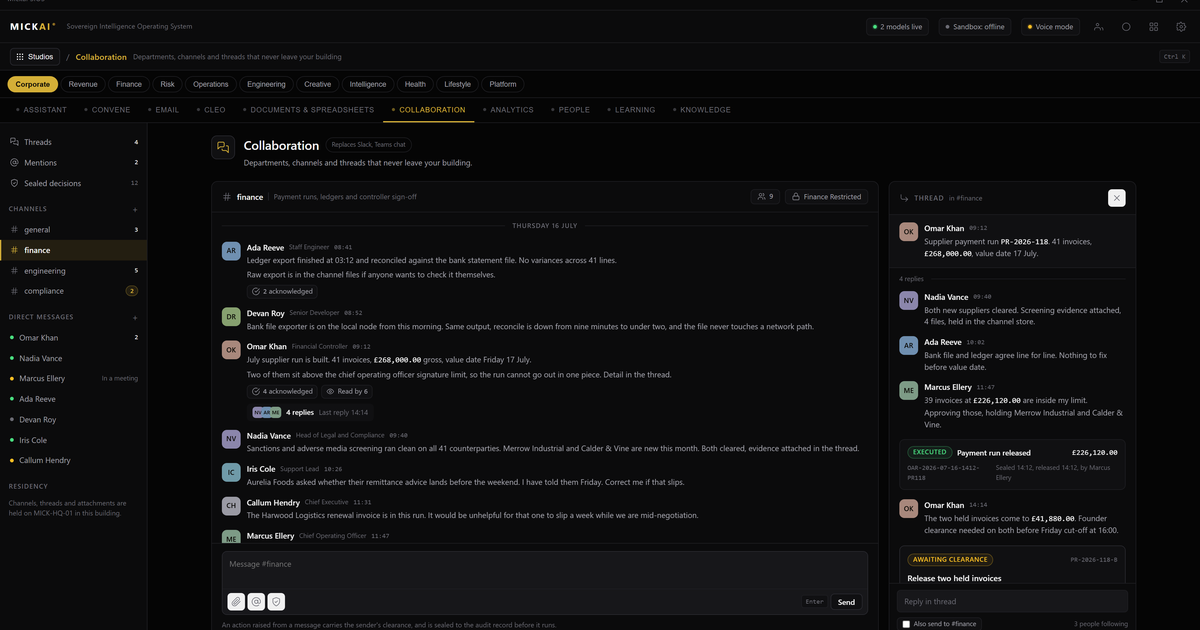
Our team chat and departments studio is a Slack alternative that runs on hardware you own. Your channels, direct messages, files and full history stay inside the company instead of sitting on a vendor's cloud. And because it is one studio on the MICKAI sovereign operating system, the same conversations feed the assistant that works across your email, meetings, CRM and every other studio.
That is the difference. Slack is a chat product you rent per person, per month, forever, and your history lives on their servers. Ours is chat you own, where the record of how your business talks to itself becomes an asset the rest of your system can use.
What the studio does
The studio gives you what a modern team expects. Channels for teams, projects and topics. Direct messages and group messages. Threaded replies so a busy channel stays readable. File sharing with the files held in your own storage. Search across the whole history. Mentions, reactions and pinned messages. Nothing about the daily experience asks your people to work differently.
The departments layer sits on top. Every team in the business gets its own space with its own channels, its own shared files and its own view of the work. Sales, operations, finance, support and the rest each get a room that belongs to them, while leadership sees across all of them. It is the org chart made into a working surface rather than a diagram.
Why owning the messages matters
Most companies underrate their own chat history. Years of decisions, context, handovers and institutional knowledge accumulate in the channels. On a rented platform that record is held by the vendor, priced per seat, and gone if you stop paying or if they change terms.
When you own the messages, three things change.
First, the history is yours permanently. It does not disappear when a licence lapses or a plan tier changes.
Second, the vendor cannot see it. The studio is air-gapped by default. Your commercial conversations, your customer names, your internal debates stay inside your building. Private deployment where the vendor cannot read your data is our baseline, not a premium add-on.
Third, and this is the part a rented tool cannot do, the messages become fuel for the assistant.
One assistant across the whole company
The studios are not separate apps bolted together. They are studios on one operating system, sharing one company data layer and one assistant.
So the assistant that helps in chat is the same assistant that drafts your email, prepares your meetings and updates your CRM. A decision reached in a sales channel is available when the assistant writes the follow-up email. A support thread concerning a recurring fault is available when the assistant summarises the week for operations. The knowledge does not stay trapped in one tool.
Rented stacks cannot do this cleanly because the data is split across separate vendors who each hold a piece and charge for the connection. When you own the whole stack, the assistant reads across all of it because it is all yours.
Every action on the record
Ownership without accountability is not enough for a regulated firm. Every action in the studio is written to the Open Audit Record. You can see who posted, who shared a file, who was added to a department, who exported a conversation, at the level of the action rather than just the login.
For a firm that has to answer to a regulator or an auditor, that record is the difference between saying what your policy is and showing what actually happened.
The cost comparison, done honestly
Slack publishes its pricing per user, per month. That is the number to work with, because we do not publish MICKAI pricing and will not invent one here.
The method is simple. Take your headcount, take Slack's current published paid rate per user per month, and multiply by twelve for the annual figure. Then multiply by the number of years you expect to keep the tool.
As a worked example using round numbers, a 200 person company on a paid plan at a published rate of, say, ten pounds per user per month pays 200 times 10 times 12, which is 24,000 pounds a year, every year, rising as you hire. Over five years that is 120,000 pounds in rent for a chat tool whose history you never own. Substitute Slack's actual current published rate and your own headcount to get your real figure. The assumption to state plainly is that per seat pricing scales with headcount and never stops.
Against that, our studio is one part of an operating system you run on hardware you own. We are not going to pretend the owned model has no cost. It has hardware and it has a platform. But the shape is different: you are buying a system you keep, not renting a seat you lose the moment you stop paying, and the chat is one of many studios on the same platform rather than a standalone subscription.
Where this fits
Our team chat and departments studio is one studio on a platform that spans 63 studios on the same sovereign operating system. Most companies do not switch everything at once. Clients onboard onto an initial focused set of studios that matter most to them and grow from there, with each new studio joining the same data layer and the same assistant.
Chat is a natural place to start because it touches everyone and the value of owning the history compounds from day one.
Who we built it for
We built this for regulated small and mid-sized firms. The heavyweight vendors optimise for very large enterprises and leave smaller regulated businesses to rent tools that hold their data elsewhere. Those firms have the same duty to keep client information inside the business, and the same need for a clear audit trail, without the appetite to run a large in-house platform team.
That is the gap we serve. A whole software stack the company runs on its own hardware, chat and departments included, rather than a model or a single app you have to integrate.
The short version
Slack rents you chat and keeps your history. We give you chat and departments you own, on your own hardware, air-gapped by default, with every action on the Open Audit Record. Your messages and files stay in the company, and the same data makes the assistant across every other studio smarter. Rent the seat or own the system. That is the choice.
FAQ
Is this a Slack clone? No. It is a team chat and departments studio running on your own hardware as part of one sovereign operating system. Channels, direct messages, files and history live in your company, and the same data feeds the assistant across every other studio.
How does the cost compare to Slack? Slack publishes per user per month pricing. We do not publish pricing. Use your own user count and Slack's current published rate, multiplied by twelve, to build the annual rental figure, then weigh it against a platform you own.
Where do our messages and files live? On hardware you own, inside your own network. The system is air-gapped by default and the vendor cannot see your channels, files or history.
Does the chat connect to the rest of our tools? Yes. Chat, departments, meetings, email, CRM and the other studios share one company data layer and one assistant.
Is every action recorded? Yes. Actions are written to the Open Audit Record, so you can see who did what and when at the action level.
Can smaller regulated firms use this? Yes. We built it for regulated small and mid-sized firms that need conversations to stay inside the business without running a large platform team.
Frequently asked questions
Is this a Slack clone?
No. It is a team chat and departments studio running on your own hardware as part of one sovereign operating system. Channels, direct messages, files and history live in your company, not on a vendor's servers, and the same data feeds the assistant across every other studio.
How does the cost compare to Slack?
Slack publishes per user per month pricing. We do not publish pricing. The honest comparison is a recurring per seat rental that scales with headcount versus a platform you run on hardware you own. Use your own user count and Slack's current published rate to build the annual figure.
Where do our messages and files live?
On hardware you own, inside your own network. The system is air-gapped by default. The vendor cannot see your channels, your files or your history.
Does the chat connect to the rest of our tools?
Yes. Chat, departments, meetings, email, CRM and the other studios share one company data layer and one assistant. A decision made in a channel is available to the assistant when it drafts an email or updates a record.
Is every action recorded?
Yes. Actions are written to the Open Audit Record, so you can see who did what and when at the action level, not just at the login level.
Can smaller regulated firms use this?
Yes. We built it for regulated small and mid-sized firms that need their conversations to stay inside the business but do not want to run a large in-house platform team.