How the assistant moves work between studios
One assistant carries an email into a CRM task, a meeting and an invoice, because every studio reads the same company data on one owned OS.
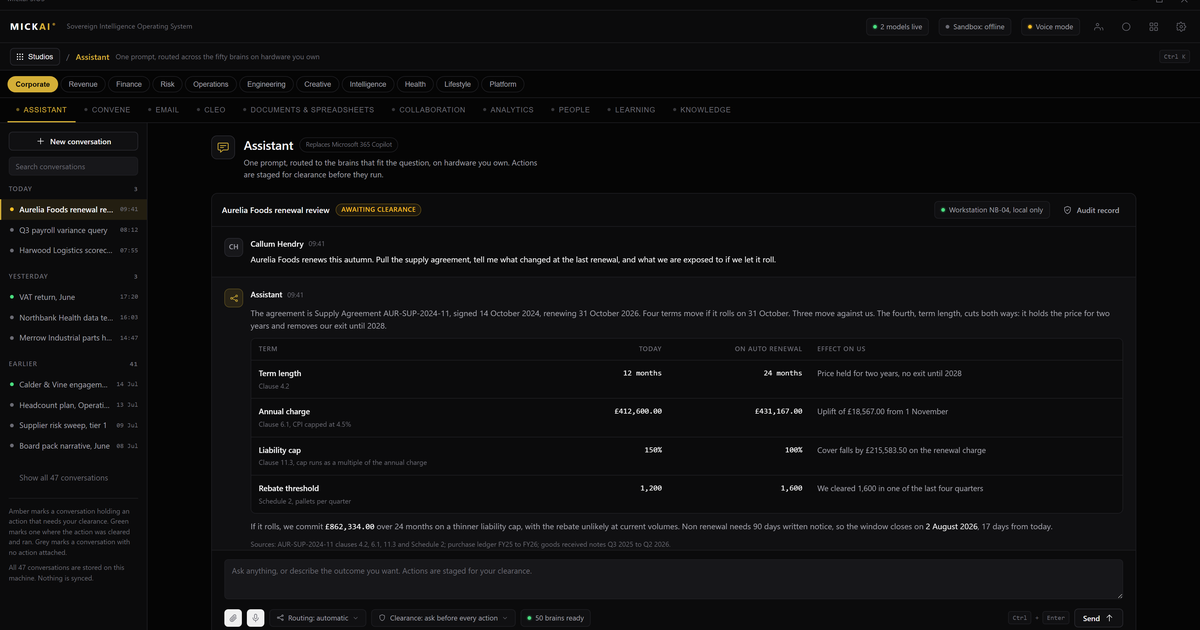
Work moves through a company as one thread: an enquiry becomes a customer record, a record becomes a meeting, a meeting becomes an invoice. On most firms that thread is cut four times, because email, CRM, calendar and finance are separate rented services that do not share the same data. On our sovereign operating system they are studios on one machine, and one assistant carries the context the whole way.
That is the whole point of putting the studios on one OS. The assistant does not integrate four vendors. It reads one company database, and it writes back into the same place the next studio will read from.
The thread, start to finish
Take a real sequence. A prospect emails asking for a quote.
In our email system the assistant reads the message and recognises it is a new enquiry, not an existing thread. It does not need a connector to check, because the sender, the domain and the history are in the same company data the CRM uses. So the assistant proposes the next step in plain language: create a contact, log the enquiry, book a call.
You say yes. Now watch what does not happen. Nothing is exported. No CSV, no copy-paste into a separate tool, no zap firing across an API to a service you rent. The assistant creates the contact and the enquiry directly in our CRM, on the same database the email lives on. The email is already linked to the contact because they were never in two systems to begin with.
The assistant then opens our meetings platform, reads the prospect's stated availability from the email body, checks your own calendar in the same OS, and proposes three slots. You pick one. The invite goes out from our email system, and the meeting record is attached to the same contact. One person, one record, four studios, no seams.
After the call, the assistant drafts the follow-up and the quote. When the work is agreed, it creates the invoice in our finance studio, pre-filled from the contact, the meeting notes and the agreed scope, because all of that is sitting in one place. The invoice carries the enquiry reference back to the original email. If someone asks in six months why this customer was billed this amount, the answer is one chain, not four screenshots from four vendors.
Why one OS makes this possible
The reason most assistants cannot do this is that the data is not theirs to move. A calendar tool cannot write a CRM record without a paid integration, permission scopes and a sync that breaks. Every hop is a place where context is lost and where a subscription is charged.
We removed the hops. The studios are not apps talking to each other over the internet. They are views onto the same company data on the same operating system. The assistant does not carry information between systems. It works inside one system that happens to present email, CRM, meetings and invoicing as different studios.
This is why the assistant can be confident about context. When it says "this is the same customer who emailed on Tuesday," it is not guessing across a sync gap. It is reading the same record. When it books the meeting, the calendar and the CRM update together because they are the same data. When it raises the invoice, the finance studio already knows who the customer is.
What the assistant actually does at each step
The assistant is one surface, not one feature per studio. Staff talk to it in plain language and it opens the right studio and fills in what it already knows.
In our email system it triages, drafts, and spots the enquiries worth acting on. In our CRM it creates and updates records, links the correspondence, and keeps the history in one thread. In our meetings platform it finds times, sends invites, and after the call turns the notes into next actions. In our finance studio it prepares the invoice from everything upstream, so nobody re-keys the customer, the scope or the amount.
None of this needs the member of staff to know which studio holds which field. They ask for the outcome. The assistant knows the outcome touches four studios and one dataset, and it does the routing.
The audit trail is the same thread
Because it all runs on one OS, the record of what happened is also one thread. Every action the assistant takes is written to an Open Audit Record at the action level: not "the assistant was used today," but "at 10:14 it created this contact from this email, at 11:02 it booked this meeting, at 15:30 it raised this invoice for this amount."
For a regulated small or mid-sized firm this matters more than the time saved. When a reviewer, an auditor or a regulator asks how a decision was reached, the chain is already assembled. The email, the record, the meeting and the invoice are one linked sequence with the assistant's actions logged against each. You are not reconstructing the story from four vendors' export files.
The cost of renting the four studios separately
The usual way to run this thread is to rent it in pieces: a mail and calendar subscription, a CRM subscription, a meetings subscription, a finance subscription. Each is priced per user per month, and the prices are public.
Here is the conservative method, not a headline. Take the incumbents' published list prices per user per month for the tier a firm actually uses. Add them for one seat. Multiply by your headcount, then by twelve for the year.
For a fifty-person firm the arithmetic is: (mail and calendar price + CRM price + meetings price + finance price) per user, times 50 users, times 12 months. Put the incumbents' current published per-user prices into that formula and the annual figure is the number you are paying every year, forever, to rent four services that still do not share your data. We are stating the method so you can run it against today's list prices rather than trusting a figure that may be stale. The renting never stops, the prices rise, and the data stays on someone else's servers.
Owning the studios changes the shape of the spend. The software stack runs on hardware you own. The assistant works across all of it. You are not paying per user per month to four landlords for the privilege of a workflow that breaks at every handover.
Beyond the private cloud
Running your own tenant of a rented service is better than nothing, and it is the baseline a serious firm should already meet. Our value is past that line.
The studios are the whole software stack on hardware you own, air-gapped by default, not a model you have to integrate into someone else's suite. The assistant works without sending your customer, meeting or invoice data anywhere to think. And the Open Audit Record captures what the assistant did at the action level, which a private cloud tenancy of four separate vendors cannot give you as one chain. That is the difference between a more private version of the old shape and a different shape: one OS, one dataset, one assistant, one audit trail, on your own machines.
We hold 104 filed UK patent applications with 2,340 claims covering this work. They are filed, not granted, and they sit behind the product rather than in front of it. The point a firm feels first is simpler: the email became a task, the task became a meeting, the meeting became an invoice, and one assistant carried it the whole way because there was only ever one place the work lived.
Frequently asked questions
Does the assistant copy data between the studios?
No. The studios read one company database on your own operating system. The assistant moves context and creates records in place, so nothing is copied out to a separate app.
Where does the work run?
On hardware you own, air-gapped by default. Email, CRM, meetings and invoicing are studios on one sovereign operating system, not separate cloud services.
Can we see what the assistant did?
Yes. Every action the assistant takes is written to an Open Audit Record at the action level, so a reviewer can see the email, the task, the meeting and the invoice as one chain.
Which AI model powers it?
The reasoning layer runs on your hardware and serves the studios. We describe what it does, not which model it is, and it never sends your data out to answer.
Do staff have to learn a new tool for each step?
No. The assistant is one surface across every studio. Staff ask in plain language and the assistant opens the right studio and fills in what it already knows.
What does this replace?
The bundle of separate subscriptions a firm rents for mail, CRM, meetings and finance. Here they are studios on one OS you own, sharing one set of company data.