


How Pantheon Changes the Blockchain and Artificial Intelligence Landscape
Blockchains record what happened; artificial intelligence acts without proof. Pantheon promotes a working post-quantum attestation substrate into a Layer 1 and closes the gap between the two.
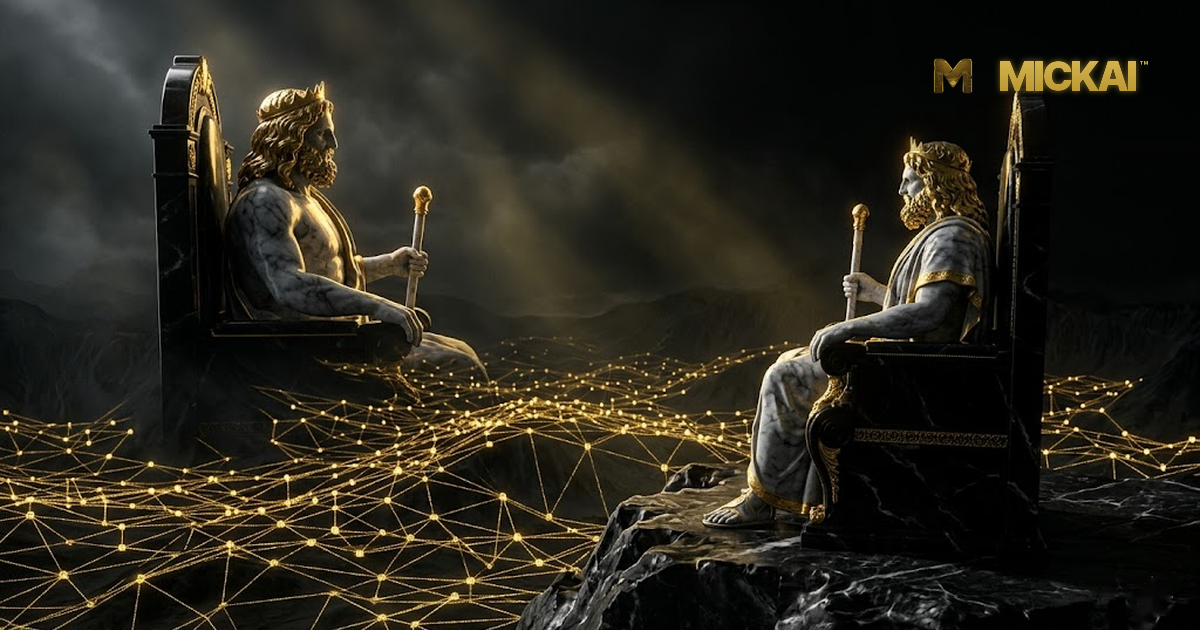
The Receipt and the Reasoning
A bank wire leaves a record. The amount, the sender, the recipient, the timestamp: all of it settles onto a ledger that no single party can quietly rewrite. This is the achievement of public blockchains, and it is genuine. Yet the ledger is silent on the one question that now matters most. It records that a thing happened. It cannot tell you what produced it. Was the transaction authorised by a human, or by an autonomous agent acting on her behalf? Under whose policy? With what reasoning, and what evidence weighed along the way? The chain keeps the receipt and discards the reasoning. As machines begin to transact, govern treasuries, route capital and act in the world at speed, that missing half of the record stops being a philosophical curiosity and becomes the central liability of the decade.
Pantheon is built to close that gap. It is a sovereign Layer 1 blockchain (often shortened to L1, the base settlement layer of a network), built on the Mickai substrate, whose defining property is simple to state and hard to engineer: the attestation layer is post-quantum from genesis. Every settled action carries a seal from the Open Audit Record (OAR), signed under FIPS 204 ML-DSA-65, the National Institute of Standards and Technology post-quantum digital-signature standard, before it reaches consensus. The chain does not merely order transactions. It orders proofs of what produced them, and it does so in a form that anyone holding only the operator public key can verify offline, forever.
Two Half-Records, One Substrate
To see why Pantheon is a category and not a feature, hold the two prevailing systems side by side. A public blockchain is an excellent witness to settlement and a poor witness to intent. An artificial intelligence (AI) system is the inverse: it can act with extraordinary capability, but it cannot prove, after the fact and offline, what it did, under whose authority, and on what grounds. The first records the outcome and forgets the cause. The second performs the cause and leaves no durable proof of it. Each is half a record. Neither, on its own, is sufficient for a world in which autonomous systems are counterparties.
The Open Audit Record is the missing half made concrete. It is an append-only, hash-chained ledger in which every action a sovereign system takes is sealed as a first-class object: the authority invoked, the policy applied, the models consulted, the decision returned. Each entry is signed under ML-DSA-65 and chained to the last, so the record cannot be silently edited, reordered or pruned without breaking the chain of hashes. Pantheon promotes this working attestation substrate, already operating inside the Mickai Sovereign Intelligence Operating System (SIOS), into the consensus layer of a blockchain. The proof and the settlement become one object. That is the shift in a sentence: not a chain that logs transactions, but a chain whose unit of consensus is an attested action.
Seal Before Own Consensus
The architecture deserves precision, because the precision is the point. Pantheon is built on the Polkadot software development kit (Substrate), written in Rust, as a standalone sovereign proof-of-stake (PoS) chain. It uses the framework's audited machinery for block production and finality (BABE and Aura for producing blocks, GRANDPA for finalising them). It is not a fork of Bitcoin and it is not a rollup tenant renting space on Ethereum. It runs its own consensus over its own state, which is what allows the attestation to live where it has to live.
Inside that runtime, the Open Audit Record is a native module (pallet-oar), not a smart contract bolted on top. Seals are first-class objects of consensus rather than entries in some contract's storage map. We call the resulting property seal-before-own-consensus: the chain validates operator-sealed post-quantum records before it orders them into a block. Most systems that attempt machine attestation treat the proof as application data, something a contract writes after the fact and that the base layer never inspects. Pantheon inverts that. The proof is checked by the protocol itself, at the moment of settlement, as a condition of settlement. There is no path by which an action settles without its attestation being valid first.
Fifteen Subsystems, One Settlement Layer
A base layer is only as meaningful as the work that flows through it, and Pantheon is not waiting for hypothetical demand. Fifteen application chains map directly to live Mickai subsystems, each settling its sealed actions to the base layer in the native asset. The set spans the real surface of the operating system: trading and decentralised finance, the Trust Agent audit trail, knowledge and retrieval, the PENELOPE open-source-intelligence capability, the VIGIL sky and sensing layer, civilisation and survival planning, the Vinis assistant, a marketplace, governance, health under HYGEIA, legal under THEMIS, compliance, identity, the autonomous marketing and outreach engine, and hardware orchestration under HELIOS.
The economic consequence is structural rather than promotional. Each time a subsystem does real work, an audit sealed, a trade settled, a knowledge query attested, a sensor reading committed, that work produces a sealed action that settles to the base layer and pays its fee in PAN. The more the subsystems run, the more settlement flows downward to the L1. Usage is not a marketing metric layered on top of the token. It is the token's fee economy, generated by an operating system that already exists and already does the work.
Bitcoin as Witness, Not Master
Sovereignty does not mean isolation, and Pantheon is candid about where it borrows external strength. Periodically, a Merkle commitment of the chain's Open Audit Record root is anchored to Bitcoin using OpenTimestamps, a free and public timestamp proof. This buys something specific: an independent, globally witnessed assurance that the state of Pantheon's attestation ledger existed at a given moment, rooted in the most battle-tested proof-of-work chain in the world.
The relationship is deliberately narrow. Bitcoin is used only as an external witness, at no protocol cost. Pantheon does not fork Bitcoin, does not depend on it for execution, and does not inherit its throughput limits. The chain runs its own consensus and its own finality, while Bitcoin simply notarises a hash now and then. The result is a layered assurance model that is honest about its boundaries: post-quantum seals as the native guarantee, Bitcoin's proof of work as a free, periodic, external corroboration of the record's existence in time.
Tokenomics Coupled to Attested Work
PAN is the native asset of the Pantheon Layer 1, with a fixed supply of five billion (5,000,000,000), no inflation, and no mint authority. It exists simultaneously as an omnichain token on Ethereum, BNB Chain, Base and Arbitrum, through a lock-and-mint bridge of the LayerZero omnichain-fungible-token class, so a single fixed supply spans every venue. The intent is plain: keep sovereignty where the moat is, on the L1, and place liquidity where the market already trades. PAN carries the working load of the system. It settles fees across the base layer and the fifteen application chains, bonds validators who stake it, and confers governance over parameters, treasury and buyback policy. Pantheon issues no stablecoin; PAN is a single utility and governance asset, nothing more and nothing less.
The rewards engine is where Pantheon departs most sharply from convention. There are no emission-based staking rewards and therefore no inflation sell pressure. Validator and staker yield is funded by revenue buybacks. A governed share of protocol revenue buys PAN on the open market and is split, indicatively and tunable by governance, roughly forty per cent to staker and validator yield, thirty per cent to a permanent burn, and thirty per cent to a governance lock. A base-fee burn in the manner of Ethereum's EIP-1559 (Ethereum Improvement Proposal 1559) removes part of every transaction fee, so genuine network usage contracts the supply rather than diluting it. Each buyback, each burn, each lock is itself sealed into the Open Audit Record and verifiable on-chain. Yield is paid by demonstrated revenue, not by printing tokens, and the proof of that payment sits in the same auditable ledger as everything else.
- Software validators download a single node binary, run it on commodity hardware, and stake PAN.
- Delegators nominate validators through nominated proof of stake (NPoS), run no infrastructure, and share in rewards.
- Mickai hardware appliances are premium plug-in validators from the Mickai hardware lineup, shipping twelve months after funding, offered as a path and never as a gate.
Governance That Cannot Erase Its Own History
Decentralisation is meaningless if the validator set can be captured by capital, so the set is held deliberately open. Anyone can run the node binary on ordinary hardware, and the premium hardware appliances are a convenience for those who want a sealed, plug-in path, never a requirement for participation. The target active set is fifty to one hundred and fifty validators, large enough to be credibly decentralised and small enough to finalise quickly. Sovereignty, in this design, is a property the network keeps because the door to running it stays open to software operators.
Governance itself is two-keyed, and this is one of the clearest inheritances from the operating system beneath. PAN-holder on-chain referenda decide direction: parameters, treasury allocation, buyback policy. Beneath those votes sits a sealed execution-safety layer carried over from the SIOS. Before a gated action executes, a quorum of independent sovereign models must each return ALLOW, every vote sealed to the Open Audit Record. When something must be undone, it is undone by an append-only compensation, a forward entry that corrects the state, never a deletion that pretends the original never happened. The history of governance is therefore as immutable and as auditable as the history of settlement. A chain that can attest to AI actions ought to be able to attest to its own, and Pantheon is constructed so that it must.
The Wedge Against the Field
It is fair to ask who else is working this seam, and the honest answer is that several capable teams are. EQTY Lab, Sahara AI, 0G, ORA and Prove AI are all building toward verifiable AI in some form, and EQTY Lab in particular is a well-funded and serious peer. The difference is architectural and it is specific. The nearest competitors root their trust in vendor silicon, hardware trusted execution environments such as Intel TDX or NVIDIA enclaves, which makes their guarantee only as strong as a chip vendor's supply chain and firmware. They sign with classical cryptography, which a sufficiently capable future quantum computer is expected to break. They anchor to Hedera or to their own chain rather than to Bitcoin's external witness.
Pantheon's opening is the precise stack none of them assembles at once. It seals in software, on commodity hardware, with no dependence on a particular vendor's enclave. It signs under FIPS 204 ML-DSA-65, implemented and verifiable offline, a claim stated as that exact standard rather than a vague gesture at being quantum-safe. It runs its own consensus over operator-sealed records rather than logging them as contract data. It anchors to Bitcoin as a free external witness. Its Open Audit Record compliance mapper generates signed evidence against the European Union Artificial Intelligence Act, the NIST AI Risk Management Framework, and ISO 42001, so the chain's own regulatory posture is continuously auditable. And it ships earning validator appliances while coupling its tokenomics to attested usage rather than to emissions. No incumbent Layer 1 offers that combination. That is the wedge, and it is a narrow one by design.
“Public blockchains proved that we can agree on what happened without trusting a central party. Pantheon extends the same discipline to the harder question: agreeing on what produced it, in a form that survives the arrival of quantum computers and verifies on a laptop that has never touched the internet.”
What Is Built, and What Is Gated
Precision about status is part of the argument, not a footnote to it. Pantheon is designed in full. The omnichain Ethereum Virtual Machine (EVM) contracts are built and smoke-tested on a local testnet. The Substrate Layer 1 is in active build. The bridge mechanisms are covered by filed UK patent applications within the Pantheon bridge family, part of a portfolio of 104 filed UK patent applications, 2,340 claims, owned by Mickai LTD with named inventor Micky Irons. Mainnet is gated by an independent security audit and by legal and securities clearance, not by missing code. The token generation event (TGE) is targeted for the first quarter of 2027. The raise is thirty million pounds on Ladder B, roughly twenty-four per cent of supply, offered through simple-agreement-for-future-tokens (SAFT) instruments to professional investors only, marketed in the European Union via the Markets in Crypto-Assets (MiCA) utility-token notification route, with no United Kingdom retail promotion.
Read the design and the status together and the thesis lands. For a decade, two systems have each held half of the record that an autonomous world requires. Blockchains gave us settlement we can trust without a referee, and gave up the reasoning. AI gave us capability without proof. Pantheon is the attempt to hold both halves in a single ledger: settlement and attestation, outcome and cause, signed before consensus under a post-quantum standard and witnessed by Bitcoin. If that gap is the defining liability of machine-speed finance and governance, then closing it is not a feature on a roadmap. It is the reason the category exists, and Pantheon is designed to be the chain that occupies it first.