


Hold Your Own Keys
Two billion-pound rivals, one rented model, and the question no operator can answer with a policy they did not write
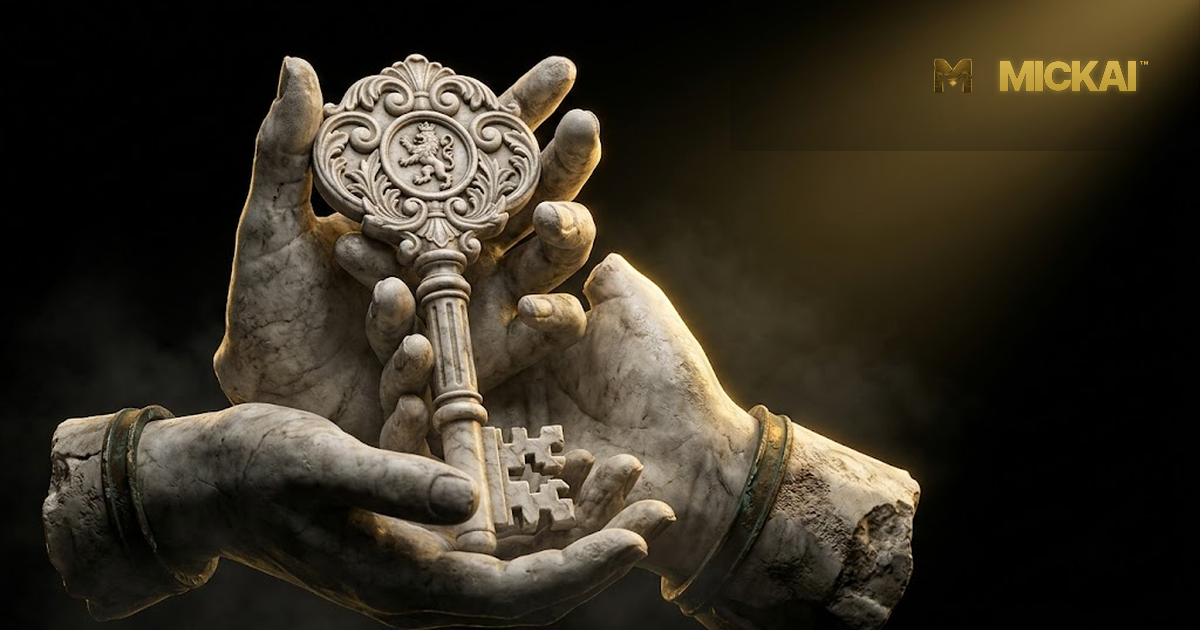
Picture two fashion houses. Both are worth a billion pounds. Both sell to the same shoppers, chase the same season, fight for the same shelf. And both of them, quietly, run their sales tactics and their forecasting through the same rented artificial intelligence model. Your pipeline flows through it. Your projections flow through it. So does theirs.
Now answer me one question. What, that you actually control, stops one of those rivals from reaching someone on the inside and pulling your numbers out?
Let me be precise, because this is where the argument usually goes wrong. The frontier providers are good. OpenAI and Anthropic build serious models and run serious security. Real controls, real teams, real incident response. I am not telling you they are careless and I am not telling you they leak. They do not. Keep using them. They are brilliant at what they do.
My point is not about anyone's conduct. It is about architecture. When your most sensitive intelligence is processed by a shared third party that your competitors also rent from, the only things standing between your secrets and theirs are that provider's policy, that provider's staff, and that provider's response when something goes wrong. Every one of those is real. Not one of them is yours. Custody you do not hold is exposure you cannot control. That is true of any external custodian, by design, not because anyone is doing anything wrong.
The shared spring
Think of a marble fountain in a city square. The whole market comes to drink from it. It is clean, it is well kept, it serves everyone fairly. That is the frontier model, and it is a marvel. But you and your rivals are all dipping the same vessels into the same water. Your trade secrets and theirs run through the same pipes, kept apart by rules written and enforced by someone else.
There is nothing sinister in the spring. The risk is not the water. The risk is the shape of the thing. When an entire industry leans on a small handful of custodians, the boundary around your crown jewels is only ever as firm as a policy you did not write and cannot amend. Most days that holds. The question is what you placed on the table for the day it is tested.
When there is money on the table
Here is the part operators feel in the gut. Knowing how a billion-pound rival generates leads, where its margins really sit, what its next two quarters look like, that knowledge is worth a fortune to the company across the street. Hermes was patron of merchants and of thieves at the same time, and the ancients were not being cute about it. Where there is trade, there is the temptation to take. Put a large enough number beside a secret and someone, somewhere, starts working out how to reach it.
I am not accusing anyone of theft. I am pointing at incentive. The provider's defences are aimed at outside attackers and they are strong against them. But the exposure I am describing does not need a breach of the model. It needs a motive, a shared dependency, and a boundary that you do not personally hold. Two of those three already exist the moment you and your competitor rent from the same place. And here is the uncomfortable bit: nobody at the provider has to do anything wrong for the geometry to put you at risk. That is not a slur on their staff. It is the shape of the arrangement, and the shape does not care how good the people are.
For most companies, there is nothing in that chain the company itself controls. You have outsourced the lock and kept the liability.
Custody is the whole game
So separate two ideas that usually get welded together. One is capability: can the model write the email, draft the campaign, crunch the scenario. The frontier is superb at capability and you should keep renting it for everything that does not expose you. The other is custody: who physically holds the keys to the data and the intelligence while the work is done. Different questions. You can buy capability anywhere. Custody you either hold or you have handed away.
This is the hinge of everything I have built. Capability is abundant and getting cheaper. Custody of your crown jewels is the scarce thing, and it is the thing nobody can sell back to you once it is gone. Hold your own keys, and the incentive problem disappears, because there is no shared custodian to reach. There is only your hardware, in your building, under your hand.
What sovereignty actually looks like
This is why I built Mickai the way I did. Mickai is a Sovereign Intelligence Operating System, an SIOS: fifty specialised artificial intelligence brains that run on hardware the operator owns. Fully offline-capable. Nothing about your pipeline, your tactics, or your projections has to leave the building to be useful. The keys stay with you because there is no one else in the room to hold them.
Custody is not just where the data sits. It is whether you can prove what happened to it. In Mickai every consequential action can be sealed into an Open Audit Record, a tamper-evident account of what the system did and when. Themis held the scales because a law nobody can verify is not a law, it is a promise. A record you hold yourself turns trust into evidence.
None of this is a slide. It is filed and on the record. Mickai is evidenced by one hundred and four filed United Kingdom patent applications, around two thousand two hundred and thirty four claims, owned by Mickai LTD, with myself as named inventor. We are actively training our own specialised models now. I am not asking you to take the architecture on faith. I am telling you it exists and where to look.
An ally, not a war on the frontier
Let me kill the obvious misreading before it spreads. This is not an OpenAI killer. It is not a war on the frontier. I admire those labs and I use that class of model myself for everything that does not expose me. Mickai is a sovereign ally, the vault beside the workshop, not a rival to the workshop.
The line I draw is narrow and it is sharp. Everything that does not expose you, rent freely and enjoy the brilliance. Your crown jewels, the pipeline and the tactics and the projections, the few things that would hand a rival the keys to your year, those run on intelligence you own. That is not paranoia. That is just deciding which doors you are willing to let someone else hold the key to, and which ones you are not.
Look at your own stack honestly. Map what flows through a rented model today. Most of it can stay there and should. Then find the handful of things that would end you if a competitor read them over breakfast. Those are the things to bring home. Not all of your intelligence. The part that is actually yours.
“Capability you can rent from the best in the world, and you should. Custody of your crown jewels is the one thing you can never get back once you hand it away. Hold your own keys.”
The shared spring will keep serving the market, and it will keep doing it well. That is not the problem to solve. The problem to solve is that your sharpest secrets are sitting in water everyone drinks from, behind a wall you did not build. You cannot fix the incentive of a rival with money on the table. You can remove the thing they would reach for. Keep your own intelligence in your own house, sealed and accounted for, and the question I opened with stops being frightening, because the answer finally belongs to you.
About Mickai
Mickai is a Sovereign Intelligence Operating System, an SIOS: fifty specialised artificial intelligence brains that run on hardware the operator owns, fully offline-capable, with nothing required to leave the building. Every consequential action can be sealed into an Open Audit Record. The portfolio is evidenced by one hundred and four filed United Kingdom patent applications, around two thousand two hundred and thirty four claims, owned by Mickai LTD, named inventor Micky Irons, who founded the company. Mickai is actively training its own specialised models now. The principle is simple: hold the keys to your own intelligence and your own data.