Hardware Root of Trust for AI
Why secure boot and a silicon anchor are the foundation every signed action in a Sovereign Intelligence Operating System stands on.
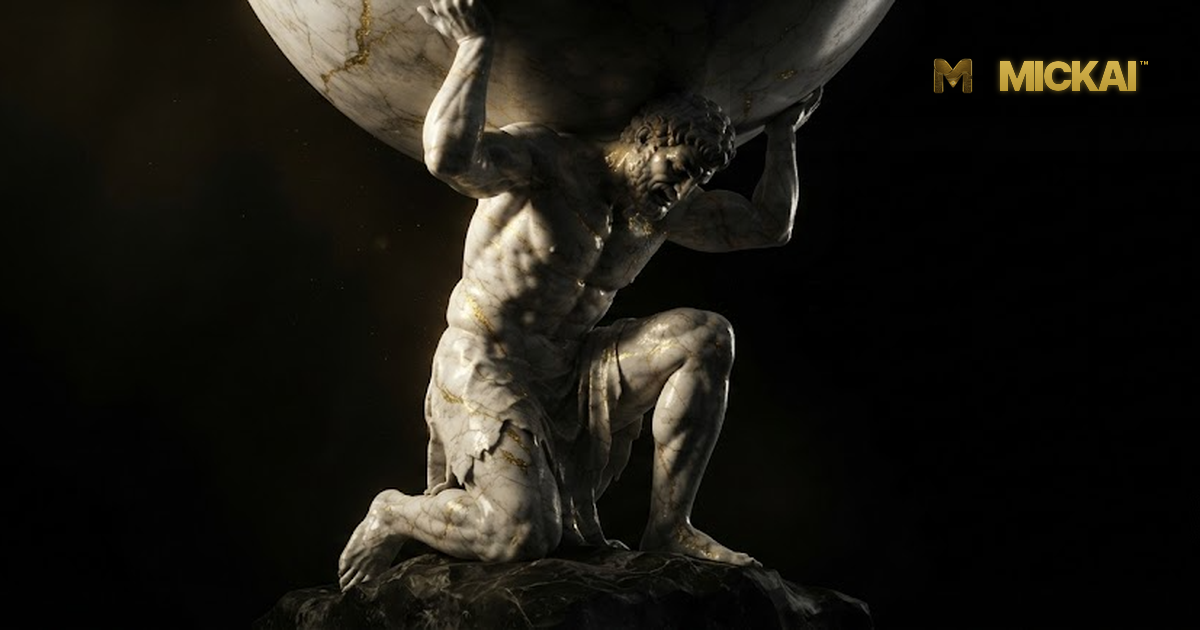
Every signed action a Sovereign Intelligence Operating System takes has to stand on something. A cryptographic signature is only as trustworthy as the machine that produced it, and a machine is only trustworthy if it started life the way its owner intended. If an attacker can rewrite the firmware, poison the boot loader, or slip a rogue kernel underneath the operating system, then every audit record above that layer is a beautiful signature written on sand.
This is why we begin at the metal. Before a single brain loads, before the first Operation Attestation Record (OAR) is minted, before any studio renders a pixel, Mickai proves that the hardware it runs on is the hardware it was sealed to, booted in a state nobody has quietly altered. That proof is the hardware root of trust, and it is the foundation the whole tower rests on.
Why software trust needs a floor
Software can measure software, but software cannot bootstrap its own honesty. A compromised loader will happily attest that everything above it is pristine, because the liar is the one holding the pen. To break that circle you need an anchor that ships in silicon, that cannot be reflashed by ordinary means, and that measures the very first instructions before those instructions get a chance to lie about themselves.
That anchor is what regulators increasingly expect too. The European Union Artificial Intelligence Act (EU AI Act) and the Digital Operational Resilience Act (DORA) both push high-risk systems towards demonstrable integrity, not asserted integrity. It is no longer enough to say a model ran in a controlled environment. You have to be able to prove, cryptographically and after the fact, that the environment was what you claimed. A hardware root of trust is how that proof gets a floor to stand on.
Measured boot, from the first instruction
On a Mickai node the sequence is deliberate. A silicon root of trust holds the first stage of firmware and refuses to hand control onward unless each subsequent stage matches a signed measurement. The firmware measures the boot loader, the boot loader measures the kernel, the kernel measures the initial runtime, and each measurement is folded into a hardware register that can be extended but never rewound. By the time the operating system is alive, there is a chain of hashes describing exactly how it got there.
We hash-link those measurements with SHA-3-512 so the boot record inherits the same discipline as the rest of the ledger. Nothing is trusted because it looks familiar. Everything is trusted because it matches a value that was sealed in advance. Any deviation, whether a swapped module, a downgraded driver, or an injected rootkit, changes a hash and breaks the chain visibly rather than silently.
Sealing the sovereign brains to the metal
A root of trust that only guards the operating system would leave the most valuable cargo exposed. Mickai extends the anchor to the brains themselves. Model weights, policy bundles, and the keys that sign actions are sealed against the boot measurements, which means they only unseal on a machine that booted into exactly the expected state. Move the drive to a tampered host, or boot the same host with altered firmware, and the seal simply will not open.
This is what lets us say, honestly, that Mickai runs on hardware the customer owns with zero data egress. The brains do not need to phone a distant service to be told they are allowed to run. Their permission is bound to the physical machine, air-gapped or on-premise, and enforced by silicon rather than by a network call that an adversary could sever or spoof.
Why every OAR points back here
An Operation Attestation Record signs each action before it executes, capturing intent, the approving brains, and the state of the system at that instant. Those records carry post-quantum signatures under the FIPS 204 ML-DSA-65 standard and are chained together into a tamper-evident audit ledger. But a signature is a claim about a signer, and the signer is a key, and a key is only meaningful if the machine holding it is sound.
The hardware root of trust closes that loop. Because the signing keys are sealed to a measured boot, every OAR implicitly asserts more than its own contents. It asserts that it was produced on an untampered machine in a known-good state. When an auditor verifies an action offline months later, they are not merely checking that the mathematics adds up. They are checking a chain that reaches all the way down to the first instruction the silicon ever ran.
High-stakes actions and the anchor beneath them
For the actions that matter most, such as moving funds, releasing data, or altering a control system, Mickai requires multi-brain plus voice-biometric approval. Several independent brains must agree, and a human voice must match a stored biometric, before the operation is allowed to proceed. It is a strong gate, and precisely because it is strong it needs an unshakeable footing.
If the underlying host could be quietly compromised, an attacker would not need to defeat the approval logic. They would sit beneath it and forge its outputs. The hardware root of trust denies them that ground. The approval brains run in a measured, sealed state, their revocation status is checked against a chain that cannot be silently edited, and a revoked brain cannot resurrect itself simply because the box was rebooted. Trust flows upward from the metal, never downward from an assertion.
A different layer, not a rival
None of this competes with the public cloud. OpenAI, Microsoft, Amazon Web Services, Google, and Oracle operate a magnificent layer, and Mickai is a different one. We serve the regulated boundary that layer cannot cross on the customer's own terms: the classified network, the hospital that must honour the Health Insurance Portability and Accountability Act (HIPAA), the bank governed by Basel and the Markets in Financial Instruments Directive (MiFID II), and the defence programme bound by the International Traffic in Arms Regulations (ITAR).
On that boundary, a hardware root of trust is not a luxury. It is the difference between an environment you assert is secure and one you can prove was secure, on hardware you physically control, in a form an auditor can verify without ever asking us to vouch for ourselves. The capability to do this is described across our 104 filed UK patent applications, 2,340 claims owned by Mickai LTD, framed around integrity that starts in silicon.
The bottom line
Every signature Mickai produces is a promise, and a promise needs something to stand on. The hardware root of trust is that something: a measured boot from the first instruction, brains sealed to the exact machine, keys that only unseal in a known-good state, and an audit ledger whose lowest link is silicon rather than assertion. Build the tower as high as you like. It holds because Atlas is carrying it at the base.