Forms and surveys that never leave your building
Run forms and surveys on hardware you own. Respondent data stays in the building, wired to your CRM and analytics on one sovereign OS.
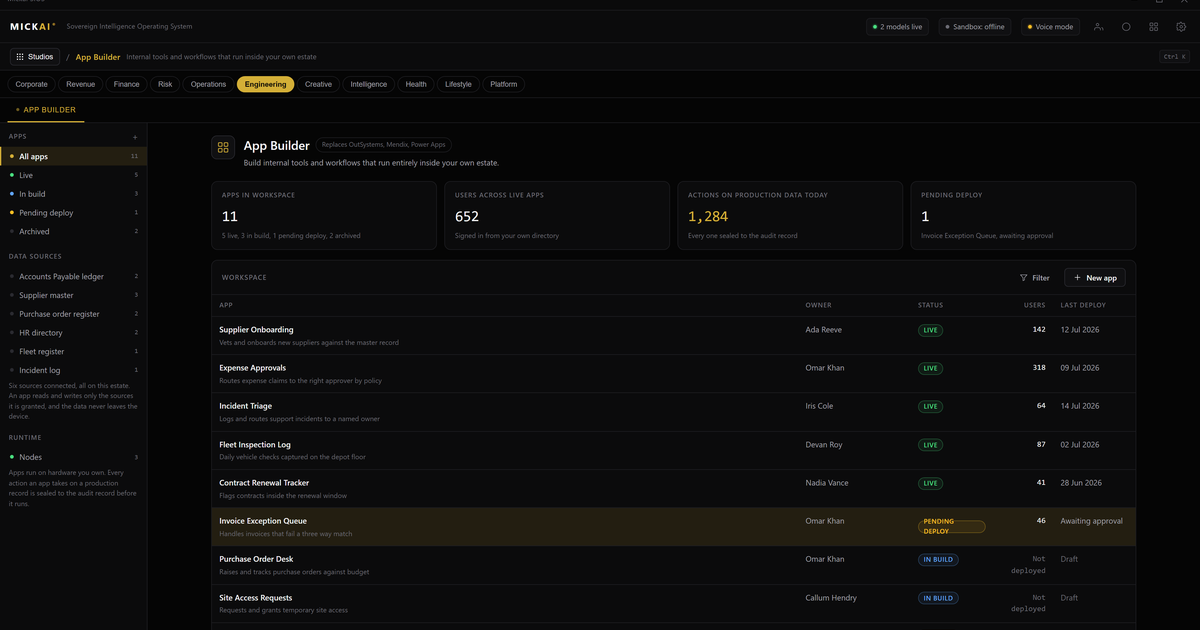
Forms and surveys are how a company collects the most sensitive data it will ever touch: patient intake, staff grievances, supplier due diligence, customer complaints. Our forms studio keeps every one of those responses on hardware you own, inside your building, wired straight to your CRM and analytics. The respondent fills in an ordinary web form. The answer lands in your database, not a vendor's.
That is the whole idea. You publish forms the way you always have. What changes is where the answers live.
The problem with renting a form
When you build a form on a hosted survey tool, the responses are stored on the vendor's servers. You are trusting a third party with the raw text your customers and staff typed in. For a marketing quiz that may be fine. For an occupational health questionnaire, a whistleblowing form or a KYC intake, it is a data protection question you have to answer every time an auditor asks where the data sits.
The usual reply is a private or enterprise plan. That helps, but it is still someone else's platform, someone else's account, and someone else's export path when you want the data in your CRM. You are paying to keep your own data slightly closer.
We took the other route. The forms studio is one of the 63 studios on our sovereign operating system. It runs on your hardware. The responses are written to your database. There is no vendor account in the loop because there is no vendor.
What you actually get
The forms studio does the ordinary work well. You build a form or a survey with a visual editor: short text, long text, multiple choice, ratings, file uploads, logic that branches on an answer, required fields, validation. You publish it to a link or embed it on your website. You collect responses and see them in a results view with completion rates and per-question breakdowns.
Then it does the part hosted tools cannot. Because the studio sits on the same operating system as the rest of your platforms, a response is not trapped in a survey silo:
- A new enquiry form can create or update a contact in your CRM the moment it is submitted.
- A supplier questionnaire can attach its answers to that supplier's record.
- Survey results can flow into the analytics studio and appear on a dashboard next to your other numbers.
- The assistant that runs across every studio can read the responses and summarise them, flag outliers or draft a reply, without the data leaving the building.
None of that needs an integration you buy separately or a nightly export. The studios share one company's data. That is what "one operating system, not separate apps" means in practice.
The audit record
Every action in the forms studio is written to an Open Audit Record: who created a form, who changed a question, who viewed the responses, who exported them. Not a login log, an action log. For a regulated small or mid-sized firm, that record is often the difference between saying you control the data and being able to show it.
This is the part that goes beyond a private deployment. Keeping the server in your building tells you where the data is. The action-level record tells you what was done to it and by whom. The stack runs air-gapped by default, so the honest answer to "could this leave the building" is no unless you decide to open a route.
The money
Here is the method, so you can run it on your own numbers rather than trust ours.
Hosted survey tools are rented per seat or per plan, per month, forever. Take the published list prices as reported public facts and multiply out.
Typeform lists its Business plan on its public pricing page at 66 US dollars per month billed annually, and its higher tiers add seats on top. SurveyMonkey lists team plans on its public pricing page at published tiers from 25 to 75 US dollars per user per month depending on tier, billed annually. Prices change and vary by region and currency, so treat these as the published figures at time of writing and check the vendor's current page before you rely on them.
Now the worked example. Assume a firm needs ten people who build and manage forms and surveys, on a per user per month team plan. Take a conservative 30 US dollars per user per month:
- 10 users times 30 US dollars times 12 months = 3,600 US dollars per year.
Push it to a fuller team of twenty five people on a mid team tier at 40 US dollars per user per month:
- 25 users times 40 US dollars times 12 months = 12,000 US dollars per year.
That is one capability. It renews every year and rises with every colleague who needs access. The same shape repeats across the email tool, the CRM, the meetings platform and the rest of the stack, which is the real bill: not one subscription, a wall of them.
We do not publish our price here, and this article is not the place for it. The point is the model. When you own the software and it runs on hardware you own, the per-seat meter is not running. Adding the eleventh person who needs to build a form is a login, not a line item.
Where this matters most
The firms that feel this hardest are the regulated small and mid-sized ones. A clinic, a law firm, a broker, a housing association, a local authority team. They collect sensitive answers all day and they answer to a regulator about where those answers sit. They rarely have the leverage to negotiate a bespoke private cloud, so they end up on a standard hosted plan and hope the data map holds up.
Owning the stack changes the conversation. When the auditor asks where the whistleblowing responses are stored, the answer is a room you can point at. When they ask who has seen them, the answer is a record you can print. When they ask whether the data can leave, the answer is no by default. That is a stronger position than any hosted plan can offer, because it does not depend on a vendor's promise.
One assistant across the lot
The same assistant runs across every studio on the operating system. In the forms studio it can build a survey from a plain description, tidy the wording of your questions, watch responses arrive and tell you when a pattern emerges, then draft the follow up in your CRM. It reads your data because it runs inside your building on your hardware. It is describing and acting on your forms, not shipping your responses to an outside service to be processed.
The state of the platform
The forms studio is one of 63 studios on the sovereign operating system. Behind the platform sit 104 filed UK patent applications carrying 2,340 claims. Those are filed applications, not granted rights, and we say so plainly. The studios reach customers through a distribution partner we do not name. We hold no security certifications and we do not claim any. What we do claim is narrow and testable: your forms, your responses and your reports run on hardware you own, on one operating system, with an action-level audit record, air-gapped by default.
Forms and surveys are where sensitive data enters a company. The sensible place for that data to land is the building it was always meant to stay in.
Frequently asked questions
Where do survey responses get stored?
On the hardware you own, inside your building or your own data centre. Responses are written to your own database. Nothing is copied to a form vendor's cloud, because there is no form vendor in the loop.
Can we still send a public link to respondents?
Yes. You publish a form to a link or embed it on your site. The submission travels to your own server. The person filling it in sees an ordinary web form. What changes is the destination: your building, not a third party's account.
How is this different from a private or self-hosted plan from a form vendor?
A private deployment is the baseline we start from. Our value is beyond it: the form studio shares one database with your CRM and analytics, every action is written to an Open Audit Record, and the whole stack runs air-gapped by default. You own the software, not a licence to someone else's model.
Does it connect to our CRM and reporting?
Yes. The form studio, the CRM and the analytics studio sit on the same operating system and read the same data. A new response can create or update a contact and appear in a dashboard without an export, an integration fee or a copy leaving the building.
Do we need to be online for this to work?
No. The stack runs on your own hardware and works air-gapped. You can accept responses on an internal network with no route to the public internet, which is often what regulated teams need.
Is there one price per user?
We do not publish pricing here. The point of this article is the model: you own the software and the hardware, so you are not paying a per-seat rental that grows with every colleague who needs to build a form.