


The End of Trust Me: Where Decentralised Finance Meets Artificial Intelligence
Artificial-intelligence-driven decentralised finance still asks you to trust an unverifiable model. Pantheon replaces the promise with a sealed, post-quantum proof of what the model actually did.
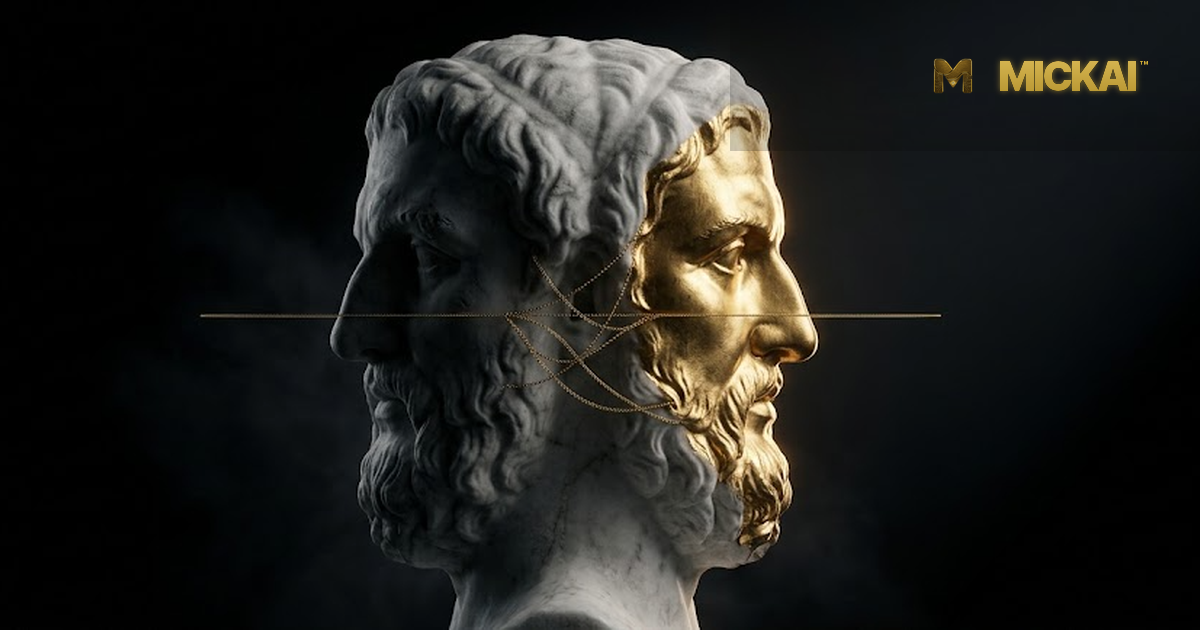
Two Faces at the Liquidity Pool
An autonomous trading agent moves four million pounds of stablecoin liquidity at three in the morning. It rebalances a lending vault, unwinds a leveraged position, and routes the proceeds across three venues before most of its operators are awake. By breakfast the position has either saved the protocol or quietly drained it, and someone asks the obvious question: why did it do that, on whose authority, and using which reasoning. The honest answer, across nearly every artificial-intelligence-driven decentralised finance system shipping today, is that nobody can prove it. The model acted. The chain recorded the transfers. Neither can attest to the decision that produced them. This is the Janus problem at the heart of where decentralised finance (DeFi) meets artificial intelligence (AI). One face shows you gold: a clean ledger of settled transactions, immutable and public. The other face is shadow: the model that decided, the authority it claimed, the inputs it weighed, all of it off-chain, unsigned, and gone the moment the inference completes. You are asked to trust the gold face and ignore the shadow. Pantheon is built on the refusal to accept that bargain.
What the Ledger Cannot See
Public blockchains are extraordinary at one thing: they record transactions and make that record tamper-evident. What they cannot do is attest to what produced a transaction. A swap appears on Ethereum as an immutable fact, but the chain holds no opinion on whether a human, a script, or an opaque neural network authored it, whether that author was permitted to, or whether the reasoning behind it was sound. The execution is verifiable. The intent and the authority are not. Artificial intelligence has the mirror-image weakness. A model acts, faster and more often than any human treasury committee, but it cannot prove, after the fact and offline, what it did, under whose authority, and with what reasoning. The weights are private, the prompt context is ephemeral, and the decision log, where one exists at all, is a plain text file on a server the operator controls and could rewrite.
Put the two together and the gap compounds. You have an actor that cannot prove its decisions running on a venue that cannot see them. The result is the oldest instrument in finance dressed as innovation: trust me. That instrument was tolerable when the actors were people you could subpoena and the sums were small. It is not tolerable when the actor is an autonomous model managing pooled capital across sovereign and permissionless venues, and when the next cycle of DeFi-meets-AI will put exactly that into production at scale. The missing primitive is not faster execution or cheaper gas. It is proof of behaviour.
Sealing the Decision, Not Just the Trade
Pantheon is a sovereign Layer 1 blockchain built on the Mickai Sovereign Intelligence Operating System (SIOS), and its defining move is to make the decision itself a first-class object of consensus. Every action a Mickai subsystem takes is sealed into the Open Audit Record (OAR): an append-only, hash-chained ledger in which each entry is signed under ML-DSA-65, the digital-signature scheme standardised as Federal Information Processing Standard 204 (FIPS 204) by the United States National Institute of Standards and Technology. Anyone holding only the operator public key can verify a seal offline, forever, with no vendor, no enclave, and no network connection required. On Pantheon the OAR is not contract storage bolted onto a general-purpose virtual machine. It is a native runtime module of the chain, pallet-oar, which means seals are validated as part of ordering, not as an afterthought written by an application. We call this seal-before-own-consensus: the chain validates an operator-sealed, post-quantum record of what an AI did before it agrees on where that action sits in history. The trade and the proof of the decision behind it enter the canonical record together, cryptographically bound, in the same step.
The architectural choices underneath are deliberately conservative. Pantheon is built on the Polkadot Software Development Kit (Substrate) in Rust, a standalone sovereign proof-of-stake (PoS) chain using the framework's audited block-production and finality machinery (BABE and Aura for block production, GRANDPA for finality). It is not a fork of Bitcoin and not a rollup tenant renting security from Ethereum. The novelty is concentrated where it belongs, in the attestation layer, and the consensus around it is boring on purpose. Boring is what you want underneath money.
Gating: When the Model Must Ask Permission
Sealing a decision after the fact is necessary but not sufficient. The harder requirement in AI-driven finance is to stop a bad action before it settles, and to prove that the safety check ran. Pantheon inherits a sealed execution-safety layer from the SIOS that sits beneath the token-holder governance. Before a gated action executes, a quorum of independent sovereign models must return ALLOW. Every one of those votes is sealed to the OAR. Where an action must later be reversed, the reversal is an append-only compensation that never deletes the original history. Translate that into a lending market. An autonomous agent proposes to liquidate a tranche of collateral. Under classical AI-DeFi the agent simply does it and emits a transaction. Under Pantheon the proposal is a gated action: the independent models evaluate it against policy, the quorum returns its verdict, the verdict is sealed, and only an ALLOW lets the liquidation reach consensus. If the position was misread, the compensating action is itself sealed, and the full sequence (proposal, votes, execution, correction) remains permanently auditable.
This is the wedge that matters for the coming cycle. The market does not lack AI agents willing to manage capital. It lacks any way to bound and prove their behaviour without surrendering the decision to a centralised operator who promises to have watched. Sealed gating replaces that promise with on-chain, post-quantum evidence that the watch happened, that a quorum agreed, and that nothing was quietly erased afterwards. The protocol does not ask the market to trust that a guardrail existed. It produces the guardrail's signed minutes.
“Public blockchains can prove a transaction happened. Artificial intelligence can decide at machine speed. Until now neither could prove what the other did. The settlement layer for autonomous finance has to do both, in the same record, and survive a quantum adversary that has not been built yet.”
Why the Existing Stacks Stop Short
A serious field is forming around verifiable AI, and it deserves a precise reading rather than a dismissal. The nearest peers, including EQTY Lab, Sahara AI, 0G, ORA and Prove AI, are addressing real problems and some are well capitalised. EQTY Lab in particular is a substantive engineering effort and the closest architectural neighbour. The differences are not marketing; they are structural, and they decide who can still verify a record in ten years. The existing approaches root trust in vendor silicon, in hardware trusted execution environments such as Intel Trust Domain Extensions or NVIDIA enclaves, or in token incentives. They sign their attestations with classical cryptography, the elliptic-curve and RSA families that a sufficiently large quantum computer is expected to break. And they anchor to a third party's ledger, whether Hedera or their own chain. Each of those choices imports a dependency: on a chip vendor's enclave remaining unbroken, on a signature scheme remaining hard, on another network remaining honest and available.
Pantheon makes the opposite choices on every axis. It seals in software on commodity hardware, so the proof does not die when a particular enclave is compromised or a vendor changes its terms. It signs under FIPS 204 ML-DSA-65, a post-quantum scheme that is implemented and verifiable today, not a vague promise of being quantum-safe later. It runs its own consensus over operator-sealed records rather than posting them to someone else's chain. And it adds an external witness that costs the protocol nothing: periodically a Merkle commitment of the chain's OAR root is anchored to Bitcoin via OpenTimestamps, a free public timestamp proof. Bitcoin is used only as a witness; Pantheon does not fork it and does not depend on it to execute. No incumbent couples all of these, and none additionally maps its own conduct to a recognised governance standard.
The Economics of Attested Usage
Proof has to be paid for, and the way a network pays for it shapes what it becomes. Fifteen application chains map to live Mickai subsystems, spanning trading and DeFi, audit, knowledge retrieval, open-source intelligence, sky and infrastructure monitoring, civilisation and survival, the Vinis assistant, a marketplace, governance, health, legal, compliance, identity, autonomous market tasks, and hardware. Each settles its sealed actions to the base layer in PAN, the native asset of the Pantheon Layer 1. The relationship is direct: the more the subsystems run, the more sealed settlement flows to the base layer. Value tracks attested usage, not narrative. PAN has a fixed supply of five billion (5,000,000,000), with no inflation and no mint authority, and it exists simultaneously as an omnichain token on Ethereum, BNB Chain, Base and Arbitrum through a lock-and-mint bridge of the LayerZero Omnichain Fungible Token class. One fixed supply spans every venue: sovereignty where the moat is, liquidity where the market is. PAN settles fees across the Layer 1 and its fifteen Layer 2 chains, bonds validators who stake it, and carries governance over parameters, treasury and buyback policy.
The rewards engine is where Pantheon departs hardest from the prevailing model, because there are no emission-based staking rewards and therefore no inflationary sell pressure manufactured to pay stakers. Validator and staker yield is funded by revenue buybacks. A governed share of protocol revenue buys PAN on the open market and is split, indicatively and tunable by governance, roughly forty per cent to staker and validator yield, thirty per cent to permanent burn, and thirty per cent to a governance lock. On top of that an EIP-1559-style base-fee burn removes part of every transaction fee, so genuine network usage contracts supply rather than diluting it. Every buyback, burn and lock is itself sealed into the OAR and verifiable on-chain, which means the token economics are subject to the same standard of proof as everything else the chain does.
Open Validation and a Regulator That Can Read the Chain
A settlement layer for autonomous finance has to be credibly decentralised, or it is just a private database with extra steps. Pantheon keeps validation open across three tiers. Software validators download a single node binary, run it on commodity hardware, and stake PAN. Delegators nominate validators through nominated proof-of-stake (NPoS) without running any infrastructure and share in the rewards. Mickai hardware appliances offer a premium plug-in validator path from the Mickai hardware lineup, shipping twelve months after funding. Hardware is a premium route and never a gate; the set stays open to software operators, with a target active set of fifty to one hundred and fifty validators. The final piece closes the loop that AI-DeFi has left open since it began. The OAR compliance mapper generates signed evidence against the European Union Artificial Intelligence Act, the National Institute of Standards and Technology AI Risk Management Framework, and ISO 42001, the international management-system standard for artificial intelligence. The chain's own regulatory posture is therefore continuously auditable from its own records. A supervisor does not have to take an operator's word or wait for an annual attestation; the evidence is sealed, post-quantum, and on-chain. No incumbent Layer 1 offers this.
Status, and Why This Matters Now
It is worth being exact about where Pantheon stands, because precision is the whole point of the project. Pantheon is designed and filed. The Ethereum-virtual-machine contracts are built and smoke-tested on a local testnet, the Substrate Layer 1 is in build, and the bridge mechanisms are covered by filed United Kingdom patent applications within the wider portfolio of 104 filed UK patent applications, 2,340 claims, owned by Mickai LTD, named inventor Micky Irons. Mainnet is gated by an independent security audit and by legal and securities clearance, not by code. The raise is thirty million pounds under Ladder B, roughly twenty-four per cent of supply, sold via Simple Agreement for Future Tokens (SAFT) instruments to professional investors only, with European marketing under the Markets in Crypto-Assets (MiCA) utility-token notification route and no United Kingdom retail promotion. The token generation event (TGE) is targeted for the first quarter of 2027. Pantheon issues no stablecoin; PAN is a single utility and governance asset.
The convergence of decentralised finance and artificial intelligence is not a question of whether but of when, and the next cycle will hand pooled, permissionless capital to models that act faster than any human can supervise. Two futures follow. In one, those models keep asking the market to trust an unverifiable promise, and every failure becomes an unprovable argument after the fact. In the other, every gated decision is sealed before it settles, signed under a standard built to outlast quantum hardware, anchored to Bitcoin as a neutral witness, and readable by a regulator without a single privileged credential. Pantheon is the architecture for the second future. The end of trust me is not a slogan. It is a record you can verify yourself, offline, with nothing but a public key.