

The economics of document review: where the hours actually go
The hours in document review go on first pass reading, cross referencing and evidence assembly, mechanical work a sovereign system can carry while people keep judgement and sign off.
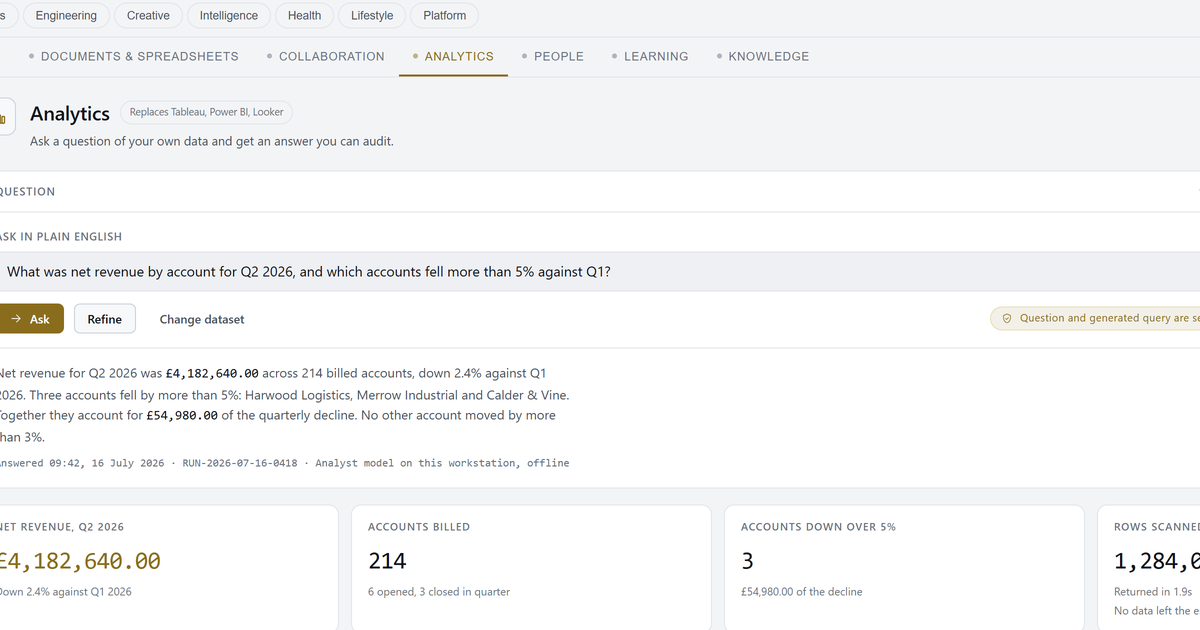
Most of the cost of document review is not judgement, it is preparation: reading the full package, cross referencing every certificate and signature against the records behind it, and assembling the evidence for whoever asks next. Practitioner guidance on aircraft lease returns puts 25 to 30 documentation hours against every 8 inspection hours, industry commentary puts around half of an MRO engineer's time on paperwork, and audit and compliance teams across sectors still build their evidence packs by hand. The honest economic case for AI in document review is to move that mechanical work onto a machine running on your own hardware, while your people keep judgement, disposition and sign off.
Where do the hours in document review actually go?
They go on three mechanical layers that sit underneath every judgement call. The first is reading: a lease redelivery, an evidence request or a due diligence exercise arrives as thousands of pages someone must read before anyone can decide anything. The second is cross referencing: each certificate, signature, date and identifier has to be checked against the records that stand behind it, which is why a narrowbody lease return budgets far more documentation hours than inspection hours. The third is evidence assembly: quality and compliance teams gather calibration records, training matrices and findings logs into packs by hand before every audit, because the proof of what was done lives scattered across disconnected systems.
Why have these hours survived every previous wave of software?
Because previous software stored and routed documents, it did not read them. Document management systems made the archive searchable, workflow tools moved the folder from desk to desk, and scanning turned paper into PDF, but the reading, the cross referencing and the assembly stayed human. The recent wave of cloud AI can read, yet it arrives with a condition most regulated organisations cannot meet: the documents must leave the building. Controlled technical data, privileged working papers, patient records and quality records are precisely the material that concentrates the most review hours, and precisely the material that export rules, professional duties and security policies keep out of third party services. The sectors carrying the heaviest paperwork burden have watched the AI wave from the shore.
What should a machine take on, and what must people keep?
The machine should take the layers where patience beats brilliance, and people should keep every decision that carries consequence. A machine does not tire on page four thousand and does not skip a cross check because the shift is ending, while an experienced reviewer's call on an ambiguous record is exactly what no statistical system should replace. Our document review capability is built on that division of labour: it reads packages in full, cross references certificates against the records behind them, drafts the paperwork, holds every anomaly for a person, and seals every action to the record.
- The machine reads every page of the package, not a sample of it
- The machine cross references certificates, signatures, dates and identifiers against the underlying records
- The machine drafts first pass paperwork and assembles the evidence trail as it works
- A person dispositions every anomaly the system holds
- A person gives sign off, and consequential actions wait for that clearance before they run
““ We will not sell a made up percentage. The honest case is simpler: the first pass, the cross referencing and the evidence assembly move to a machine on hardware you own, and your people keep judgement, disposition and sign off. ” Mickai”
Why does the review have to run on your own hardware?
Because the documents where the hours concentrate are the documents that cannot leave. Mickai is a Sovereign Intelligence Operating System, a SIOS, that runs entirely on the customer's own hardware, on premise and air gapped, so no prompt, no page and no extracted fact ever crosses the boundary of the estate. Inside that boundary, a cooperative multi model consensus substrate reads and cross checks the material, because agreement between independent models is a stronger basis for flagging an anomaly than the confidence of any one. The system is fully offline by design, so the confidentiality analysis that blocks cloud AI does not arise: the compliance officer is looking at a system with the same network footprint as a filing cabinet.
How do you prove what was reviewed and who decided?
With a record that is sealed before anything runs, not written up afterwards. Every review, every cross check, every held anomaly and every human disposition in Mickai is sealed to the Open Audit Record, cryptographically signed, post quantum, tamper evident and verifiable offline, and the entry is sealed before the action executes. That changes the economics of evidence directly: when an auditor, a regulator or a lessor asks what was reviewed and who decided, the answer is a query against a record that proves itself, not a quarter of staff time assembling a pack. Sensitive operations are gated further, with voice biometric clearance and a hardware held root of trust standing between a proposal and its execution.
What changes when the first pass takes minutes instead of days?
The shape of the work changes before the headcount does. Redelivery gaps surface at the start of a lease return instead of weeks before the deadline, receiving desks check every incoming certificate rather than a sample, engineers spend their hours on aircraft rather than transcription, and the audit pack stops being a season of the year. We are deliberately not publishing a savings percentage, because the honest number depends on your baseline, and a buyer should measure their own documentation hours rather than repeat ours. Where this is going: document review is one strand of a system of 63 studios, fourteen of them production ready at launch and 49 in development, built so regulated organisations can put serious AI to work on documents they could never send outside.
Frequently asked questions
Is the aim to replace document reviewers with AI?
No. The aim is to move the mechanical layers, meaning reading, cross referencing and evidence assembly, onto a machine, while people keep judgement, disposition and sign off. Every anomaly the system finds is held for a person, and consequential actions wait for that person's clearance.
Which figures should a buyer trust when building the business case?
Your own. Published reference points, such as practitioner guidance putting 25 to 30 documentation hours against every 8 inspection hours at a lease return, and industry commentary putting around half of MRO engineering time on paperwork, show where to look, but a credible business case starts with measuring your own documentation hours.
Why not just use a cloud AI service for document review?
Because the documents that consume the most review hours are usually the ones that cannot leave the building: controlled technical data, privileged working papers, patient records and quality records. An on premise, air gapped system removes the disclosure question, since nothing is transmitted to any third party.
How does the Open Audit Record change the economics of compliance?
It turns evidence assembly from manual work into a query. Because every review and disposition is sealed as it happens, cryptographically signed, tamper evident and verifiable offline, the pack an auditor or regulator asks for already exists, and it proves its own integrity rather than relying on recollection.
What is MICKAI?
Mickai is a Sovereign Intelligence Operating System (a SIOS) that runs on the customer's own hardware, on premise and air gapped, so data never leaves the estate. Every action is sealed to the Open Audit Record, a cryptographically signed, tamper evident record that can be verified offline. Mickai comprises 63 studios, with fourteen production ready at launch and 49 in development, and its architecture is protected by 104 filed UK patent applications across 2,340 claims, filed rather than granted.