E-signature built into your operating system
Sign contracts where they already live. No per envelope fee, records land in the Open Audit Record, all on hardware you own.
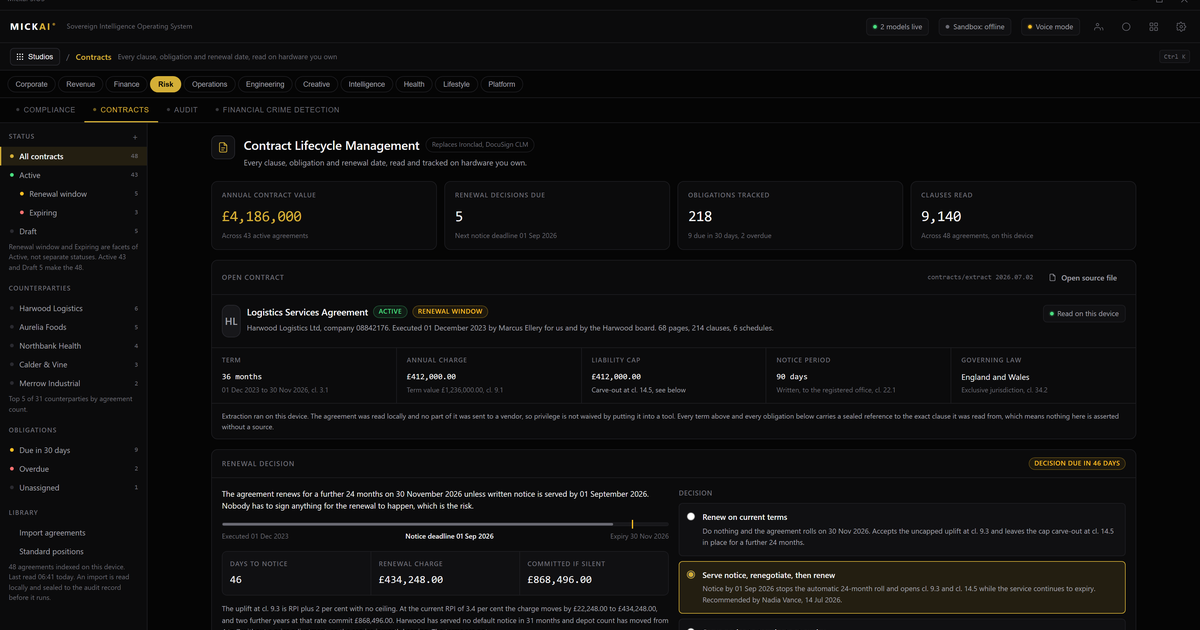
Signing a contract should not mean sending it to someone else's cloud and paying a fee every time it moves. On the MICKAI sovereign operating system, e-signature is a function of the system itself. The contract, the signature and the record all live in the same place, on hardware you own, with no per envelope charge.
That is the whole point. You are not renting a signing service and pushing your agreements through it. You are signing inside the system where the agreement was already drafted, stored and approved.
The contract already lives here
Most firms draft in one tool, store in another, and sign in a third. The document leaves your control, travels to a signing vendor, gets marked up, and comes back. Every hop is a copy, a login, and a place your agreement now exists that you do not run.
Our approach removes the hops. The document management studio, the contract drafting work, the approval routing and the signature are studios on one operating system, sharing your company's own data. When a contract is ready to sign, it does not go anywhere. The signing capability comes to it.
For a regulated small or mid-sized firm, that matters beyond convenience. The fewer copies of a binding agreement scattered across third party clouds, the fewer places you have to account for when someone asks where your contracts are and who touched them.
No per envelope fee
The dominant e-signature vendors meter their service. You pay per user per month, and plans cap the number of envelopes, sends or documents. Go over, and you buy more. The pricing rewards the vendor for every agreement you move.
We do not meter signing. E-signature is a capability of the operating system you own, in the same way saving a file is a capability of a computer you own. There is no per envelope fee and no per signature fee in the model. You sign as many contracts as your business generates, without a counter running in the background.
A conservative worked example
DocuSign publishes its list prices openly. As reported on its own pricing pages, the Standard plan lists at 25 US dollars per user per month, billed annually, and the Business Pro plan lists at 40 US dollars per user per month. Personal plans sit lower and cap envelopes tightly. These are the vendor's published figures, quoted here as public facts.
Take a firm with 40 people who send or countersign agreements: legal, sales, procurement, finance and operations. Put them on the Standard plan at the published 25 dollars per user per month.
- 40 users times 25 dollars, times 12 months
- Equals 12,000 US dollars per year, on published list price
Move the same 40 users to Business Pro at the published 40 dollars per user per month, which many firms need for payments, bulk send and advanced fields:
- 40 users times 40 dollars, times 12 months
- Equals 19,200 US dollars per year, on published list price
The assumption is simple: 40 seats, twelve months, the vendor's own list price, before any envelope overage, add-on or renewal uplift. Your seat count and plan will differ. The method is what carries: take the published per user per month price, multiply by your seats, multiply by twelve, and you have the recurring cost of renting the capability rather than owning it.
We state no MICKAI price here. The point of the worked example is the line item you stop paying every year when signing lives in software you own, on your own hardware.
The record lands in the Open Audit Record
An e-signature is only as good as the evidence around it. Who signed, when, from where, against which version of the document, and what happened before and after.
On our system, every signing action writes to the Open Audit Record. This is not a certificate stapled to a PDF. It is an action level log, tamper evident, that captures the signing event alongside the rest of the activity in your business: the draft, the approvals, the send, the countersignature, the storage. Because the signing studio and the audit record are the same operating system, there is no reconciliation between a vendor's audit trail and your own. There is one record.
You can read it, query it and export it. When a regulator, an auditor or a counterparty asks you to evidence a signature, you are not requesting a certificate from a third party's servers. You are producing it from a log you hold.
Air-gapped by default
Private deployment is the baseline across this market now. Serious vendors will run in your tenant or your cloud. We treat that as the floor, not the ceiling.
Our system is air-gapped by default. Signing a contract does not require the document, the signer's identity, or the resulting record to leave your network at any point. For firms handling agreements they cannot expose to an outside service, financial terms, personal data, defence and public sector work, that is the difference between a capability they can use and one they cannot.
You are not integrating a model or trusting a remote signing endpoint. You are running the whole software stack yourself, on hardware you own, with signing as one of its native functions.
One assistant across the whole flow
Because signing is part of the operating system, the assistant that runs across every studio runs here too. One assistant, one view of your data.
It can prepare a contract from your template, pull the right counterparty details from your CRM, route the document for internal approval, place it for signature, and then reconcile the signed record against your finance and document systems. It does this without moving your data between vendors, because the CRM, the document store, the approvals and the signature are all the same system. Ask the assistant where a contract stands, and it answers from the live record, not from a status email a signing vendor sent you.
Studios, not apps
E-signature is one capability among many. There are 63 studios on the sovereign operating system, covering the work a company actually does day to day. They are not separate apps you buy and wire together. They are studios on one operating system, sharing the company's own data, driven by one assistant.
Signing sits naturally inside that. A contract drafted in one studio, approved in another and stored in a third does not need an outside signing service bolted on, because the capability is already present in the system holding the contract. The saving is not only the per envelope fee you stop paying. It is the integration work, the second audit trail, the extra login and the extra copy of your agreements that you no longer have to manage.
What we hold
We hold 104 filed UK patent applications, with 2,340 claims. These are filed, not granted, and they cover the architecture behind this approach, including the action level audit record and the sovereign, air-gapped design. Distribution is handled through a partner we do not name.
We do not claim certifications we do not hold. What we describe here is the product: e-signature built into an operating system you own, where the contract already lives, with no per envelope fee and a full record in your own hands.
The practical benefit
Sign where the contract lives. Stop paying to move your own agreements through someone else's cloud. Keep the evidence in a log you control, on hardware you own, with an assistant that can run the whole flow from draft to signed record.
Work out what you pay today with the method above: published per user per month price, times your seats, times twelve. That number is the recurring cost of renting a signature. Owning the capability is a different proposition.
Frequently asked questions
Is this a separate signing app?
No. Signing is a function of the operating system, not a bolt-on. The contract, the signature and the record sit in the same place, on your hardware.
Do you charge per envelope or per signature?
There is no per envelope fee and no per signature fee in the model. Signing is a capability of the system you own, not metered traffic through a third party.
Where does the signed record go?
Into the Open Audit Record. Every action, who signed, when, from where, and the document version, is written to a tamper evident log you can read and export.
Can it work air-gapped?
Yes. The system is air-gapped by default. Signing does not require the document, the signer or the record to leave your network.
Does the assistant help with signing?
Yes. One assistant runs across every studio. It can prepare a contract, route it for signature and reconcile the record against your other systems, because they are all the same system.
How should we compare the cost to what we pay now?
Take your incumbent's published per user per month list price, multiply by your seat count and by twelve. That annual figure is the recurring cost you stop paying when signing lives in software you own.