Customer success on your own hardware
Run accounts, health scores and renewals on hardware you own. A customer success studio on the MICKAI sovereign OS, wired to your CRM and support.
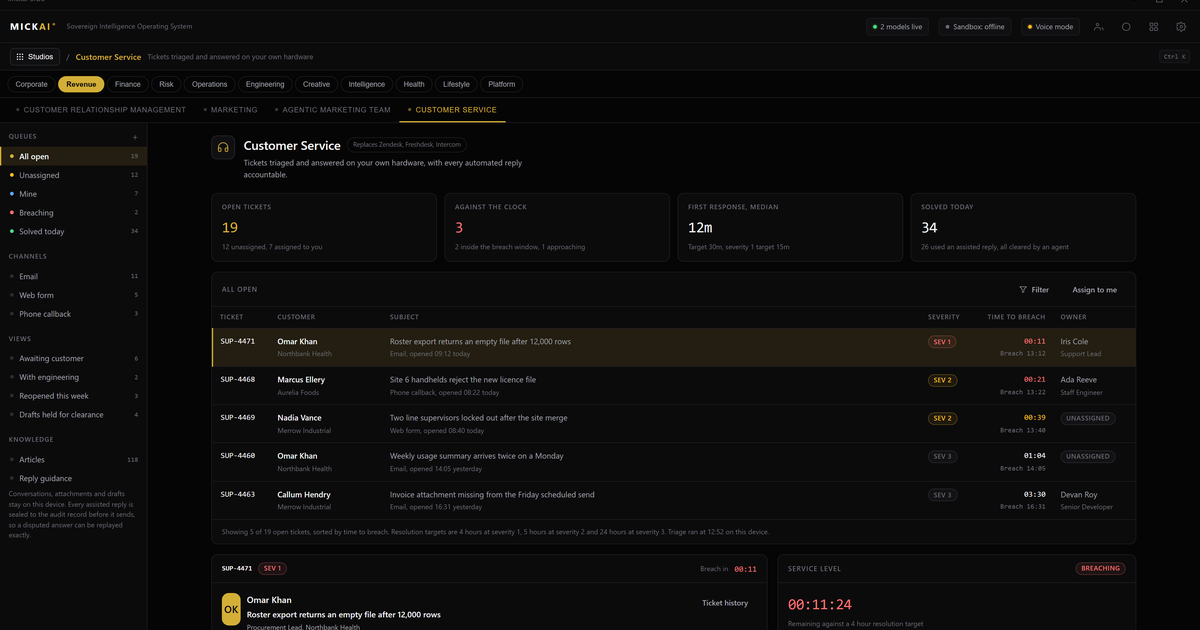
Customer success does not need a hosted platform. Accounts, health scores, renewal timelines and the reviews that hold it together can run on hardware you own, wired straight to your own CRM and support desk. One assistant reads across all of it, and no customer record leaves the building.
That is what our customer success studio is. Not a separate app you subscribe to, but one studio on the MICKAI sovereign operating system, sharing the same data as our CRM, our support desk and our meetings platform. The accounts your sales team closed, the tickets your support team resolved and the usage your product generates all sit in one store, on machines you control.
The work, on your own machines
The studio does the ordinary, load-bearing work of customer success.
It holds every account with the fields you care about: contract value, renewal date, the named contacts, the plan they are on. It scores account health from the signals you already have, support tickets, login and usage patterns, open commitments, sentiment from the last review. It runs playbooks: onboarding steps, quarterly business reviews, an escalation path when a red account appears. It tracks renewals and expansion on a timeline, so nothing lapses quietly. And it produces the review pack, the account summary, the health trend, the risks and the asks, without anyone rebuilding a slide by hand.
None of that is new to customer success. What is different is where it lives. The whole studio runs on hardware you own, air-gapped by default. You decide if anything ever crosses the boundary.
One operating system, not a stack of subscriptions
The reason it works without connectors is that the pieces are not separate products. Our CRM, our support desk, our meetings platform and this studio are studios on the same operating system. An account in the CRM is the same account the success studio scores. A support ticket is the same ticket that drags a health score down. A renewal booked here shows up in the revenue view there.
You are not paying three vendors to hold three copies of the same customer and then paying a fourth to reconcile them. There is one copy, on your hardware, and every studio reads it.
What the renting costs
Hosted customer success platforms are sold per user per month, and the published list prices are easy to check. The method matters more than any single figure, so here is the method and a worked example.
Take a mid-market customer success platform advertised at a list price in the region of 100 US dollars per user per month for a team plan. That is a reported public list price, not our number. Put twenty five customer success and account managers on it. The arithmetic is twenty five users times 100 dollars times twelve months, which is 30,000 dollars a year, before the usual add-ons for extra data, analytics seats or premium support. Over three years, and before any price rise, that is 90,000 dollars for one function's tooling.
If your team is fifty, double it. If the per-seat price sits higher, as several enterprise tiers do, the line grows with it. The point is not the exact figure, which you can read off the vendor's own page. The point is the shape: a recurring bill that scales with every person you add and every year you stay, for software you never own and data you hold on someone else's servers.
We do not publish a MICKAI price, and this is not a price comparison dressed as one. It is a framing. On owned hardware, the number that grows is not a per-seat subscription. You buy the machines once and run the studios on them.
The assistant across all of it
There is one assistant, and it works across every studio on the operating system, not just this one.
For customer success that means it reads the whole picture at once. It looks across accounts, support tickets and usage, and tells you which accounts are drifting towards a bad renewal while there is still time to act. It drafts the renewal note in your voice, pulls the quarterly review together, and answers a plain question like which enterprise accounts have an open escalation and a renewal inside ninety days. Because it can see the CRM and the support desk directly, it does not need to be handed a spreadsheet first.
It runs locally, against your own records, on your own hardware. Your accounts, contracts and usage are not sent anywhere to train a model. The reasoning happens where the data already is.
Every move on the record
When an assistant starts drafting renewal notes and flagging accounts, the obvious question is what it did and why. Our answer is the Open Audit Record.
Every action the assistant takes is written down at the level of the action itself: which account it read, what it changed, what it sent, when, and on whose instruction. Not a vague log that something happened, but a record you can hand to an auditor, a customer or your own board and follow line by line. For a regulated firm this is the difference between trusting a black box and being able to show your working.
That record lives on your hardware with everything else. It is not a report you request from a supplier. It is yours.
Who this is for
We build for the regulated small and mid-sized firm, the one that has a real customer base and a real obligation to know where its data is, but does not want to run a hyperscale platform team to get there.
Private deployment is the baseline others offer, a hosted product you can point at your own tenancy. Our value sits beyond that. The whole software stack runs on hardware you own, air-gapped by default, with action-level audit built in. It is not a model you have to integrate into a stack you still have to assemble. It is the stack.
The intelligence, the customer success studio, our CRM, our support desk and one assistant come as parts of a single operating system. Our patent position stands behind the platform, with 104 UK patent applications filed and 2,340 claims across them, filed and not yet granted. There are 63 studios on the operating system today. Customer success is one of them.
The short version
You already own the customer relationships. On the right platform you own the software that manages them too, and the data underneath, and the record of every decision made on your behalf. It runs on your hardware, it talks to your CRM and your support desk because they live on the same operating system, and one assistant works across all of it.
The renting has a running meter. Ownership has a boundary you control. For customer success, that boundary is where your accounts live, and it should be inside your own building.
FAQ
Does the customer success studio need the cloud? No. Accounts, health scores, renewal timelines and the assistant all run on hardware you own. It works air-gapped by default. You choose whether anything ever leaves the building.
How does it connect to our CRM and support desk? Through the shared operating system. Our CRM and our support desk are studios on the same OS, so account records, tickets and usage sit in one store. No connectors to rent, no data copied to a third party.
Can it replace a hosted customer success tool? It covers the same work: account health, playbooks, renewal and expansion tracking, executive reviews. The difference is you own the software and the data, and you pay for hardware not per seat per month.
What does the assistant actually do? It reads across accounts, tickets and usage, flags the accounts at risk, drafts the renewal note and the review deck, and shows its working. Every action it takes is written to the Open Audit Record.
Is our customer data used to train anything? No. Your accounts, contracts and usage stay on your hardware and are not sent out for training. The intelligence layer runs locally against your own records.
What about certifications? We hold none and claim none. The design point is that data does not leave your building, so the compliance question changes shape: you are auditing your own estate, not a supplier's.
Frequently asked questions
Does the customer success studio need the cloud?
No. Accounts, health scores, renewal timelines and the assistant all run on hardware you own. It works air-gapped by default. You choose whether anything ever leaves the building.
How does it connect to our CRM and support desk?
Through the shared operating system. Our CRM and our support desk are studios on the same OS, so account records, tickets and usage sit in one store. No connectors to rent, no data copied to a third party.
Can it replace a hosted customer success tool?
It covers the same work: account health, playbooks, renewal and expansion tracking, executive reviews. The difference is you own the software and the data, and you pay for hardware not per seat per month.
What does the assistant actually do?
It reads across accounts, tickets and usage, flags the accounts at risk, drafts the renewal note and the review deck, and shows its working. Every action it takes is written to the Open Audit Record.
Is our customer data used to train anything?
No. Your accounts, contracts and usage stay on your hardware and are not sent out for training. The intelligence layer runs locally against your own records.
What about certifications?
We hold none and claim none. The design point is that data does not leave your building, so the compliance question changes shape: you are auditing your own estate, not a supplier's.