Is There a Private Alternative to Otter and Fireflies That Keeps Transcripts On Your Own Hardware?
Yes: Mickai transcribes, summarises and assigns meeting actions entirely on your own hardware, so no audio or transcript ever reaches a cloud service.
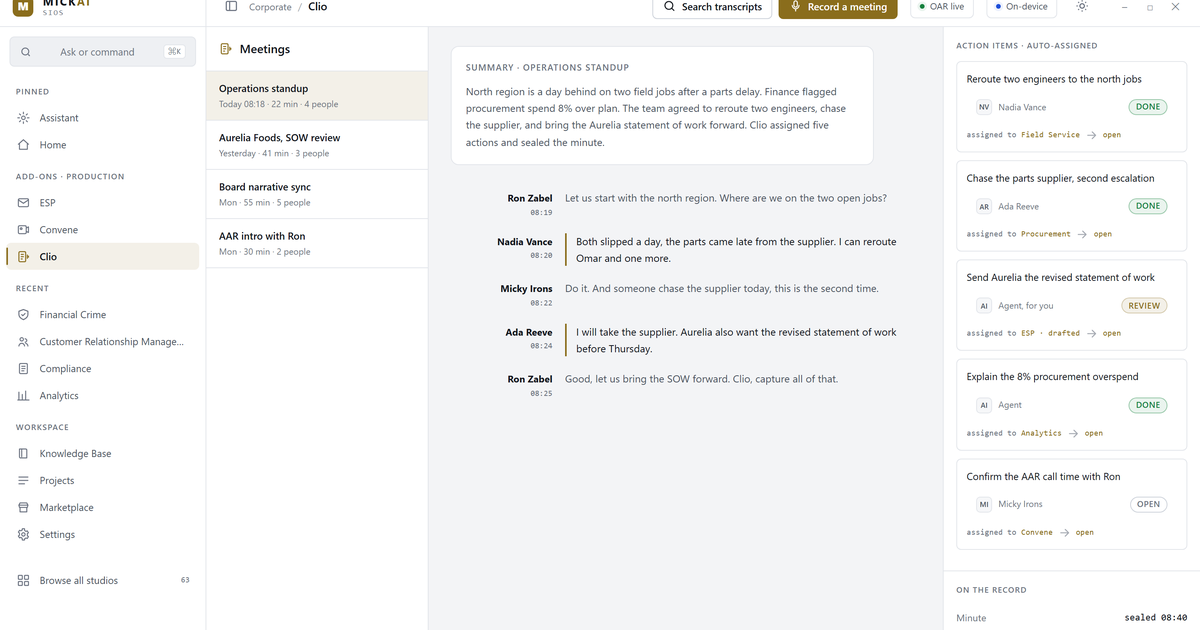
Yes. Mickai is a Sovereign Intelligence Operating System that records a meeting, writes the summary and assigns the actions entirely on operator-owned hardware, so no audio, transcript or minute ever leaves the building. It is a private alternative to Otter and Fireflies because it runs offline behind a zero-egress inbound perimeter, which means there is no cloud endpoint for the recording to travel to. The transcription, the summary and the action list are produced by sovereign models on your own machines, and every step is cryptographically sealed to an audit ledger you hold.
The question matters because most meeting note-takers are cloud services by design. They upload audio to a third party, process it on shared infrastructure and send the notes back over the internet. For a law firm, a bank, a defence supplier or a health provider, that upload is the compliance problem, not a feature. In 2026 the pressure is regulatory and jurisdictional at once, and a transcript that never leaves your hardware removes the exposure at its root rather than managing it with contracts and data-processing addenda.
How does an on-premise meeting note-taker work?
Capture, transcription and reasoning all happen locally. Audio from the room or the call is taken on hardware you own. Sovereign models, which run on your own silicon with no external call, perform the speech-to-text, separate the speakers, draft the minute and extract the decisions and owners. The result is written to local storage. Nothing is streamed to an outside service at any stage, because the inbound perimeter is zero-egress by design: connections come in to the operator, and data does not flow out. The meeting function in Mickai, the studio we call Clio, is one part of a wider system rather than a separate hosted service.
What can an auditor check after the meeting?
Every action is sealed to a tamper-evident audit ledger. An auditor can verify who spoke, what was decided, which model produced which line and when, without an internet connection, because the record and its proof sit together on the operator's hardware. Identity is hardware-attested and bound to the audit chain, so a minute can be tied to the specific machine and operator that produced it. The ledger is signed with post-quantum digital signatures under FIPS 204, the ML-DSA standard, with FIPS 205 available as a stateless-hash alternative, so the seal remains verifiable even against a future quantum adversary. These mechanisms sit within a body of work covered by 104 filed UK patent applications, approximately 2,340 claims, owned by Mickai LTD, and remain patent pending.
Which rules make a private note-taker necessary?
Several regimes point the same way. The US CLOUD Act lets US authorities compel data held by US-linked providers wherever it is stored, which is the core reason a European regulated buyer cannot rely on a cloud note-taker for privileged or sensitive discussion. GDPR treats a meeting transcript containing personal data as personal data. DORA, in force since January 2025, holds financial entities responsible for their third-party technology risk. NIS2 extends security and reporting duties across essential and important entities. ISO/IEC 42001 sets an auditable management standard for AI systems. On the EU AI Act, the high-risk obligations under Annex III that were once due on 2 August 2026 have been deferred by the Digital Omnibus to 2 December 2027, with embedded high-risk systems under Annex I moving to 2 August 2028 and the Article 50 transparency duties largely unchanged. We read that as a build window, not a reprieve.
Why can a cloud note-taker not meet the same test?
A cloud note-taker fails at the first step, because it must move the audio off your hardware to work. Once the recording is on a third party's infrastructure it is subject to that provider's jurisdiction, its sub-processors and its breach surface, none of which you control. Contracts and encryption in transit reduce the risk but do not remove it, because the provider can still be compelled to disclose and can still be breached. The difference is architectural. Otter and Fireflies are built to send audio out. A sovereign system is built so that it cannot.
How accurate is the summary, and how are actions assigned?
Accuracy is raised by cross-model consensus rather than a single pass. More than one sovereign model transcribes and summarises, and the system reconciles their output, which reduces the single-model errors that produce a confident but wrong minute. Actions are extracted as structured items: a task, an owner and, where stated, a date. Because the reasoning is local, the summary can draw on prior meetings and internal documents held on the same hardware without exposing any of it to an outside service.
What should a buyer test before trusting it?
Run one test. Disconnect the machine from the network, hold the meeting, and let the system transcribe, summarise and assign the actions. Then reconnect and inspect the network log. A genuine on-premise note-taker produces the full minute with the cable pulled and shows no outbound traffic carrying audio or text. A cloud service cannot pass this test, because it has nothing to process once the connection is gone. Ask any vendor to demonstrate it live, and ask to verify the signed ledger offline afterwards.
“A transcript that never leaves your hardware cannot be subpoenaed from a cloud provider, leaked from a shared tenancy or read under a foreign disclosure order, because there is no external copy to reach.”
Frequently asked questions
Can Mickai replace Otter or Fireflies for a regulated team?
Yes, for the core job of transcription, summary and assigned actions, with the difference that the work stays on your hardware. Otter and Fireflies are cloud services that upload audio to a third party. Mickai performs the same tasks offline behind a zero-egress perimeter, so a regulated team gets the notes without the data transfer that creates the compliance problem.
Does an on-premise note-taker need an internet connection?
No. Capture, transcription, summary and action assignment all run on local hardware, so the full minute is produced with the network disconnected. A connection is only needed for optional tasks you choose to allow, such as sending an approved summary to a named recipient. The transcript itself never requires egress.
Is a self-hosted transcript enough for GDPR and the EU AI Act?
Keeping the transcript on your own hardware removes the cross-border transfer and third-party processing that drive much of the GDPR risk, and it gives you the records an auditor needs. It is a strong foundation rather than an automatic tick, because compliance also depends on your policies, retention and access controls. The EU AI Act high-risk obligations under Annex III now fall due on 2 December 2027, which is time to build the controls properly.
How is the audit ledger protected against future quantum attacks?
The ledger is sealed with post-quantum digital signatures standardised by NIST. FIPS 204, the ML-DSA standard, is the primary signature scheme, with FIPS 205, the stateless-hash SLH-DSA standard, available as an alternative. These are signature standards, so they protect the integrity and verifiability of the record against an adversary with a future quantum computer.
Can it assign actions and not just transcribe?
Yes. Alongside the transcript and the summary, the system extracts structured actions: the task, the owner and any stated date. Because the reasoning runs locally against your own prior meetings and documents, the actions can be grounded in real context without sending any of it to an outside service.