Can you fine-tune an AI model on customer data without it leaking?
Yes, if you treat the fine-tuned weights as a copy of the training data and keep both inside your own perimeter.
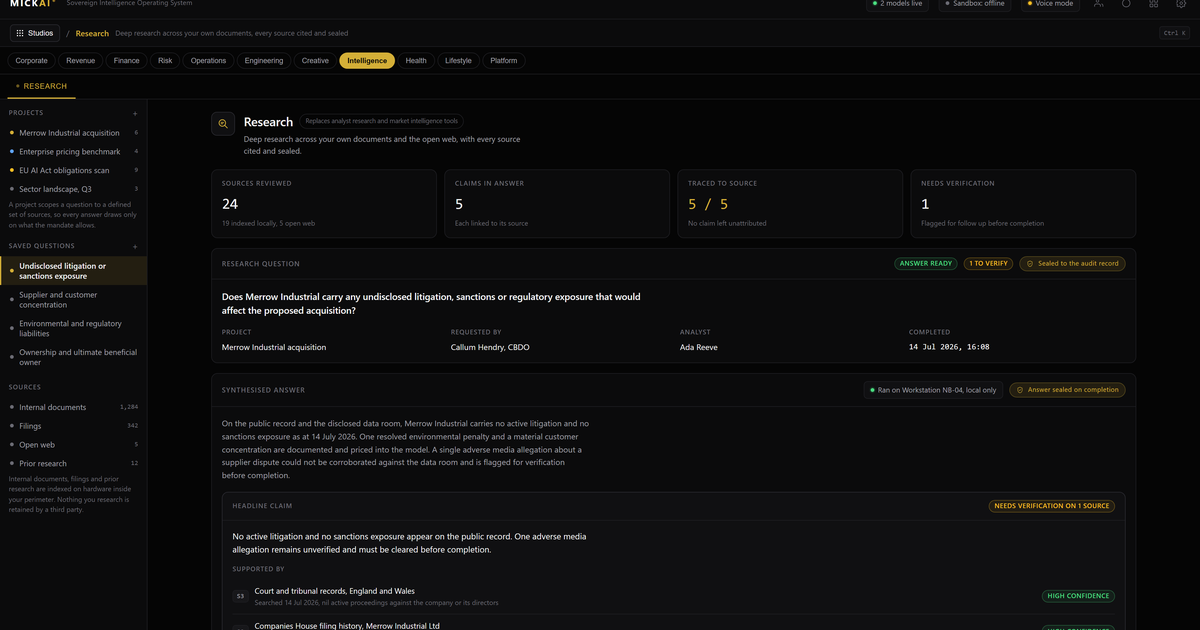
Yes, customer data can be used to fine-tune an AI model without leaking, but only under one discipline: treat the fine-tuned model as a derivative of the data it was trained on. Fine-tuned models can memorise training examples and repeat them in output, so the resulting weights inherit the confidentiality class of the training set. That means a model fine-tuned on customer records should be trained, stored and served inside infrastructure you control, with the weights versioned, hashed and tested for regurgitation before anyone can query them.
The question matters in 2026 because fine-tuning has moved from research teams to ordinary engineering backlogs. Regulated firms can now adapt capable sovereign models on a single rack, and the governance question has shifted from whether fine-tuning works to where the trained weights are allowed to live.
Why do fine-tuned models leak training data?
Neural networks compress their training data into weights, and the compression is imperfect. Rare, distinctive or frequently repeated records are the most likely to be memorised verbatim: a unique customer complaint, an unusual name and address pairing, a contract clause that appears in many documents. Prompting the finished model in the right way can then reproduce those records. This is not a defect of any one training stack; it is a property of how models fit themselves to data, which is why the protection has to sit in the architecture around the model rather than in a promise about the model itself.
What does this mean under UK GDPR?
Two consequences follow once a fine-tuned model is treated as a derivative of its training data. First, the training run is itself processing: purpose limitation and a lawful basis apply to the act of training, not only to the original collection of the data. Training on records collected for service delivery, without a compatible purpose, creates regulatory risk. Second, the weights inherit obligations: access control, retention and deletion questions attach to the model file just as they attach to the database it learned from. Deleting the source records while the weights persist does not straightforwardly discharge those obligations.
Which mitigations actually reduce memorisation?
No single technique eliminates memorisation, but several measurably reduce it and belong in any responsible training pipeline.
- Deduplicate the training set: repeated examples are memorised far more readily than unique ones.
- Keep epoch counts low: every additional pass over the same data increases the chance of verbatim recall.
- Hold sensitive records out of training where task performance does not need them.
- Evaluate for regurgitation before release: probe the model with prefixes of training records and check whether it completes them.
The final test matters most. A model that has never been probed for regurgitation has not been shown to be safe; it has simply not been asked.
When is retrieval the better answer than fine-tuning?
Often. If the goal is for the model to answer questions about customer records, retrieval keeps the records in a governed store and places them in the prompt at query time, so nothing is baked into the weights. Access control then works at the document level, deletion is real, and the model itself stays clean. Fine-tuning earns its place when the goal is behaviour rather than knowledge: house style, domain vocabulary, structured output formats. A useful rule: fine-tune the model on how you want it to work, and retrieve what you want it to know.
Why do the weights belong inside your own perimeter?
Because the weights are the data. A model fine-tuned on customer records and hosted on infrastructure you do not control is a copy of customer information sitting in someone else's environment, exposed to that environment's staff, jurisdiction and breach surface. Contractual assurances about isolation are promises, not technical guarantees. Our answer is architectural: Mickai is a Sovereign Intelligence Operating System that trains and serves models offline on operator-owned hardware behind a zero-egress inbound perimeter, so the derivative never leaves the boundary the original data was governed under.
How do you prove, later, what a training run did?
Provenance is the part most pipelines skip. Inside Mickai, every training run writes to a post-quantum signed audit ledger, sealed with ML-DSA under FIPS 204, recording which dataset version was used, which base weights were adapted, who authorised the run and what evaluation the result passed. The finished weights are versioned and hashed, so the exact artefact serving in production can be tied back to the exact data and approvals that produced it, and identity is hardware-attested and bound to the audit chain. When a regulator or a customer asks what a model learned from, the answer is a verifiable record, not a reconstruction. This sealing architecture sits within the 104 filed UK patent applications owned by Mickai LTD, which contain 2,340 claims.
“A model fine-tuned on customer data is not a separate asset from that data; it is another copy of it, and it must be protected as one.”
How training, serving and sealing fit together inside one boundary is set out at /sovereign-ai, and the film at /film shows the interface in operation.
Frequently asked questions
Can I delete customer data if it has already been used to fine-tune a model?
Deleting the source records does not remove what the weights have learned. If the model may have memorised the data, the defensible options are retraining without those records, retiring the affected model version, or demonstrating through regurgitation testing that the records are not recoverable. This is why weights should be versioned from the start: retiring a version is only possible if versions exist.
Is fine-tuning on customer data allowed under UK GDPR?
It can be, but the training run needs its own justification. Purpose limitation and lawful basis apply to training as a processing activity, and the resulting weights carry the same confidentiality obligations as the training set. Firms that document the purpose, minimise the data used and test the result for regurgitation are in a defensible position; firms that treat training as exempt plumbing are not.
Does a data processing agreement make cloud fine-tuning safe?
An agreement allocates liability; it does not change where the data and the derived weights physically sit. A contractual promise that data will not be retained or reused is not a technical guarantee, and the weights produced by the run remain a derivative of customer records in an environment the firm does not operate. For low-sensitivity data that trade may be acceptable. For customer records, the architecture should make the promise unnecessary.
How do I test a fine-tuned model for regurgitation before release?
Sample records from the training set, feed the model their opening tokens and measure how often it completes them with the genuine continuation. Distinctive and repeated records deserve the heaviest probing because they are the most likely to be memorised. Any verbatim recovery of personal data is a release blocker, and the test results belong in the model's audit record alongside its hash.
Should I fine-tune a model or use retrieval for customer support?
Use retrieval for anything the model needs to look up, because documents stay in a governed store where access control and deletion work. Reserve fine-tuning for behaviour: tone, format, domain vocabulary. Most customer support deployments need both, and the split keeps personal data out of the weights entirely.