Can HR use AI on grievance and disciplinary cases?
Yes, for summarising and drafting inside the employer's own boundary, with humans deciding outcomes and a sealed record of every AI action.
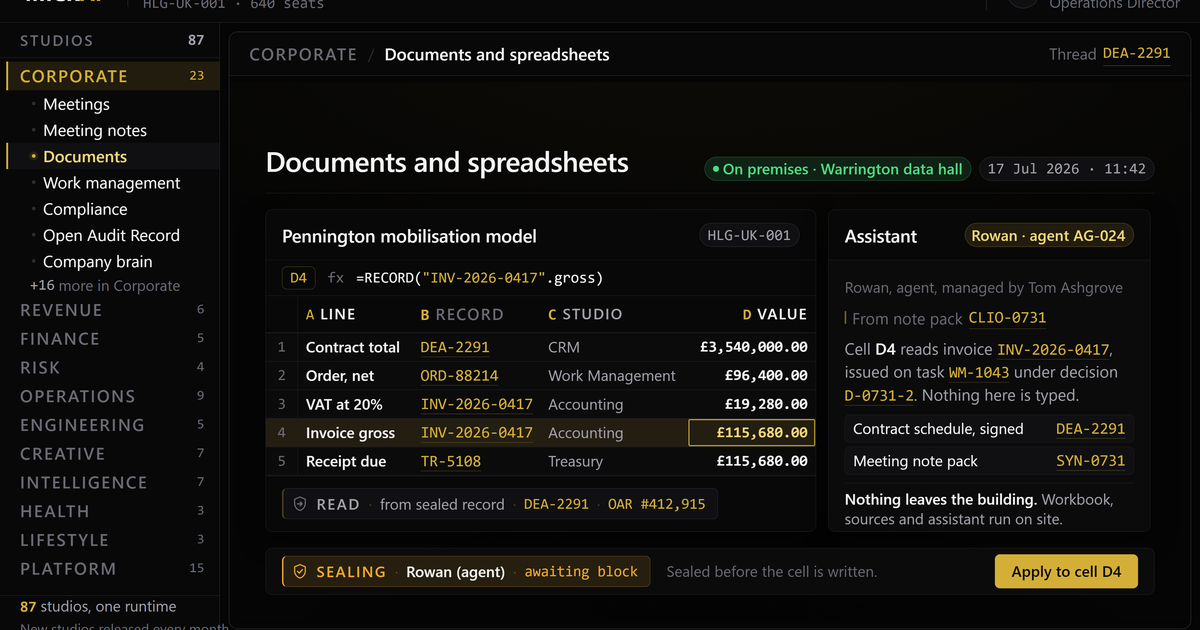
Yes, within strict limits. AI can help HR summarise evidence bundles, draft process documents and check consistency across cases, provided the case file never leaves the employer's boundary, every output is a draft for a human decision maker, and a sealed record can show exactly what the AI did and did not decide. Feed a grievance file into a public cloud service and the position changes entirely, because the employer may later have to explain to an employment tribunal where that file went.
The question matters in 2026 because grievance and disciplinary caseloads are document heavy, HR teams are stretched, and consumer AI services are one browser tab away. Employers that set the rules deliberately will fare better than those whose staff set them informally.
What makes grievance and disciplinary files different from other HR data?
They are among the most sensitive records an employer holds. A single case file can contain allegations against named individuals, witness statements given in confidence, occupational health reports, and protected characteristic data such as health or religion. Unlike most HR records, these files are built for contest: they end up in employment tribunals, where disclosure is ordered, process fairness is examined against the ACAS code, and every document the process created can be read back to its author.
What happens when the employee makes a subject access request?
A subject access request reaches AI processing of the employee's personal data, including prompts and outputs about them. If a manager pasted a case summary into a cloud AI service, the prompt and the generated text form part of the record the employer must search, retrieve and assess for disclosure. That raises two uncomfortable questions: can the employer actually retrieve what a third party holds, and what does the retrieved material reveal about how the case was really handled? An employer that cannot answer a DSAR accurately has a data protection problem stacked on top of an employment dispute.
Will an employment tribunal see what the AI did?
It can. Tribunal disclosure reaches the records the process created, and tribunals examine the fairness of the process, not only the outcome. If an AI service summarised the evidence, drafted the outcome letter or scored the allegations, those artefacts are potentially disclosable, and gaps in the record are themselves telling. The practical test is simple: use AI in a disciplinary process only in ways the organisation would be comfortable explaining to a tribunal, with records that support the explanation.
Can AI influence the outcome of a disciplinary decision?
This is the sharpest edge. A decision with legal or similarly significant effect on an employee that is materially shaped by automated processing moves into UK GDPR Article 22 territory, a regime the UK Data (Use and Access) Act 2025 is reworking in stages. The defensible line does not depend on the fine print: the AI organises, summarises and drafts, and the human decides. The decision maker must read the underlying evidence, not only the machine's summary of it, and the record should show that they did.
What can AI safely do in a grievance or disciplinary process?
Plenty, on the right architecture. The tasks below are organisation and drafting, not judgement.
- Summarising an evidence bundle into a chronology with references back to the source documents.
- Drafting invitation letters, outcome letters and meeting notes for human review.
- Checking a proposed sanction against how similar past cases were handled, surfacing inconsistency rather than deciding.
- Flagging gaps: witnesses not interviewed, allegations not put, documents referenced but missing.
Each of these speeds up a fair process. None of them replaces the decision.
What does a defensible deployment look like?
Four properties. First, the case file never leaves the employer's boundary: on Mickai, a Sovereign Intelligence Operating System running offline on operator-owned hardware, a zero-egress perimeter means a grievance file has no outbound route to take. Second, access is role-limited, so only the people entitled to see a case can put it in front of the AI. Third, every action is sealed to a post-quantum signed audit ledger bound to hardware-attested identity, so the employer can show a tribunal precisely what the AI summarised, what it drafted and what it never touched. Fourth, the record verifies offline, so the evidence does not depend on trusting anyone's infrastructure, including ours.
“In an AI assisted disciplinary process the employer must be able to prove two things: where the case file went, and who decided.”
How the boundary, the sealed ledger and the rest of the architecture fit together is set out at /sovereign-ai, and the film at /film shows the interface in operation.
Frequently asked questions
Can I use ChatGPT to draft a disciplinary outcome letter?
Entering case detail into a public cloud service such as ChatGPT, Claude, Gemini or Microsoft 365 Copilot places allegations, witness material and often health data on infrastructure the employer does not control. A subject access request or a tribunal disclosure order then reaches material the employer may be unable to fully retrieve or evidence. A sanctioned route inside the employer's own boundary delivers the drafting benefit without creating that exposure.
Does a subject access request cover AI prompts and outputs about me?
Where prompts and outputs contain an employee's personal data, they fall within the scope of a subject access request like any other recorded information. The employer must be able to search for them, retrieve them and assess them for disclosure, which is straightforward when the AI runs on the employer's own infrastructure and difficult when it does not.
Does using AI in a disciplinary process breach the ACAS code?
The code governs the fairness of the process rather than the technology used to run it. The risk is indirect: if AI summarisation replaces a genuine review of the evidence, or an automated score shapes the sanction, fairness is open to challenge. AI used for drafting and organisation, with a human decision taken on the full evidence, sits comfortably within a fair procedure.
Can AI decide whether a grievance is upheld?
No. A decision of that kind carries significant effects for everyone involved and belongs to a human decision maker who has read the evidence. Automated decisions with legal or similarly significant effects engage UK GDPR safeguards, and the evidential position is far stronger when the record shows the machine drafted and the manager decided.
What should we tell employees about AI use in HR processes?
Transparency obligations under UK GDPR mean employees should be told, in privacy information and in practice, when AI is applied to their data and for what purpose. A clear statement that AI assists with summarisation and drafting while decisions rest with named human roles is honest, simple to give, and far easier to defend than silence.