


Most Blockchain-and-Artificial-Intelligence Projects Are Built Backwards. Here Is the Correction.
The standard stack puts data on-chain, trusts a vendor chip, signs classically, and settles on someone else's ledger. Pantheon inverts each choice.
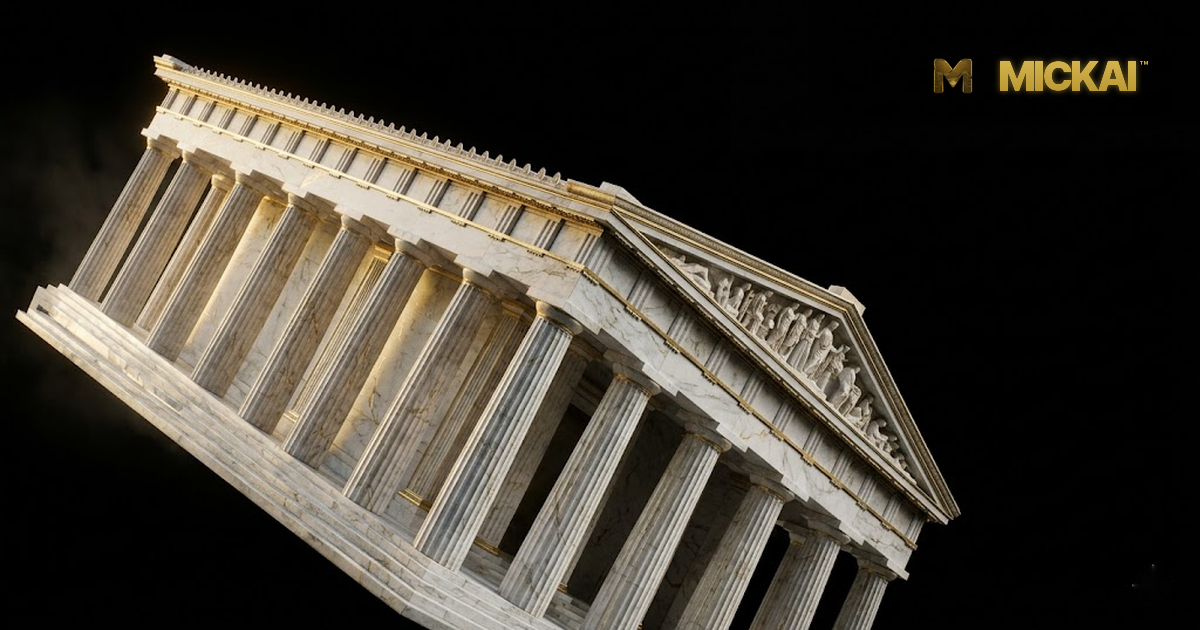
The Standard Stack Has the Arrow Pointing the Wrong Way
Picture the architecture diagram that ships with almost every project at the intersection of blockchain and artificial intelligence. Raw data goes on-chain. Trust is rooted in a hardware enclave bought from a silicon vendor. Records are signed with classical cryptography. The whole thing is anchored to someone else's ledger, often Hedera or the project's own settlement layer. Each of those four choices feels reasonable in isolation. Taken together they point the arrow the wrong way. They record the output of a system while leaving the thing that actually matters, the proof of what produced it, dependent on a chip, a key, and a host that the operator does not control. Pantheon, a sovereign Layer 1 blockchain built on the Mickai substrate, inverts each of the four. This article walks the correction one decision at a time.
The premise is simple and worth stating plainly before the detail. Public blockchains are very good at recording that a transaction happened. They are silent on what authority produced it and with what reasoning. Artificial-intelligence systems are the opposite: they act constantly, but they cannot prove after the fact, offline, what they did and under whose instruction. The gap between those two silences is where every current project plants its flag, and where almost every one of them plants it on rented ground.
Correction One: Put Proof On-Chain, Not Data
The first instinct is to put data on the ledger. Model outputs, inference logs, training references, the artefacts themselves. That instinct mistakes the ledger's job. A blockchain is a poor database and an expensive one, and storing the artefact does nothing to prove that the artefact is what a governed process actually produced. Pantheon stores proof instead. Every settled action on the chain carries an Open Audit Record (OAR) seal: a compact, signed attestation of what was done, under whose authority, and against which policy. The OAR is an append-only, hash-chained ledger in its own right, each entry signed and verifiable by anyone holding only the operator public key. The chain does not hold the work. It holds the receipt that the work was authorised, reasoned, and sealed, and that the receipt cannot be altered without breaking the chain.
This is more than a storage preference. On Pantheon the OAR is a native runtime module, pallet-oar, which means seals are first-class objects of consensus rather than entries in some contract's storage map. The chain orders and finalises seals the way other chains order and finalise token transfers. That distinction is the difference between a system that can attest and a system that merely files. When proof is what settles, the ledger answers the question that data alone never could: not what was recorded, but what authority and reasoning stand behind it.
Correction Two: Seal in Software on Commodity Hardware, Not in a Vendor Enclave
The second standard choice is to root trust in a hardware trusted execution environment (TEE): Intel Trust Domain Extensions (TDX), an NVIDIA confidential-computing enclave, or similar. The pitch is appealing. Let the silicon vouch for the computation. The cost is rarely stated as plainly. You have now made your trust model a property of a specific vendor's chip, its firmware, its attestation service, and its supply chain. Your sovereignty is exactly as durable as that vendor's roadmap and that vendor's last side-channel disclosure. The nearest peers in this space, EQTY Lab among them, build precisely here, and EQTY Lab in particular is a serious and well-funded team whose work is worth respecting. The disagreement is architectural, not personal.
Pantheon seals in software, on commodity hardware. The OAR seal is produced and verified without any dependency on a particular enclave, a particular chip generation, or a particular attestation server that has to be online and trusted. A node on an ordinary machine can produce a valid seal, and any party with the public key can verify it years later with no special hardware at all. The trust does not live in silicon you have to buy from one company. It lives in mathematics that anyone can check. That is what sovereignty over the attestation layer actually requires, and it is the difference between trust you hold and trust you rent.
Correction Three: Sign Post-Quantum From Genesis, Not Classically
The third standard choice is the quietest and, over a long horizon, the most consequential. Nearly every attestation system in this field signs with classical cryptography: elliptic-curve and Rivest-Shamir-Adleman (RSA) signatures that are secure today and breakable by a sufficiently capable quantum computer tomorrow. For a payment that settles in seconds this may not matter. For an audit record meant to prove, decades from now, what an artificial-intelligence system did under whose authority, it matters enormously. A signature that can be forged in 2040 is not an audit trail. It is a placeholder.
Pantheon signs every OAR seal under ML-DSA-65, the Module-Lattice Digital Signature Algorithm standardised as Federal Information Processing Standard 204 (FIPS 204), the United States National Institute of Standards and Technology (NIST) post-quantum signature standard. This is stated precisely on purpose. The claim is not the vague marketing phrase 'quantum-safe'. It is a named, standardised algorithm, implemented in the seal path and verifiable offline by anyone. And it is post-quantum from genesis, not a migration planned for some future hard fork. The attestation layer is born resistant. Every settled action carries a seal that a future quantum machine cannot forge, which is the only honest definition of an audit record that is supposed to outlive the hardware that wrote it.
Correction Four: Run Your Own Consensus, and Use Bitcoin Only as a Witness
The fourth standard choice is to anchor to someone else. Settle to Hedera, or to your own thin chain, or live as a rollup tenant on Ethereum, and inherit that host's ordering, its economics, and its governance. Pantheon does neither of the two common things. It is a standalone sovereign proof-of-stake (PoS) Layer 1, built on the Polkadot Software Development Kit (Substrate) in Rust, using the framework's audited machinery: BABE and Aura for block production, GRANDPA for finality. It is not a fork of Bitcoin and not a rollup tenant on Ethereum. It runs its own consensus over operator-sealed, post-quantum records, a property worth naming directly as seal-before-own-consensus: the chain validates the operator's sealed post-quantum record before it orders and finalises it.
Bitcoin still appears, but in its correct role. Periodically a Merkle commitment of the chain's OAR root is anchored to Bitcoin through OpenTimestamps, the free public timestamp-proof system. That gives every sealed record an external, globally recognised witness that it existed by a certain time, at no protocol cost and with no execution dependency. Pantheon does not fork Bitcoin and does not need Bitcoin to run. It borrows only Bitcoin's longevity as a clock. Own consensus for control, Bitcoin for an incorruptible second opinion, and neither one rented.
The Token That Falls Out of the Corrections
An honest correction at the protocol layer forces an honest correction at the economic layer. Pantheon's native asset, PAN, has a fixed supply of five billion (5,000,000,000), no inflation, and no mint authority. There is no emission pool quietly printing rewards and diluting holders. Validator and staker yield is funded instead by revenue buybacks: a governed share of real protocol revenue buys PAN on the open market and is split, indicatively and governance-tunable, roughly forty per cent to staker and validator yield, thirty per cent to a permanent burn, and thirty per cent to a governance lock. A base-fee burn in the style of Ethereum Improvement Proposal 1559 (EIP-1559) removes part of every transaction fee, so usage shrinks supply rather than inflating it. Every buyback, every burn, and every lock is itself sealed into the OAR and verifiable on-chain, which means the token economy is auditable by the same machinery that audits everything else.
Where that revenue comes from is the part most token designs leave abstract. Pantheon hosts fifteen application chains, each mapped to a live Mickai subsystem: trading and decentralised finance, Trust Agent audit, knowledge and retrieval, PENELOPE open-source intelligence, VIGIL sky monitoring, civilisation and survival, the Vinis assistant, a marketplace, governance, health (HYGEIA), legal (THEMIS), compliance, identity, autonomous market tasking, and hardware (HELIOS). Each settles its sealed actions to the base layer in PAN. The more the subsystems run, the more settlement flows down to the base layer, and the more revenue there is to buy back. Tokenomics here is coupled to attested usage, not to a promise of future usage. That coupling is the wedge no incumbent Layer 1 currently offers.
Decentralisation Without a Hardware Gate
A sovereign chain that can only be validated by the people who build it is not sovereign in any meaningful sense. Pantheon's validator design keeps the set genuinely open across three tiers, with a target active set of fifty to one hundred and fifty validators.
- Software validators download a single node binary, run it on commodity hardware, and bond PAN. No special silicon required.
- Delegators nominate validators through nominated proof-of-stake (NPoS), run no infrastructure at all, and share in rewards.
- Mickai hardware appliances offer a premium plug-in validator path from the Mickai hardware lineup, shipping twelve months after funding.
The hardware appliance is a convenience and a premium product. It is never a gate. The chain stays fully validatable by anyone running the free binary on an ordinary machine, which is what keeps it credibly decentralised. This is the same discipline as the software-sealing choice, applied to participation: the door stays open to commodity operators, and the premium path adds comfort rather than permission.
Governance and Compliance That Audit Themselves
Two further corrections sit beneath the visible token. Governance on Pantheon is two-keyed. PAN holders decide direction through on-chain referenda over parameters, treasury, and buyback policy. Beneath them sits a sealed execution-safety layer inherited from the Mickai Sovereign Intelligence Operating System (SIOS): before any gated action executes, a quorum of independent sovereign models must each return ALLOW. Every vote is sealed to the OAR, and every reversal is an append-only compensation that never deletes history. Direction is set by holders; safety is enforced by an independent quorum; and the full record of both is permanent.
Compliance is handled the same way, as a property of the chain rather than a quarterly attestation. The OAR compliance mapper generates signed evidence against the European Union Artificial Intelligence Act, the NIST Artificial Intelligence Risk Management Framework, and the International Organization for Standardization standard 42001 (ISO 42001), so the chain's own regulatory posture is continuously auditable rather than asserted once and trusted. No incumbent Layer 1 produces signed, ongoing evidence of its own compliance footing. That is not a side feature. For any institution that has to answer for the systems it runs, it is the reason to be here at all.
What Is Real Today, and What Is Designed
Precision matters most where enthusiasm is easiest. Pantheon is designed and substantially filed, not live. The Ethereum Virtual Machine (EVM) contracts are built and smoke-tested on a local testnet. The Substrate Layer 1 is in build. The bridge mechanisms, which let PAN exist as one fixed supply across Ethereum, BNB Chain, Base, and Arbitrum through a LayerZero omnichain-fungible-token-class lock-and-mint design, are covered by filed UK patent applications in the Pantheon bridge family. That family sits inside a portfolio of 104 filed UK patent applications, 2,340 claims, owned by Mickai LTD, with named inventor Micky Irons. Mainnet is gated by an independent security audit and by legal and securities clearance, not by unfinished code. The raise is thirty million pounds (Ladder B), roughly twenty-four per cent of supply, offered through Simple Agreement for Future Tokens (SAFT) instruments to professional investors only, marketed in the European Union via the Markets in Crypto-Assets (MiCA) utility-token notification route, with no United Kingdom retail promotion. The token generation event (TGE) is targeted for the first quarter of 2027. PAN does not trade today and the mainnet is not live today.
“Public ledgers prove that something happened. Pantheon is built to prove what produced it, under whose authority, with what reasoning, and to let anyone check that proof offline, decades later, without trusting a vendor's chip or a vendor's chain.”
The Correction, in One Line
Four standard choices, four inversions. Proof on-chain rather than data. Software seals on commodity hardware rather than trust rented from a silicon vendor. Post-quantum signatures under FIPS 204 ML-DSA-65 from genesis rather than classical signatures awaiting a forced migration. Its own consensus over operator-sealed records, with Bitcoin as an external witness, rather than settlement borrowed from a host. Each inversion is independently defensible. Together they describe a chain whose attestation layer is sovereign at every level it can be: the cryptography, the hardware, the consensus, and the economics. The competitors in this field each get one or two of these right. None assembles the whole stack on commodity hardware under a named post-quantum standard with its own consensus and a Bitcoin witness. That precise, unoccupied position is where Pantheon is being built, and it is why the correction is worth making in full rather than one fashionable piece at a time.