


An Audit Trail That Outlives the Company: Immutable Artificial Intelligence Records on a Sovereign Chain
When the company is gone, the seals remain: post-quantum records on Pantheon stay verifiable offline with only a public key, anchored to Bitcoin.
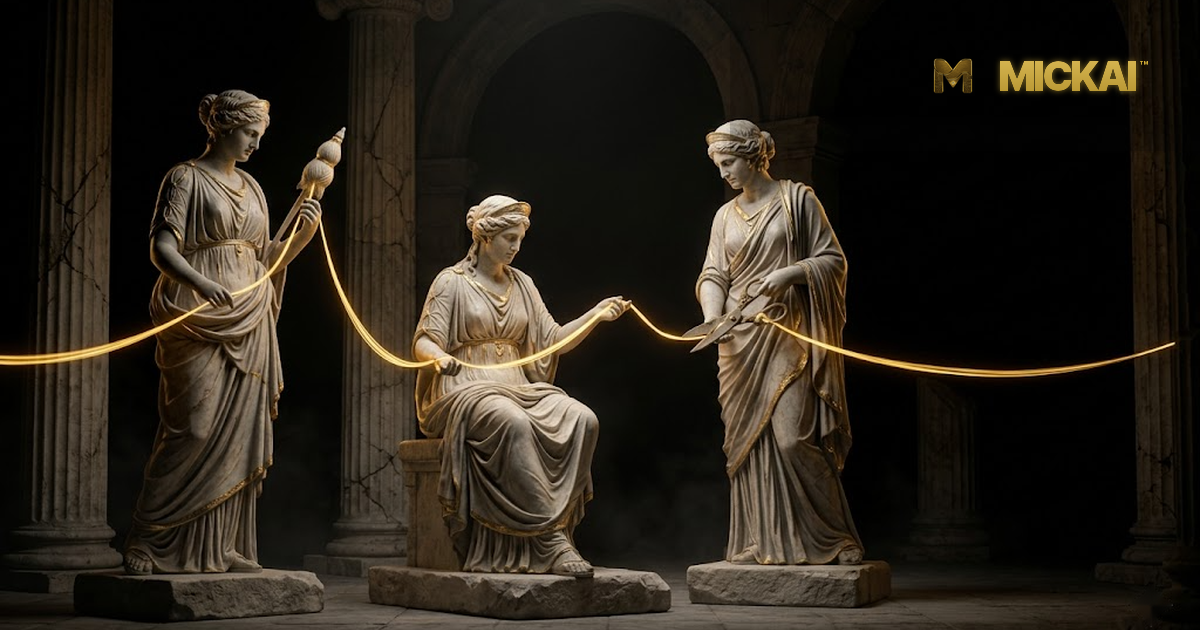
The Receipt That Survives the Issuer
Imagine an automated decision made on a Tuesday in 2027: a model approves a transaction, denies a claim, or releases a record. Now imagine the company that built that model is gone by 2034. The servers are decommissioned, the cloud account is closed, the founders have scattered, the source code sits in a defunct repository nobody can log into. Someone, a regulator, a court, a wronged counterparty, still needs to know exactly what happened that Tuesday: what acted, under whose authority, on what reasoning, and whether the record was tampered with afterwards. In almost every system built today, the honest answer is that the evidence died with the vendor. Pantheon is designed so that it does not.
Pantheon is a sovereign Layer 1 blockchain built on the Mickai Sovereign Intelligence Operating System (SIOS). Its single defining property is that its attestation layer is post-quantum from genesis. Every settled action carries an Open Audit Record (OAR) seal, signed under the Module-Lattice Digital Signature Algorithm at security level 65 (ML-DSA-65, standardised as FIPS 204, the United States National Institute of Standards and Technology post-quantum signature standard), before that action ever reaches consensus. The seal is verifiable offline, forever, by anyone holding only the operator public key. That last clause is the whole argument of this piece. Verification needs no running service, no live database, no surviving company. It needs a public key and a file.
What an Audit Trail Usually Depends On
Most audit trails are hostages to infrastructure. A conventional log is a row in a database. To trust it, you trust the database administrator who could edit it, the access controls that may have lapsed, and the organisation that keeps the lights on. The moment that organisation dissolves, the log becomes an orphan: a file of unverifiable assertions with no chain of custody and no way to prove it was not rewritten the day before the doors closed. Cloud audit services improve the convenience but not the dependency. They move the single point of failure from your basement to a vendor's region, and they sign, where they sign at all, with classical cryptography that a sufficiently capable quantum computer is expected to break within the working life of any record meant to last decades.
Artificial intelligence systems make this worse, not better, because they act faster and more opaquely than the humans they replace. A public blockchain can record that a transaction occurred, but it cannot attest to what produced it: which model, which version, under which operator's authority, with what inputs and what reasoning. The transaction is visible; the provenance is missing. Pantheon was designed to close precisely that gap, and to close it in a way that does not lean on the continued existence of the entity that created the record.
Seal Before Consensus, Not After
The mechanism is structural rather than procedural. On Pantheon, the OAR is not a smart contract bolted onto a general-purpose chain; it is a native runtime module, pallet-oar, written into the Substrate runtime itself. Pantheon is built on the Polkadot software development kit (SDK) in Rust, a standalone sovereign proof-of-stake (PoS) chain using the framework's audited block-production and finality machinery (BABE and Aura for production, GRANDPA for finality). It is not a fork of Bitcoin and not a rollup tenant renting space on Ethereum. Because the OAR is native, seals are first-class objects of consensus.
We call this seal-before-own-consensus. An action is sealed by the operator, signed under ML-DSA-65, and only then submitted to the chain, where validators order and finalise it as a post-quantum record. The signature is not an afterthought appended to a confirmed block; it is the precondition for the record entering the ledger at all. The OAR itself is append-only and hash-chained, so each entry binds to the one before it. Nothing is ever deleted. A reversal is not an erasure but an append-only compensation: a new sealed entry that corrects the effect while preserving the original in full view. History on Pantheon does not get rewritten, because the data structure makes rewriting it visible by construction.
This matters for permanence because it removes the human and institutional discretion that conventional logs depend on. There is no privileged account that can quietly amend the record, no administrator whose departure breaks the chain of custody, no migration that silently drops the provenance. The proof of what happened is welded to the act of recording it, and the welding happens before the record is allowed into consensus rather than after.
Why Permanence Is a Governance Feature
Permanence is usually filed under reliability, a convenience for tidy engineers. On Pantheon it is a governance feature, because accountability that expires is not accountability at all. A regulator examining a model's behaviour in 2031 needs the 2027 record to be both intact and independently checkable without asking the model's owner for permission or for a server. A litigant needs to demonstrate to a court that a sealed decision has not been altered, using nothing but mathematics and a public key entered into evidence years earlier. A successor organisation acquiring a portfolio needs to inherit a verifiable history, not a folder of claims.
Pantheon's governance is two-keyed, and both keys are designed to leave permanent traces. PAN-holder on-chain referenda decide direction: parameters, treasury, buyback policy. Beneath the referenda sits a sealed execution-safety layer inherited from the SIOS, which requires a quorum of independent sovereign models to return ALLOW before any gated action executes. Every vote, every model verdict, every reversal is sealed to the OAR. The result is a governance system whose decisions cannot be quietly disowned later, because the deliberation that produced them is itself part of the permanent record. Governance you can audit after the fact, offline, decades on, is a different and stronger thing than governance you simply have to trust in the moment.
“An audit trail that depends on the auditor's survival is not an audit trail. It is a promise with an expiry date.”
Bitcoin as an External Witness
A chain can attest to itself, but a sceptic will reasonably ask who attests to the chain. Pantheon's answer is to periodically anchor a Merkle commitment of its OAR root to Bitcoin using OpenTimestamps, a free and public timestamp proof. The point is narrow and deliberate. Bitcoin is used only as an external witness: an independent, globally distributed clock that places a cryptographic fingerprint of Pantheon's history at a fixed point in time, beyond the reach of anyone who later wishes the record had said something else. Pantheon does not fork Bitcoin, does not depend on it for execution, and pays no protocol cost to use it.
The consequence for durability is considerable. Even in a scenario where Pantheon's own validators have long stopped producing blocks, the anchored commitments persist inside the most heavily replicated ledger on earth. A holder of an OAR seal can show that the corresponding root existed at a given time by checking it against Bitcoin, then verify the seal itself under ML-DSA-65 against the operator public key. Two independent witnesses, one for time and one for authenticity, neither of which requires Pantheon, Mickai, or any company to still be answering its phones. The seals outlive the issuer because their verification was never routed through the issuer in the first place.
The Stack No Incumbent Assembles
The market for verifiable artificial intelligence is real and contested, and it is worth being precise about where Pantheon sits within it. The nearest peers, among them EQTY Lab, which is the closest and is well-funded, along with Sahara AI, 0G, ORA and Prove AI, root their trust in vendor silicon (hardware trusted execution environments such as Intel Trust Domain Extensions or NVIDIA enclaves) or in token economics. They sign with classical cryptography, the kind a future quantum computer is expected to break, and they anchor to Hedera or to their own chain. Each is a serious effort. None, on the public record, assembles the particular combination that defines Pantheon.
That combination is the wedge. Pantheon seals in software, under FIPS 204 ML-DSA-65, on commodity hardware, so trust does not depend on owning a particular vendor's chip. It runs its own consensus over operator-sealed records rather than parking them in someone else's contract storage. It anchors to Bitcoin as a neutral external witness. Its OAR compliance mapper generates signed evidence against the European Union Artificial Intelligence Act (EU AI Act), the National Institute of Standards and Technology Artificial Intelligence Risk Management Framework (NIST AI RMF), and ISO 42001, so the chain's own regulatory posture stays continuously auditable. And it couples its economics to attested usage rather than to inflation, which the next section sets out.
Economics Aligned With the Record
Permanence shapes Pantheon's token design as much as its ledger. PAN is the native asset of the Layer 1, with a fixed supply of five billion (5,000,000,000), no inflation and no mint authority. Fifteen application chains map to live Mickai subsystems, spanning trading and decentralised finance, Trust Agent audit, knowledge retrieval, open-source intelligence, sky and survival monitoring, health, legal, compliance, identity, hardware and more. Each settles its sealed actions to the base layer in PAN, so the more the subsystems run, the more settlement flows to the chain that records them. PAN also exists as an omnichain token of the same fixed supply across Ethereum, BNB Chain, Base and Arbitrum, through a lock-and-mint bridge, so sovereignty sits where the moat is while liquidity reaches where the market is.
There are no emission-based staking rewards and no inflation sell pressure. Validator and staker yield is funded by revenue buybacks: a governed share of protocol revenue buys PAN on the open market and is split, indicatively and tunable by governance, roughly forty per cent to staker and validator yield, thirty per cent to permanent burn, and thirty per cent to a governance lock. A base-fee burn in the style of Ethereum Improvement Proposal 1559 removes part of every transaction fee, so usage itself shrinks supply. Every buyback, burn and lock is sealed into the OAR and verifiable on-chain, which means the economic policy is held to the same permanent, offline-checkable standard as everything else the chain does. The participants who secure that record come in three open tiers.
- Software validators download a single node binary, run it on commodity hardware, and stake PAN. This path is always open, which is what keeps the chain credibly decentralised.
- Delegators nominate validators through nominated proof of stake (NPoS), share in rewards, and run no infrastructure at all.
- Mickai hardware appliances are premium plug-in validators from the Mickai hardware lineup, shipping twelve months after funding. They are a convenience, never a gate; the validator set, targeted at fifty to one hundred and fifty active members, stays open to software operators.
What Remains When Everything Else Is Gone
Pantheon is designed, its Ethereum Virtual Machine (EVM) contracts are built and smoke-tested on a local testnet, its Substrate Layer 1 is in build, and its bridge mechanisms are covered by filed United Kingdom patent applications within the Pantheon bridge family. The wider portfolio runs to 104 filed UK patent applications, 2,340 claims, owned by Mickai LTD, with named inventor Micky Irons. Mainnet is gated by an independent security audit and by legal and securities clearance, not by code, with a token generation event (TGE) targeted for the first quarter of 2027. The raise is thirty million pounds under Ladder B, roughly twenty-four per cent of supply sold via simple agreements for future tokens (SAFTs) to professional investors only, marketed in the European Union through the Markets in Crypto-Assets (MiCA) utility-token notification route, with no United Kingdom retail promotion.
None of that timeline is the point of this article, though. The point is the asymmetry it builds toward. A normal company spends its life accumulating records that become worthless the moment it stops existing. Pantheon is designed so that the value of its records is independent of its own survival. When the servers are gone, the seals remain. When the company is wound up, the public key still verifies. When the validators fall silent, the Bitcoin anchors still stand. An audit trail that outlives the company is not a marketing flourish. It is the only kind of audit trail that was ever worth trusting, and Pantheon is built to be that kind from genesis forward.