An asset and equipment management studio
Track equipment, licences and maintenance on hardware you own, wired to finance and facilities, with one assistant keeping the register honest.
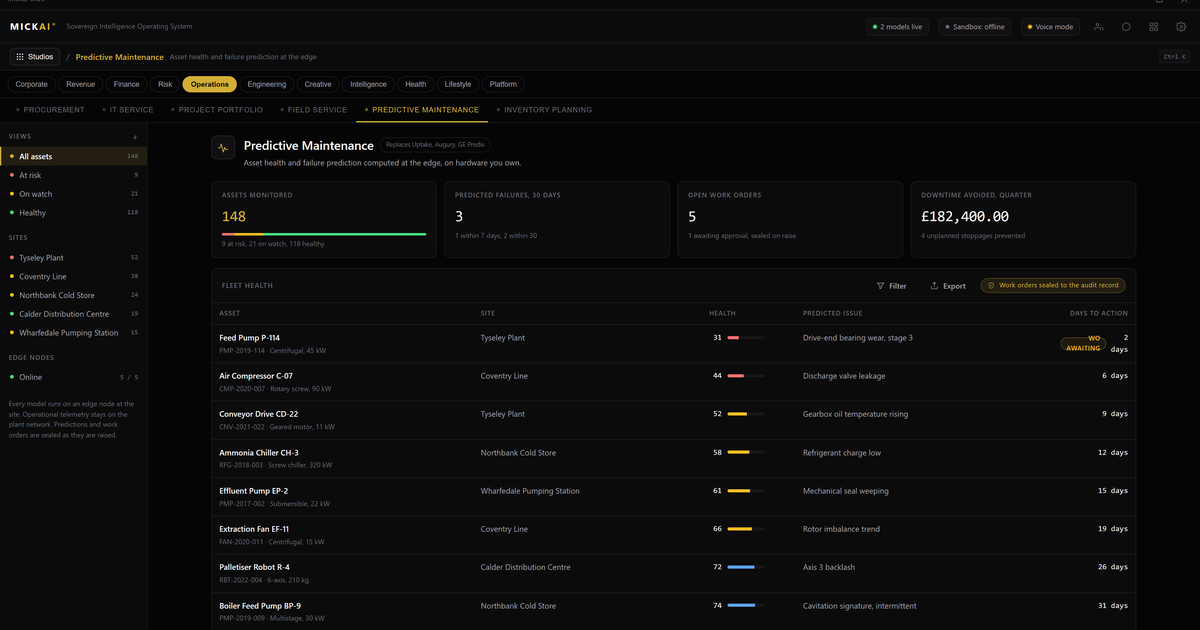
Track equipment, licences and maintenance on hardware you own, not on a vendor's cloud. The asset and equipment management studio holds one register for every laptop, tool, vehicle, instrument and software entitlement your firm controls, and it is wired to finance and facilities because all three run on the same sovereign operating system. One assistant keeps the register honest, flags what is due and drafts the action for a person to approve.
One register, not four spreadsheets
Most firms have a rough sense of what they own and rarely know it precisely. The laptop count lives in an IT sheet. The vehicle log sits with the fleet manager. Warranties are in a drawer, licence keys are in an email, and depreciation is a finance schedule that no one reconciles against the physical estate. When something goes missing, breaks, or comes up for renewal, someone spends a morning stitching those sources together.
The asset studio replaces that with a single register. Every asset carries what you would expect: what it is, where it is, who holds it, what it cost, when it was bought, what it is worth now, and what happens next. Physical kit and software entitlements sit side by side, because a lapsing licence and an overdue service are the same kind of record, a date against an asset that someone needs to act on.
Because the studio runs on the operating system rather than as a separate app, that register is not a copy of the truth. It is the truth other studios read from.
Wired to finance and facilities
An asset is a finance object and a facilities object at once. It depreciates, it sits on a book, it consumes a maintenance budget, and it lives in a building. When these are separate tools, someone has to keep them agreeing with each other, and they drift.
On one operating system they do not drift, because they share the same data. Buy a piece of plant in the asset studio and finance sees the capital entry and the depreciation schedule without a second entry. Assign it to a site and facilities sees it against that location. Retire it and the write-off, the disposal record and the removal from the floor plan all follow from one action. The assistant does the joining that a person used to do by hand, and it does it every time rather than at quarter-end.
This is the point of studios on one operating system rather than a shelf of integrations. The asset studio is not calling an API into a finance product from another company and hoping the fields line up. It is reading and writing the same records finance and facilities read and write.
The assistant keeps the register honest
A register is only useful if it is current, and registers rot. The assistant is what keeps this one alive.
It watches dates. A warranty ending, a licence about to auto-renew, a service interval reached, a calibration due, a lease expiring. It does not just show these on a dashboard and wait. It drafts the next step: a renewal to review, a maintenance job to raise, a supplier to contact, a write-off to sign off. The person approves or edits. Nothing leaves and nothing changes silently.
It watches consistency. An asset assigned to someone who left. A licence count higher than the seats in use. A device that has not checked in. Two records that look like the same item. It surfaces these as questions, not as automatic corrections, and it holds the correction until a person says yes.
Every one of those actions is written to an action-level Open Audit Record. Not a login log, not a page-view log, but a record of what was changed, proposed or approved, by whom, and when. For a regulated firm that has to show how its asset register is maintained, that record is the evidence, and it never leaves the estate.
The money is the subscription you stop renting
Asset, equipment and facilities management is usually rented. You pay a per-user, per-month subscription to a maintenance-management tool, an IT asset tool, a facilities platform, and often a separate licence-management product on top. Each one holds your data on someone else's cloud and bills you every year to keep looking at it.
The saving from owning the studio instead is the recurring subscription you stop paying. You do not need our price to work it out, because the number is already on the incumbent's own price list.
The method is plain. Take the published list price per user per month for the tool you rent today. Multiply by the number of users. Multiply by twelve. That is the annual figure ownership removes, and it recurs every year you keep operating.
A worked example, conservative and clearly assumed. Assume a facilities or asset tool at a published £40 per user per month, and 60 people who touch it. £40 times 60 is £2,400 a month. Times twelve is £28,800 a year, every year, for one tool. Add the separate licence-management subscription and the IT asset tracker and the figure climbs before you have counted a single physical item. Swap in the real published price of the products you actually rent and your own headcount, and the arithmetic is the same. We quote no MICKAI price here. The comparison stands on the incumbent's list prices as public facts and on multiplication anyone can check.
Ownership also changes what happens when you grow. Rented tools bill you more as you add people. A studio you own on hardware you own does not send a larger invoice because you hired a team.
Sovereign by default, beyond private cloud
Private deployment has become the baseline expectation, and rightly so. The asset studio takes that as the starting line, not the finish.
It runs air-gapped by default. The register, the licence keys, the supplier contacts and the maintenance history stay inside your own operating system, on your own hardware. There is no vendor with a copy, no shared control plane, and no telemetry leaving the building unless you decide otherwise and can see exactly what goes.
You get the whole software stack, not a model to integrate. The studio, the assistant that drives it, the audit record and the links into finance and facilities arrive as one system that already works together, rather than a component you have to wire into a platform from three other suppliers.
And it is built for the regulated small and mid-sized firm, the organisation that has real compliance obligations over its estate but does not have a platform team to assemble a data lake. The intelligence layer reads the register, reasons over the dates and the anomalies, and drafts the actions in plain terms. It works for the studios; we do not put a model's name in front of the person using it.
What you actually get
An asset and equipment management studio, running on the MICKAI sovereign operating system, on hardware you own. One register for physical kit and software entitlements. Live links to your finance studio and your facilities studio, sharing the same records rather than syncing copies. One assistant across all of it, drafting renewals, maintenance and write-offs and holding each for a person to approve. An action-level audit record of every change, kept on your estate.
It sits among 63 studios on the same operating system, each one a thing you would otherwise rent, all reading from the company's own data and answered by the same assistant. Our patent position stands behind the platform as one layer of the moat, 104 filed UK patent applications carrying 2,340 claims, filed and not granted, and never the headline. The headline is the register you finally own, current for once, and the subscription you stop paying every year to rent it from someone else.
FAQ
Where does the asset data live? On hardware you own, inside your own sovereign operating system. The register, the licence keys, the maintenance history and the depreciation schedule stay on your estate. Nothing is mirrored to a vendor cloud, and by default the studio runs air-gapped.
How is this different from a private cloud asset tool? Private deployment is the baseline, not the value. Our value is beyond it: an action-level Open Audit Record for every change to the register, air-gapped operation by default, and the whole software stack rather than a model you wire into someone else's system. The asset studio shares data with finance and facilities because they run on the same operating system.
Does it track software licences as well as physical kit? Yes. Laptops, tools, vehicles, plant and instruments sit in the same register as software entitlements, support contracts and warranties. The assistant flags a licence about to lapse the same way it flags a service due, because both are records against an asset.
Can the assistant act on its own? It drafts, it never sends silently. It can propose a renewal, raise a maintenance job or write off a retired asset, and it holds each action for a person to approve. Every step it takes is written to the audit record.
Do we need to name a MICKAI price to work out savings? No. The saving is the per-seat subscription you stop paying for a rented asset or facilities tool. Take the published list price, multiply by users and by twelve months, and that recurring figure is what ownership removes. We quote no price of our own here.
Is this built or planned? Built. It is one of the studios that already run on the operating system. We do not reveal a launch order or dates.
Frequently asked questions
Where does the asset data live?
On hardware you own, inside your own sovereign operating system. The register, the licence keys, the maintenance history and the depreciation schedule stay on your estate. Nothing is mirrored to a vendor cloud, and by default the studio runs air-gapped.
How is this different from a private cloud asset tool?
Private deployment is the baseline, not the value. Our value is beyond it: an action-level Open Audit Record for every change to the register, air-gapped operation by default, and the whole software stack rather than a model you wire into someone else's system. The asset studio shares data with finance and facilities because they run on the same operating system.
Does it track software licences as well as physical kit?
Yes. Laptops, tools, vehicles, plant and instruments sit in the same register as software entitlements, support contracts and warranties. The assistant flags a licence about to lapse the same way it flags a service due, because both are records against an asset.
Can the assistant act on its own?
It drafts, it never sends silently. It can propose a renewal, raise a maintenance job or write off a retired asset, and it holds each action for a person to approve. Every step it takes is written to the audit record.
Do we need to name a MICKAI price to work out savings?
No. The saving is the per-seat subscription you stop paying for a rented asset or facilities tool. Take the published list price, multiply by users and by twelve months, and that recurring figure is what ownership removes. We quote no price of our own here.
Is this built or planned?
Built. It is one of the studios that already run on the operating system. We do not reveal a launch order or dates.