Anchoring Is Not Spending: What Bitcoin Permanence Buys the Record
Why committing a hash to the most expensively defended chain on Earth is a question of proof, not payment.
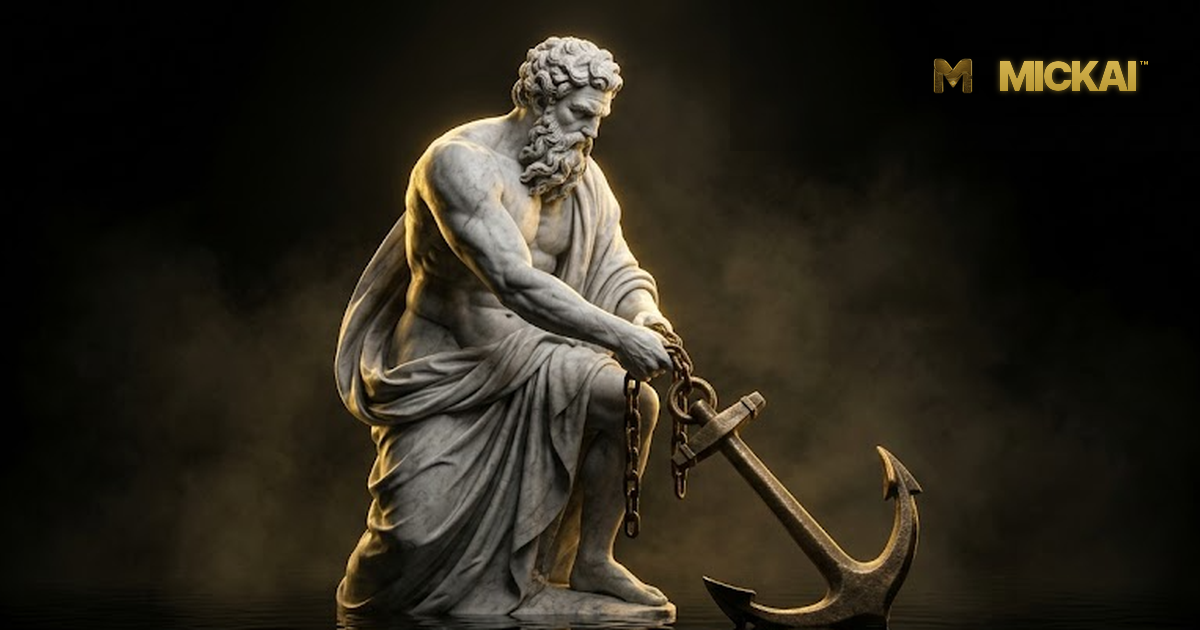
There is a persistent confusion at the heart of how people talk about putting data "on Bitcoin". They picture a payment. They imagine coins changing hands, a fee being burned, value leaving one pocket and entering another. So when they hear that a system anchors its records to Bitcoin, they assume it must be spending Bitcoin to do so. It is not. Anchoring is not spending, and the gap between those two ideas is exactly the value on offer.
Spending moves a coin. Anchoring moves nothing. It commits a fingerprint, a single cryptographic hash, into the most expensively defended ledger humanity has ever built, so that the existence and timing of a record become impossible to quietly revise. You are not buying coins. You are buying permanence, and permanence is a different good with a different price.
What a hash commitment actually is
A hash is a fixed-length fingerprint of arbitrary data. Change a single byte of the original and the fingerprint changes beyond recognition. It runs one way: you cannot reconstruct the record from the hash, which means the record itself never leaves the operator's hardware. What goes outward is a number that proves nothing about content and everything about integrity.
When that number is written into Bitcoin, it inherits Bitcoin's one genuinely scarce property: the cost of rewriting history. To alter an anchored record retroactively, an adversary would have to rewrite the chain from the anchoring block forward, out-spending the global hash rate that secures it. That is the actual product. Not storage, not coins, but a clock that cannot be wound back.
Pantheon: anchoring without spending
Pantheon is Mickai's own sovereign Layer 1, Bitcoin-anchored, with a native token (PAN) and a fixed supply of five billion. Its job in this story is narrow and deliberate. It takes the hash commitment of a sealed record and anchors it to Bitcoin for permanence. It does not move BTC. It is not a Bitcoin Layer 2, and it carries no claim on anyone's coins.
The discipline matters. A Layer 2 inherits Bitcoin's settlement and, with it, Bitcoin's economics and its custody questions. Anchoring inherits only Bitcoin's permanence and leaves the rest behind. Pantheon writes a commitment, Bitcoin remembers it, and no balance anywhere is debited. That is the whole point of saying anchoring is not spending: the security you want (irreversibility of the record) is decoupled from the cost you do not want (moving and custodying value).
Sovereignty is the reason the line is drawn this way. An operator running Mickai on their own hardware should be able to prove their records are permanent without taking on an exchange's risk, a custodian's terms, or a chain's spending mechanics. Pantheon gives them anchored permanence on their terms, which is the only kind worth having.
The record being anchored: the Open Audit Record
Permanence is only as good as the thing made permanent. In Mickai the thing is the Open Audit Record (OAR). Every consequential action the system takes is sealed and signed with FIPS 204 ML-DSA-65, the published NIST post-quantum signature standard. Mickai did not invent that standard. It adopts it, which is the correct posture: use the defences the world has already agreed to trust, do not roll your own.
So the chain of assurance reads cleanly. The action happens on the operator's own hardware. The OAR seals and signs it with a post-quantum signature, proving who did what. The hash of that record is then anchored through Pantheon to Bitcoin, proving when, and proving it has not changed since. Signature answers authorship. Anchoring answers time and immutability. Together they make a record you can stand behind years later, in front of an adversary who was not in the room.
Why operators should care about the distinction
Confusing anchoring with spending leads to the wrong objections and the wrong architecture. If you believe anchoring costs you Bitcoin, you ration it, you anchor rarely, you leave gaps an auditor can drive through. Once you understand that anchoring commits a hash and moves no value, you can anchor liberally and treat permanence as a default property of every consequential action rather than a luxury reserved for the few.
This is also why Mickai is described as a Sovereign Intelligence Operating System rather than a tool. Fifty specialised brains, twenty-five domain and twenty-five operational, run on the operator's own hardware and can run fully offline. Every consequential thing they do produces an OAR, and those records can be anchored for permanence without leaking content and without spending value. The substrate, not a feature bolted on top, is what makes the record durable.
The wider portfolio behind this approach runs to 104 filed UK patent applications, 2,340 claims, owned by Mickai LTD, with Micky Irons named as inventor. The patents are evidence that the architecture was designed deliberately, not assembled by accident. They are not the headline. The headline is simpler. You can have permanence without payment, proof without exposure, and a record that outlives the moment it was written.
The line, held
Anchoring is not spending. It commits a one-way fingerprint to the chain whose defining feature is that history cannot be cheaply rewritten, and it does so without moving a single coin. Pantheon draws that line on purpose, the OAR gives it something worth anchoring, and Mickai gives an operator both on hardware they own. What Bitcoin permanence buys the record, then, is the one thing a record most needs and can least fake: the certainty that it was there, at that time, and has not changed since.