


Anchor, Do Not Host: Where Pantheon Puts the Hash and Where It Keeps the Data
Pantheon settles the proof of an action on-chain and leaves the action itself on the operator's own hardware, the only design that satisfies verifiability and data sovereignty at the same time.
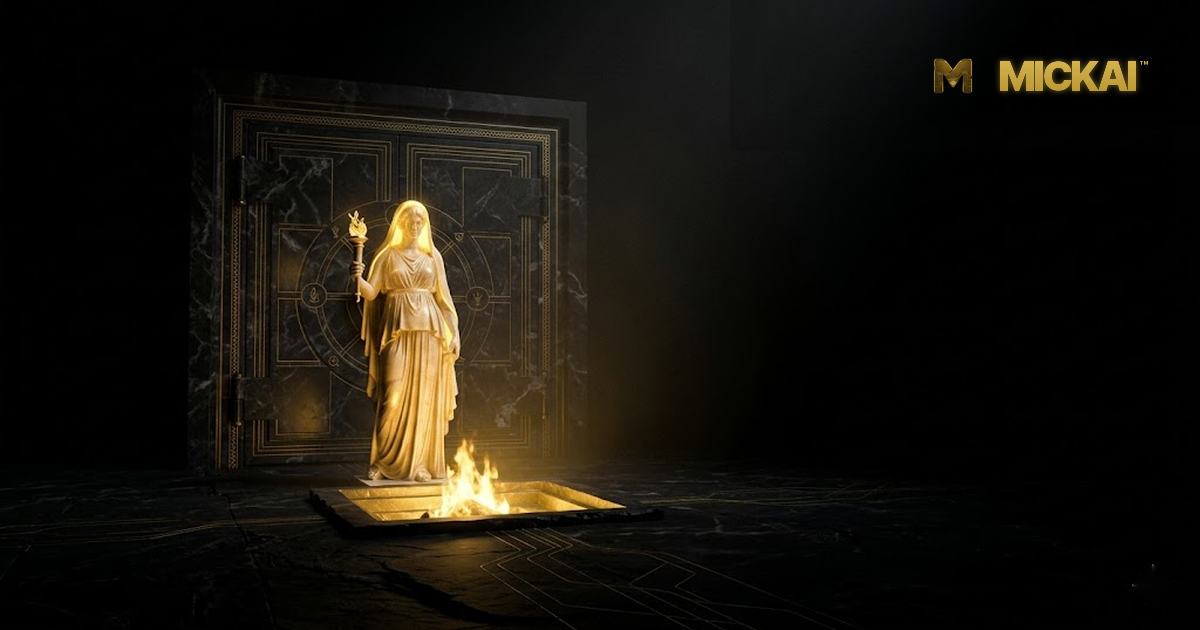
A chain that proves the act without owning the evidence
Picture a hospital running a Mickai health subsystem that triages a patient overnight. The model weighs symptoms, cross-references a private record, and recommends an escalation. Months later a regulator asks a hard question: what exactly did the system decide, under whose authority, and on what reasoning. The hospital must be able to answer with proof, not assurance. Yet the one thing it can never do is publish that patient's record to a public ledger for the world to inspect. Most blockchain thinking collapses at exactly this point. Pantheon is built around the resolution. The chain holds the proof of what happened. The operator keeps the data that happened. Those are two different objects, and Pantheon is designed so that they never have to occupy the same place.
State the principle plainly: anchor, do not host. A public Layer 1 blockchain should be the place you settle a verifiable commitment to an action, not the place you store the action's contents. Confuse the two and you are forced into a false choice between a ledger nobody can audit and a ledger that leaks everything it touches. Pantheon, a sovereign Layer 1 built on the Mickai Sovereign Intelligence Operating System (SIOS), is engineered to refuse that choice.
The seal and the payload are deliberately separated
Every action a Mickai subsystem takes is written into the Open Audit Record (OAR): an append-only, hash-chained ledger where each entry is signed under ML-DSA-65 (the Module-Lattice Digital Signature Algorithm standardised as FIPS 204, the United States National Institute of Standards and Technology post-quantum signature standard). That seal is small and self-contained. It carries a cryptographic hash of the underlying payload, the operator's signature, a timestamp, and the link back to the previous entry. It does not carry the payload itself. The patient record, the trading position, the intelligence dossier, the legal brief: none of it leaves the operator's hardware. What reaches Pantheon is the proof that a specific, unaltered thing occurred and was authorised, expressed as a fixed-size sealed object.
Because the seal commits to a hash of the data rather than the data, two properties hold at once. Anyone with the operator's public key can verify, offline and forever, that the sealed action is authentic and has not been tampered with. And nobody, including a Pantheon validator, can reconstruct the underlying content from the seal. A hash is a one-way function. You can confirm that a document matches its commitment if you already hold the document, but you cannot run the commitment backwards to recover the document. Verifiability and confidentiality stop being opponents. The chain proves the fact of the act; the operator alone holds the substance of it.
Native consensus over seals, not contract storage of secrets
On most chains, anything that needs to be trustworthy ends up in contract storage, which is to say it ends up replicated across every node and visible to anyone who reads the state. Pantheon is built differently. The OAR is a native runtime module (pallet-oar) on a standalone sovereign proof-of-stake (PoS) chain, built on the Polkadot software development kit (Substrate) in the Rust programming language, with the framework's audited block production (BABE and Aura) and finality (GRANDPA). Seals are first-class objects of consensus. Call this seal-before-own-consensus: the chain validates operator-sealed, post-quantum-signed records and then orders them. It is not a fork of Bitcoin and not a rollup tenant on someone else's Ethereum block space. It runs its own consensus over the proofs themselves.
That architectural choice is what keeps the data out. The object consensus agrees on is the seal, by design a commitment and a signature. There is no code path where settling an action requires uploading its contents, because the runtime's primitive is the proof, not the record. Fifteen application chains map to live Mickai subsystems, from trading and decentralised finance to Trust Agent audit, knowledge and retrieval, open-source intelligence, sky and infrastructure surveillance, civilisation and survival, the Vinis assistant, marketplace, governance, health, legal, compliance, identity, autonomous task management, and hardware. Each one settles its sealed actions to the base layer in PAN, the native token. Each one keeps its own data on its own hardware. The more the subsystems run, the more settlement flows down to the base layer, and none of that flow carries a payload with it.
Why this is the only model that satisfies regulated confidentiality
Data-protection regimes such as the European Union General Data Protection Regulation (GDPR) impose obligations that a naive on-chain design cannot meet. Personal data must be minimised, must stay within lawful boundaries, and crucially must be erasable on request. An immutable ledger that stores personal data directly is, by construction, in tension with the right to erasure: you cannot delete from an append-only chain. Pantheon sidesteps the tension instead of fighting it. Because the chain never holds the personal data, only a hash commitment to it, the operator can erase the underlying record on their own hardware. When the source data is gone, the on-chain hash becomes what it always was, an opaque, meaningless fingerprint that reveals nothing and can never be reversed into content. The proof of the past event survives; the personal data does not.
This is also the answer to data residency and sovereignty. A government department, a defence operator, or a clinic can run a Mickai subsystem entirely within its own jurisdiction and infrastructure, fully offline-capable, and still produce settlement to a shared chain that anyone can audit. The audit trail is global; the data is local. No incumbent design gives you both at full strength. Store the data on-chain and you fail residency and erasure. Keep the data off-chain but root your proofs in classical signatures on vendor silicon, and you have moved the trust problem rather than solved it. Anchor the hash and keep the data, sealed under a post-quantum signature you can verify on commodity hardware, and both requirements are met without compromise.
Outside witnesses, never outside custody
Verifiability should not depend on trusting Pantheon either. Periodically, a Merkle commitment (a single root hash summarising a whole tree of seals) of the chain's OAR root is anchored to Bitcoin using OpenTimestamps, a free public timestamp proof. Bitcoin functions here purely as an external witness: a globally observed clock that confirms a given set of seals existed by a given moment. Pantheon does not fork Bitcoin, does not depend on it for execution, and pays no protocol cost for the anchor. Note what crosses that boundary, which is again only a root hash. Bitcoin sees a fingerprint of a tree of fingerprints. It never sees a single action, let alone the data behind one. The witness strengthens the proof without ever touching the payload.
The same discipline runs through the post-quantum claim, which Pantheon states precisely rather than loosely. Seals are signed under FIPS 204 ML-DSA-65, implemented and verifiable offline by anyone holding only the operator public key. The nearest peers in attested artificial intelligence, EQTY Lab among them as the most serious of the group, root trust in vendor hardware enclaves or token economics, sign with classical cryptography that future quantum hardware is expected to break, and anchor to chains they do not control. Pantheon seals in software, on ordinary machines, under a signature scheme chosen to outlast the cryptographic transition, and it anchors to Bitcoin as a neutral witness. The custody of the data, throughout, stays with whoever produced it.
Governance that audits itself without seeing your data
Pantheon's governance is two-keyed, and it inherits the same anchor-do-not-host logic. PAN holders decide direction through on-chain referenda over parameters, treasury, and buyback policy. Beneath them sits a sealed execution-safety layer carried up from the SIOS: a quorum of independent sovereign models must return an explicit allow before a gated action executes, every vote sealed to the OAR, every reversal an append-only compensation that never erases history. The safety layer reasons over seals and commitments, not raw confidential payloads, so the chain can enforce policy and prove it enforced policy without the policy engine ever ingesting the very data it protects.
That posture extends to compliance itself. The OAR compliance mapper generates signed evidence against the European Union Artificial Intelligence Act, the United States National Institute of Standards and Technology Artificial Intelligence Risk Management Framework, and the ISO 42001 standard for artificial-intelligence management systems, so the chain's regulatory standing is continuously auditable. Here too the inputs are sealed records, not exposed data. A regulator can be handed cryptographic proof that an obligation was met, alongside the operator's public key to check it, without the operator surrendering the underlying material. No incumbent Layer 1 ships this, and the reason is structural: you cannot generate clean compliance evidence from a ledger that had to leak the data to record it.
The economics reward usage, not exposure
Keeping data off-chain does not weaken Pantheon's value capture, because the token is tied to attested activity rather than stored content. PAN is the native asset of the Layer 1, with a fixed supply of five billion (5,000,000,000), no inflation, and no mint authority. It also exists as an omnichain token of the lock-and-mint class on Ethereum, BNB Chain, Base, and Arbitrum, so one fixed supply spans every venue: sovereignty where the moat is, liquidity where the market is. Every application chain settles its fees in PAN, validators bond PAN to secure the chain, and holders govern with it. The volume that matters is the volume of sealed, settled actions, and that volume grows precisely as the fifteen subsystems do their work, none of which requires publishing a payload.
The rewards engine reinforces the same principle. There are no emission-based staking rewards and no inflationary sell pressure. Validator and staker yield is funded by revenue buybacks: a governed share of protocol revenue buys PAN on the open market and is split, indicatively and governance-tunable, roughly forty per cent to staker and validator yield, thirty per cent to permanent burn, and thirty per cent to a governance lock. A base-fee burn in the style of Ethereum Improvement Proposal 1559 removes part of every transaction fee, so usage itself shrinks supply. Every buyback, burn, and lock is sealed into the OAR and verifiable on-chain. The chain earns from the proof of work being done, never from the disclosure of what that work contained.
Why this design is the one that lasts
Public blockchains can record that a transaction happened but cannot attest to what produced it. Artificial-intelligence systems can act but cannot prove, after the fact and offline, what they did and under whose authority. Pantheon closes that gap from a single discipline: anchor the proof, keep the data. The seal is post-quantum from genesis, signed before it reaches consensus, verifiable offline forever. The payload stays where it was made, under the control and the law of whoever made it. This is the rare design in which a regulator, a counterparty, and a citizen can all get exactly the assurance they are owed, and not one byte more than that.
Pantheon is designed and filed. The bridge mechanisms are covered by filed UK patent applications within the Pantheon family, part of a portfolio of 104 filed UK patent applications and 2,340 claims owned by Mickai LTD, with named inventor Micky Irons. The Ethereum-compatible contracts are built and smoke-tested on a local testnet, the Substrate Layer 1 is in build, and mainnet is gated by an independent security audit and legal and securities clearance rather than by code, with a token generation event (TGE) targeted for the first quarter of 2027. The raise is thirty million pounds under Ladder B, roughly twenty-four per cent of supply, sold by simple agreements for future tokens (SAFTs) to professional investors only, with European marketing via the Markets in Crypto-Assets (MiCA) utility-token notification route and no United Kingdom retail promotion. The architecture, though, is already decided, and its first commitment is the one that should reassure anyone holding data they cannot afford to expose: the chain proves your action, and it never asks to hold it.