Air-Gapped AI for Media, Film and Music: Protecting Unreleased IP
Sovereign local indexing for studios and labels whose scripts, masters and assets are bound by multi-party NDAs
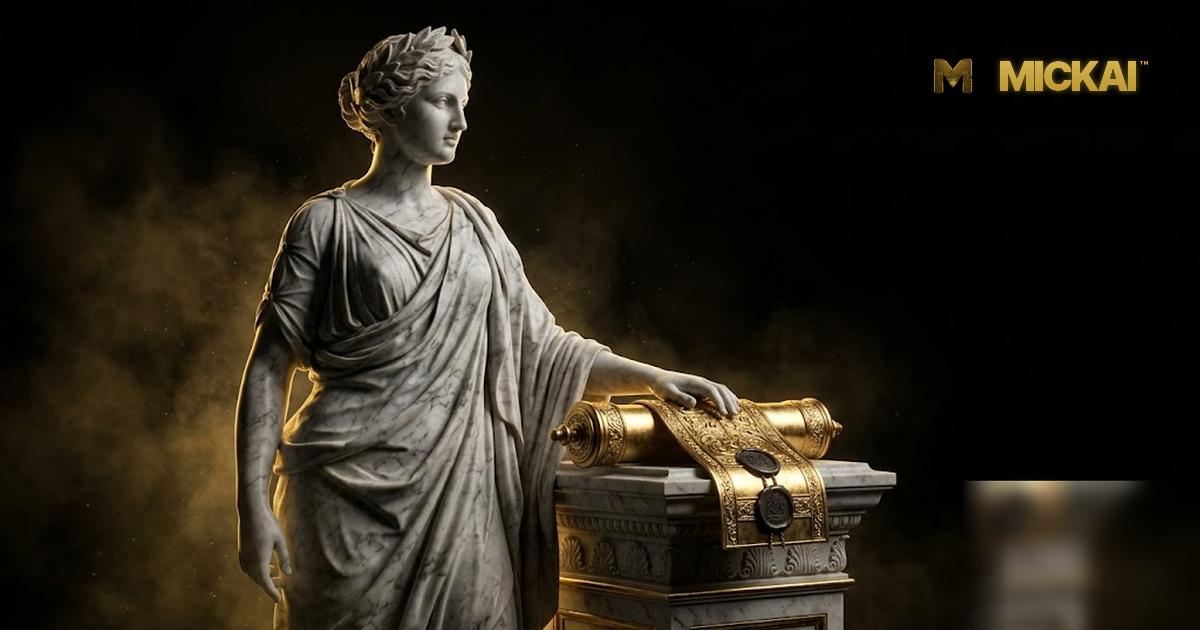
Air-gapped AI for media and entertainment is sovereign intelligence that indexes and reasons over scripts, masters and assets on hardware the studio owns, so unreleased intellectual property never crosses the internet and never enters a third party's servers. A film script, an unmastered album, a VFX asset or an unreleased episode is worth a fortune precisely because nobody outside the production has seen it. The moment it touches a shared cloud model, that scarcity is gone. The Mickai Sovereign Intelligence Operating System (SIOS) brings the compute to the asset rather than the asset to the compute, so what happens in the server room stays in the server room.
The market: an industry whose product is the secret
Film and television studios, music labels, recording houses and VFX shops all share one defining property: the value of the work is highest before release and collapses the instant it leaks. A pre-release master, a shooting script, a storyboard, a stem session and a rendered asset are the crown jewels of the business, and every one of them passes through dozens of hands under strict confidentiality.
The appetite for artificial intelligence across this estate is enormous. A studio wants to index decades of scripts and assets into something it can search in plain language, to review the dense web of rights and licensing contracts at machine speed, to tag and organise vast media libraries, and to surface continuity, legal and creative insight across a production. The demand has never been the problem. The problem is that the material carrying the value is exactly the material that cannot be exposed.
The compliance barrier: copyright and multi-party NDAs
Media and entertainment runs on a dense lattice of intellectual-property and contractual protection:
- Copyright in scripts, masters, footage and assets, owned and licensed under terms that restrict where and how the work may be held and processed.
- Multi-party non-disclosure agreements binding the studio, the talent, the agencies, the post-production houses and the financiers, each one a contractual promise that unreleased material will not leave controlled hands.
- Embargo and release-window obligations that make pre-release confidentiality a commercial and contractual imperative.
- Personal data and likeness protections where biometric or personal data of talent is involved, bringing data-protection law into play alongside the IP regime.
Uploading a script or a master to a cloud model is third-party processing of contractually protected, unreleased intellectual property. For a studio that has signed multi-party NDAs up and down its supply chain, that single act can breach dozens of agreements at once. This is not a friction to be managed. It is a contractual and commercial line that the production cannot cross.
Why cloud AI is a non-starter for studios and labels
A Data Processing Agreement does not change the physics. Once an unreleased asset leaves the studio, it sits on infrastructure the studio does not own, governed by terms that can drift, exposed to an attack surface the studio cannot audit. A signed contract does not stop a breach at the provider, an outage in the middle of a deadline, or interception in transit. The asset has still left the building, and the leak that follows is not a fine. It is a film spoiled, an album dumped early, a release window destroyed.
“In entertainment the leaked file is the catastrophe the whole industry is built to prevent. The cloud is the exfiltration vector, and a single uploaded master can undo a hundred million in value.”
There is a second risk that matters in a creative business: a public model improves on what it ingests. Feeding a studio's unreleased work to a shared model risks that work, in style or substance, surfacing elsewhere. Mickai removes that dependency through model and weight ownership. The studio owns the snapshot, insulated from a vendor's terms-of-service drift and from a public model trained on material it should never have seen.
How the Mickai SIOS serves the studio and the label
Mickai deploys a single-tenant operating system inside the studio, on hardware the studio owns, with deterministic network isolation and locally contained inference. The capabilities built for this market are:
- **The vision and audio studios**, sovereign local indexing that tags, organises and reasons over footage, stems and masters on the studio's own hardware, so an unreleased asset is understood by the system without ever crossing the internet.
- **Astraea**, contract review and legal-ops, reading the dense lattice of rights, licensing and talent agreements behind the firewall and flagging risk without a privileged contract leaving the building.
- **Documents**, for ingesting and structuring scripts, treatments, deal memos and production paperwork into a searchable, air-gapped archive.
These run as Mickai's own sovereign brains, fine-tuned on the studio's own catalogue so the system understands the studio's house style and history. The fine-tuning is local and stays local, with the Mickai sovereign vector store holding every embedding inside the perimeter. The institutional knowledge engine the studio builds is uncopyable and is never harvested to train anyone else's model.
Why studios need a sovereign system
The Mickai answer for media is local indexing with zero data egress: the script, the master and the asset are read, tagged and reasoned over entirely inside the studio's perimeter. The architecture removes the cross-border transfer and third-party processing path, so data residency holds because the asset never moves. The attack surface is reduced to what the studio itself controls, and the system runs independent of cloud outages because the studio owns the compute. The honest boundary: this removes a major category of exposure and gives the studio true data sovereignty over its unreleased work, but it does not remove the studio's own NDAs and obligations, its own access controls, or the residual insider and physical-access risk every production manages.
For a studio whose advantage is the secret, that insulation is the difference between using AI on the real, unreleased catalogue and confining it to material that is already public and therefore worthless to analyse.
What makes Mickai different
Mickai is built and owned, not rented. Three properties set it apart:
1. **The Open Audit Record (OAR).** Every material action the system takes is written to a signed, inspectable record. When a financier, a rights-holder or a legal team asks what the system processed and why, the answer is a verifiable artefact, not a vendor's word. Governance is an engineering property. 2. **A defensible moat of 104 filed UK patent applications.** The sovereign architecture is protected by 104 filed UK patent applications owned by Mickai LTD, covering the Compute-to-Data design, the audit record and the hardware-bound identity model. This is durable, original intellectual property. 3. **Hardware-bound identity.** The deployment's identity is tied to the physical machines it runs on, so the studio's catalogue and the system that reads it cannot be silently cloned or moved off the studio's hardware.
Mickai was built by Micky Irons, founder, chief executive and named inventor, who designed the SIOS for the institutions whose data is too sensitive and too valuable to send to a shared cloud, the studios and labels of media and entertainment among them.
Request a private demonstration
If you are a Chief Operating Officer, Chief Information Officer, Chief Information Security Officer, Chief Financial Officer or General Counsel at a studio, label or post-production house, request a private demonstration of the Mickai SIOS. We will show local asset indexing, contract review and archive search running entirely on hardware you own, with the Open Audit Record open for inspection and not a single unreleased asset leaving the building.