How AI Agents Finish Work Overnight Before Staff Arrive
AI agents read the inbound email, meetings and notes overnight on offline hardware, then hand staff a queue already drafted, assigned and sealed.
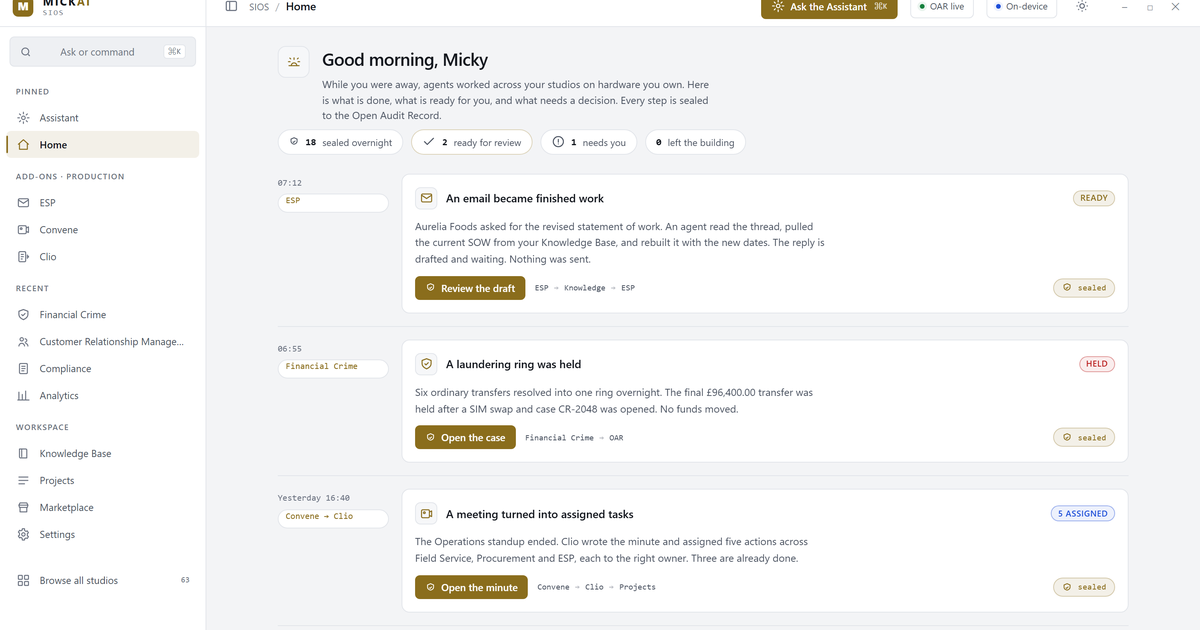
AI agents finish overnight work by running as a resident night shift on operator-owned hardware. They read the inbound email queue, the meeting record and the shared note store, then draft replies, open the right tasks, summarise each decision and route every item to a named owner before staff sign in. The morning opens with work already done, assigned and sealed for review, not a blank inbox. This is possible because the agents live inside a Sovereign Intelligence Operating System, a SIOS, that holds the data, the models and the audit trail together offline, so nothing has to leave the building to be finished.
This matters in 2026 because agent marketing has stayed abstract while buyers have grown specific. Regulated teams in finance, defence, health and government do not want a promise that an agent is powerful. They want a concrete morning: what was read, what was drafted, who owns it and how it can be checked. They also cannot send that queue to a public cloud service, so the question is not whether an agent can act, but whether it can finish the work where the data sits and prove what it did.
What does a finished morning actually look like?
By the time staff arrive, the overnight run has turned an untended inbox into a sorted, actioned queue:
- Every inbound email is read, classified and either drafted for reply or flagged with the reason it needs a person.
- Meeting recordings and transcripts are summarised into decisions, owners and dates, with the source timestamp kept for each point.
- Notes and documents shared overnight are filed, linked to the right matter and tagged for the person who needs them.
- Each action carries a named owner and a review status, so nothing is finished silently.
Nothing is sent, posted or committed to the outside world without a person releasing it. The agents prepare and seal. The human approves.
How does the overnight run actually work?
The run is a scheduled sequence, not a single call to a remote model. Inbound items arrive at a zero-egress perimeter, so the email, the meeting audio and the notes are processed with no outbound connection to a third party. Sovereign models held on the same hardware read each item. Where a judgement carries weight, such as classifying a contract clause or escalating an email, more than one model is asked and the answers compared, so no single model quietly defines the outcome. The agents then draft, file and route, and every operation is written to the audit ledger as it happens, so the record is built during the work, not reconstructed afterwards.
Why can public cloud agents not do this for regulated teams?
The blocker is not capability, it is where the data goes. A public cloud agent finishes the work by sending the inbound queue to servers the operator does not control, and for a regulated team that is often where the exercise stops. Under the US CLOUD Act, data held by a provider under US jurisdiction can be compelled regardless of where the servers sit. Capable as these services are, they are the route many regulated buyers cannot use for confidential work. A SIOS answers the same need from the opposite direction: the models come to the data inside the perimeter, so the work is finished without the queue ever leaving operator-owned hardware.
What can an auditor check the next morning?
An overnight run is only as good as what can be proved about it. Every action the agents take is written to a tamper-evident audit ledger, sealed with post-quantum digital signatures under FIPS 204, the primary signature standard, with FIPS 205 available as a stateless-hash alternative. The signatures let anyone verify, offline, that a record has not been altered since it was sealed. The identity that performed each action is hardware-attested and bound to the same chain, so the ledger shows not only what was done but which attested agent did it. An auditor can replay the night, which email was read, which model made each call and who owns the result, and confirm the record is intact without trusting any live system.
“The honest measure of an overnight agent is not how much it did while the office slept, but how completely a person can check it once the office wakes.”
Which rules make this necessary?
Several 2026 rules push in the same direction. DORA has applied to EU financial entities since January 2025 and expects operational resilience and traceable third-party risk. NIS2 extends security duties across essential and important entities. GDPR still governs how personal data in that queue is processed and where it rests. Under the EU AI Act, the high-risk Annex III obligations once due on 2 August 2026 have been deferred by the Digital Omnibus to 2 December 2027, with embedded Annex I high-risk duties moving to 2 August 2028 and the Article 50 transparency duties largely unchanged. We read that as a build window, not a reprieve: a sealed, offline audit trail is the durable way to be ready. ISO/IEC 42001 gives a management-system frame for governing this kind of automated decision-making.
What still waits for a human?
Finishing the work does not mean acting without oversight. The overnight run stops at the point of external consequence. Replies are drafted, not sent. Tasks are opened and assigned, not closed. Decisions are summarised and attributed, not enacted. Anything that leaves the building or commits the organisation waits behind a human release. The morning review is faster because the reading, sorting and drafting are done, and it slows only where a person must decide. The agents carry the volume, the human keeps the judgement and the accountability.
Frequently asked questions
Can AI agents finish work overnight without human oversight?
They can finish the preparation without supervision, but they should not take external action alone. In a SIOS the agents read, draft, summarise and assign overnight, then stop at anything that would send a message or commit the organisation, which a person releases in the morning. The oversight is built into the design, not bolted on afterwards.
Is it safe to let an AI agent read confidential email offline?
Offline is what makes it safer. When the models and the audit trail sit on operator-owned hardware behind a zero-egress perimeter, the confidential queue is never transmitted to a third party, and every read is logged and sealed, so access is provable after the fact. The risk that remains is local and governable rather than dispersed across someone else's cloud.
How do you prove to an auditor what an AI agent did overnight?
Every action is written to a tamper-evident ledger sealed with post-quantum signatures under FIPS 204. Because the signatures verify offline, an auditor can confirm months later that the record has not changed since the night it was created, and the identity that performed each action is hardware-attested and bound to the same chain. The proof does not depend on trusting a live service.
Do overnight AI agents need an internet connection to work?
No. A Sovereign Intelligence Operating System runs the models, the agents and the audit ledger on local hardware, so the overnight work is finished with no outbound connection. That is the difference from a public cloud agent, which finishes the work by sending your data out. Offline operation is what lets regulated teams use it at all.
What is a Sovereign Intelligence Operating System?
A Sovereign Intelligence Operating System, or SIOS, holds the data, the AI models and the tamper-evident audit trail together on hardware the operator owns. It runs offline, seals every action cryptographically and keeps confidential work inside the building. Mickai is a SIOS, built on 104 filed UK patent applications and approximately 2,340 claims owned by Mickai LTD.