Accounting and invoicing on your own hardware
Run ledgers and invoicing on hardware you own, joined to CRM and orders, with one assistant across it. The finance studio versus rented accounting seats.
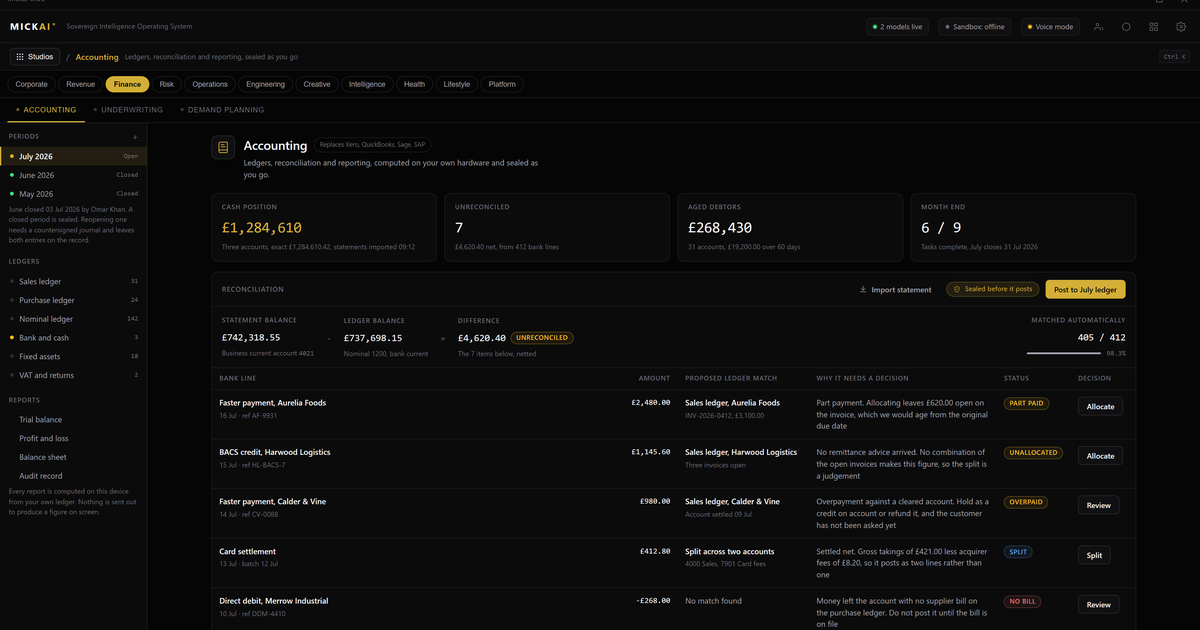
Your ledgers and your invoices are the most sensitive records your company keeps. You can run them on hardware you own, inside your own building, joined to your customer records and your orders, with one assistant across all of it. That is what our finance and invoicing studio does, and it is why the recurring seat fee on rented accounting software stops being the price of doing business.
The record you cannot afford to rent
Most firms treat accounting software as a utility. You pay a monthly subscription, your books live in the vendor's cloud, and you accept that the arrangement is permanent. The published plans are familiar. Xero and QuickBooks both advertise tiered monthly pricing per organisation, and the mid and upper tiers are where most growing firms end up. Add a payroll module, add extra users where the plan charges for them, add the payments processor's cut, and the true annual cost is well above the headline.
We build the finance studio to end that arrangement. The ledger, the chart of accounts, the invoices, the credit notes, the customer balances and the full transaction history sit on hardware you own. The software runs there. Nothing has to leave the building for the books to work.
What the finance studio is
It is a double-entry accounting and invoicing system: a general ledger, sales and purchase ledgers, invoicing and credit notes, expenses, bank reconciliation views, VAT preparation and management reporting. It is not a separate app you bolt on. It is one studio on the MICKAI sovereign operating system, sharing the same data layer as every other studio your company runs.
That last point is the difference. In the rented world, your accounting tool, your CRM and your orders system are three separate products from three vendors, and you spend real effort keeping them in step. In our world they are studios on one operating system, reading and writing the same records. A customer is one record. An order is one record. The invoice raised against that order is the same record the sales team already saw. There is nothing to export and nothing to reconcile between disconnected tools, because there are no disconnected tools.
Joined to CRM and orders
When your sales studio marks a deal as won, the finance studio already knows the customer, the terms and the value. When the orders studio fulfils an order, raising the invoice is a step in the same flow, not a re-keying exercise in a different login. Cash received updates the customer balance the sales team sees. An overdue account is visible to the person managing that relationship, not buried in a finance-only tool they never open.
This is the quiet saving that the seat price never shows. The hours your team spends copying figures between systems, chasing which number is current, and fixing what did not sync, disappear when the systems are one system.
The assistant across all of it
One assistant works across the studios, on your data, on your hardware. Ask it to draft an invoice from an order and it does, with the right customer, lines and terms. Ask it to chase the overdue accounts and it prepares the reminders. Ask why margin moved this month and it reads the ledger and tells you. Ask for the VAT view before a filing and it assembles it.
It reasons over your finance records and your sales and orders records together, because they sit in the same place. We do not send your books to someone else's model to get that. The intelligence layer runs inside your deployment and serves the studios directly, and every action it takes on your books is written down.
The Open Audit Record
Finance is where auditability stops being a slogan. Our platform keeps an action-level Open Audit Record: not just that a figure changed, but who or what changed it, when, from what to what, and in which studio. A person editing an invoice, the assistant applying a payment, a batch adjusting a ledger, all of it is recorded at the level of the action.
For a regulated small or mid-sized firm this is the point. When an auditor, a regulator or your own board asks how a number came to be, you have the answer as a record, not a reconstruction. Rented accounting seats give you an activity log inside the vendor's system. We give you an action-level record inside a system you own, on hardware you control, that can run air-gapped by default.
The cost comparison, done honestly
Here is the method, so you can run it on your own numbers rather than trust a figure we picked.
Take the published monthly price of the accounting plan you would actually use, at the tier that covers your transaction volume and features. Add the per-user charge where your plan bills additional users. Add any module you rely on, payroll being the common one. Add the payment-processing fee on the invoices you collect through the tool. Multiply the monthly software total by twelve for the annual figure.
A worked example, stated as an assumption and not a claim about your business: suppose your accounting plan and its add-ons come to 70 pounds a month, and you pay for four additional users at the per-user rate the plan advertises. Software alone, before payment fees, is 70 pounds times 12, which is 840 pounds a year, and the per-user charges and modules push it higher. That recurs every year, rises with your headcount and your vendor's price changes, and buys you no ownership of the software or, in the rented model, unconditional control of where the data sits.
Xero and QuickBooks publish their tiers openly, so use their current list prices as the input. The exact figure is yours to compute from the plan you are on. The structure is the point: it is a rent that never converts to ownership, and it grows.
Against that, our finance studio is one studio among the studios your company runs on hardware you already own or buy once. We do not publish a price here, and we set it in a briefing against your deployment. What we will say plainly is that the comparison is not seat fee against seat fee. It is a recurring rent, forever, against owning the software stack and your own data.
What owning it actually changes
Three things change when the books come home.
Control of the data. The most sensitive records in the company sit on your hardware, not in a tenancy you share with strangers. Air-gapped by default means the finance studio does not need an internet path to do its job.
The whole stack, not a model to wire up. You are not integrating an AI service into an accounting tool and hoping the two agree. The accounting system, the CRM, the orders system and the assistant are one operating system. The joins are built, not bought and maintained.
A record you can stand behind. The Open Audit Record turns finance from a system you trust into a system you can prove.
Who this is for
We build for the regulated small and mid-sized firm: the company large enough to feel the seat fees and the sync tax, and regulated enough that it needs to prove how a number was made. If that is you, the finance studio is not a cheaper subscription. It is the end of the subscription, and the start of owning the record.
The books are yours. The hardware is yours. The assistant runs on both. That is the offer.
Frequently asked questions
Where does our financial data live?
On hardware you own. The ledger, the invoices, the customer records and the payment history sit inside your own building on your own machines. Nothing is copied to a vendor's cloud for the software to work, and the finance studio can run air-gapped by default.
How is this different from private hosting of Xero or QuickBooks?
Private deployment is the baseline we start from, not the finish line. Our value is beyond it: an action-level Open Audit Record of who did what to which figure, an air-gapped default, the whole software stack rather than a model you integrate, and a focus on the regulated small and mid-sized firm.
Does the finance studio connect to our sales and orders?
Yes. It shares one data layer with the CRM and the orders system, so a won deal, a fulfilled order and a raised invoice are the same records seen from different studios. No exports, no nightly sync, no reconciliation between disconnected tools.
What does the assistant do here?
It works across the studios on your data. Draft an invoice from an order, chase an overdue account, explain a variance, prepare a VAT view, or answer a question about a customer's balance. Every action it takes is written to the Open Audit Record.
Do you replace our accountant?
No. The studio holds the ledgers and invoices and keeps them clean and auditable. Your accountant or bookkeeper works inside it or exports from it. We give them a tidier, more traceable set of books, not a reason to leave.
Can we still file with HMRC and use our bank feeds?
The studio produces the figures and views you need for filing and keeps the underlying records. Where you connect a bank feed or a filing route, that connection is yours to control, and it is logged like any other action.