A sales studio connected to the whole company
Our sales studio runs pipeline and activity on your own hardware, wired to CRM, proposals, finance and the assistant, so sales sees the whole company.
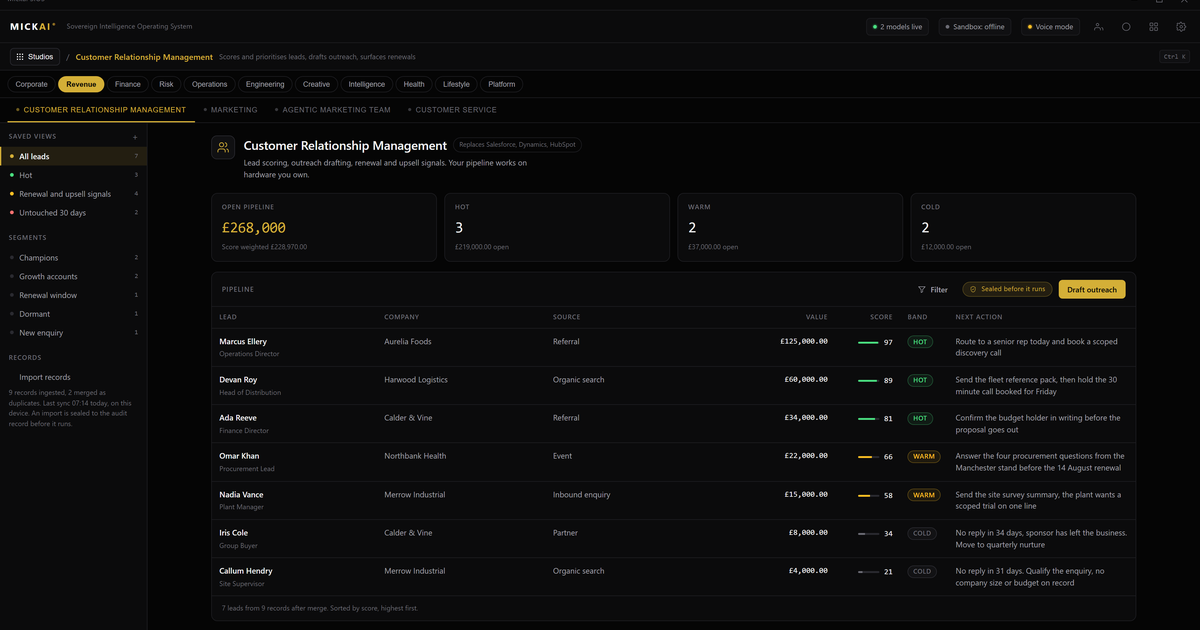
Our sales studio runs your pipeline and activity on hardware you own, wired directly to the CRM, proposals, finance and the assistant. Because those are studios on one operating system and not separate apps, sales does not work in a silo. It sees the whole company: the deal, the customer's invoices, the delivery status and the last proposal, all from one record.
That is the difference we care about. Most sales teams run a CRM that knows about deals and almost nothing else. Everything past the handshake lives in a different tool, on a different vendor's tenant, behind a different login. We built the sales studio so the wall between selling and the rest of the business is not there in the first place.
Pipeline and activity, on your own hardware
The sales studio does what you expect a good CRM to do. Contacts, accounts, deals, stages, tasks, notes and activity history. A board view for the pipeline, a list view for the grind, forecasts that add up. None of that is novel and we are not pretending it is.
What is different is where it runs. The studio sits on the MICKAI sovereign operating system, on hardware the customer owns. The pipeline is your data on your machine. You can run the whole thing air-gapped, with no outbound connection at all, and it still works, because the intelligence and the storage are local. For a firm that handles regulated client information, that is not a nice-to-have. It is the reason the conversation happens.
Private deployment on its own is the baseline now, and plenty of vendors offer a version of it. Our value is past that line. Every action taken in the studio, by a person or by the assistant, is written to an Open Audit Record at the action level. Not a login log. A record of what was changed, by whom, and when, that you can hand to an auditor without reconstructing it after the fact.
Connected to the CRM, proposals and finance
Here is the part that changes how sales actually works.
On a normal software stack, the CRM is one subscription, the proposal tool is another, and the finance system is a third, each owned by a different vendor. To get them to talk you buy connectors, maintain them, and accept that the data is copied between three places and out of date in at least two of them.
On our operating system, the CRM, the proposals studio and the finance studio are not three products. They are studios sharing one data layer. A deal record can show the account's outstanding invoices because it is reading the same finance data the accounts team reads, not a nightly export of it. A won deal can become a proposal, and an accepted proposal can become an invoice, without anyone re-keying a customer name or leaving the record.
So a salesperson looking at an account sees the whole relationship. What is in the pipeline, what has been delivered, what has been billed, what is still owed. That is the whole company from one seat, which is the opposite of the silo most sales teams sit in.
One assistant across all of it
There is one assistant, and it works across every studio rather than living inside any single one.
Because the studios share the company's own data, the assistant can do things a bolt-on chatbot cannot. Ask it to summarise an account and it reads the CRM, the proposals and the finance history together. Ask it to draft a proposal from a won deal and it pulls the deal terms, the contact and the pricing without you assembling them. Ask it what is stalling and it looks at activity across the pipeline, not at a single field.
We describe what the assistant does for the studios, and we do not talk about the reasoning layer underneath it beyond that. What matters to a buyer is the behaviour: it acts across the whole company, it acts on your hardware, and every action it takes lands in the Open Audit Record like any other. Nothing it does is invisible.
What you are actually replacing
A seat-based sales cloud is rented, per user, per month, indefinitely. The method for working out what that costs you is simple and public. Take the incumbent's published list price per user per month, multiply by your number of users, and multiply by twelve. That is one year of rent for one tool, before you add the marketing seats, the connectors and the storage tiers that the list price does not include.
As a worked example of the method only: a team of forty users on a published list price of one hundred and forty US dollars per user per month works out at forty times one hundred and forty times twelve, which is sixty-seven thousand two hundred US dollars a year, for the CRM alone. Check the current list price before you rely on any figure, because vendors change them. The point is not the exact number. The point is that it recurs every year, it scales with headcount, and it buys you access rather than ownership.
We do not publish a MICKAI price here, and pricing is a briefing conversation, not a webpage. What we will say is the shape of the trade. You own the software and the hardware it runs on. The sales studio is one of eighty-seven studios on the same operating system, so you are not stacking one subscription on top of another to get email, meetings, proposals and finance. They come as studios on the system you already own.
Why this suits a regulated small or mid-sized firm
Large enterprises can afford a team whose whole job is wiring vendor tools together. A regulated small or mid-sized firm usually cannot, and it is the one that most needs its data to stay in the building.
That firm is who the sales studio is for. It gets a pipeline that never leaves its own hardware, a CRM that shares data with proposals and finance without a single connector, one assistant across all of it, and an action-level audit trail as a property of the system rather than a feature it had to buy. The whole software estate, not a model to integrate into an estate it does not have.
A note on what we do not claim. Our patent position is one hundred and four filed UK patent applications covering two thousand three hundred and forty claims. Those are filed, not granted, and we say so plainly. We hold no certifications, and we will not imply otherwise. The distribution partner we work with stays anonymous, and we name no customers. We would rather under-claim and be trusted than the reverse.
The short version
Sales should not be the team that can see the least. On a rented stack it usually is, because its tool is walled off from everything downstream. Put the sales studio on an operating system you own, wire it to the CRM, proposals, finance and one assistant that share your own data, and the wall is gone. Sales sees the whole company, on your hardware, with every action on the record.
That is what we built, and it is the same operating system underneath every other studio a company gets from us.
Frequently asked questions
Where does the sales data live?
On hardware you own. Pipeline, contacts, activity and proposals sit inside your own operating system, not on a vendor tenant. You can run it air-gapped, and nothing leaves the building unless you decide it does.
Is this a CRM I have to integrate with everything else?
No. The CRM is one studio on the same operating system as proposals, finance, email, meetings and the assistant. They share the company's own data by default, so there is no connector to buy or maintain between them.
How does it compare to renting a seat-based CRM?
A seat-based CRM charges per user per month, every month, forever. Take a published list price, multiply by your users and by twelve, and that is your annual rent. We do not publish a price here, but you own the software and the data instead of renting access to them.
Does sales see finance and delivery, or just its own pipeline?
Sales sees the whole company. Because the studios share one data layer, a deal record can show the customer's invoices, delivery status and past proposals without exporting anything or asking another team for a screenshot.
What does the assistant actually do for sales?
It works across every studio at once. Ask it to summarise an account, draft a proposal from a won deal, or flag stalled pipeline, and it reads the CRM, proposals and finance together because they are on the same system. Every action it takes is written to an Open Audit Record.
Can a small firm run this without an IT department?
Yes. The studios ship on one operating system, so there is no stack of separate subscriptions to wire together. That is the point for a regulated small or mid-sized firm: the whole software estate, on your own hardware, run by the assistant.